<h2>Reliable Professional Cookery Assignment Assistance in Australia:<strong>Cook and Succeed</strong></h2><p>At <strong>Cookery Assignments</strong>, we deliver top-notch <strong>cookery assignment help online</strong>, ensuring every detail is clearly presented. The hospitality industry is vast, encompassing cookery courses, operational management, and food presentation, among others. Many courses delve into professional cooking. Australian universities assign various tasks to students to help them master this subject. If you're struggling with your cookery assignments, facing doubts and difficulties, contact us.</p><p>We offer the best online <a href="https://www.punjabassignmenthelp.com/blogs/commercial-cookery-assignment-help-in-australia"><strong>cookery assignment help</strong></a>, aiming to boost both your grades and your understanding. Cookery Assignments employs seasoned professionals with years of experience and solid knowledge. They provide insights and techniques to help you excel.</p><p>Our experts work under proper supervision and guidance. With the best cookery assignment help, you can learn management, catering, interpersonal skills, and food preparation. We implement quality control checks to ensure you receive the highest-quality assignments.</p><p>Here's why you should choose our top-tier online cookery assignment help and a look at the topics covered.</p><p> </p><h3>Key Topics for Cookery Assignment Help</h3><p>Topics depend on the classes and grades. We offer various online cookery assignment services. From ingredient choices to cooking times, we ensure your assignment impresses your professors. Our experts combine traditional and contemporary methods to make each recipe engaging.</p><h3>Below are some topics covered in the best online cookery assignment help:</h3><p> </p><p>* Identify specific ingredients Assignment</p><p>* Outline their culinary traits Assignment</p><p>* Provide an appropriate recipe Assignment</p><p>* Provide a basic overview Assignment</p><p>* Kosher Assignment</p><p>* Halal Food Assignment</p><p>* Indian Food Assignment</p><p>* Vegan food Assignment</p><p>* Vegetarian food Assignment</p><p>* Low Fat Diet food Assignment</p><p>* Diabetic food Assignment</p><p>* Low Carb or High Protein Diet Food Assignment</p><p>* Low Cholesterol Diet food Assignment</p><p>* Low Calorie or Kilojoules Diet food Assignment</p><p>* High Fiber Diet cookery Assignment</p><p>* Macrobiotic Diet food Assignment</p><p>* Elimination Diet food Assignment</p><p>* Environmentally sustainable work practices</p><p>* Preparation of salads and appetizers Assignment</p><p>* Preparation of poultry dishes Assignment</p><p>* Prepare food to meet special dietary requirements</p><p>* Roster staff Assignment</p><p>* Maintaining the quality of perishable items Assignment</p><p>* Produce pates and terrines Assignment</p><p>* Develop menus for special dietary requirements</p><p>* Manage finances within a budget Assignment</p><p>* Coordinate cooking operations Assignment</p><p>* Coach others in job skills Assignment</p><p>* Clean kitchen premises and equipment Assignment</p><p> </p><p>These are general topics in cookery assignment services. You can provide your topic, and our experts will offer the best help. Students need to understand different cultures to better understand the subject. Each culture brings uniqueness, which should reflect in food. Our experts have researched various cultures.</p><p> </p><h4><strong>Why Choose Our Online Cookery Assignment Help?</strong></h4><p> </p><p><strong>Cookery Assignments</strong> offers numerous advantages when you seek our <strong>online cookery assignment help</strong>. We deliver premium quality and unique insights to help you secure high grades. With competitive prices and a tracking system, it’s simple to acquire our <strong>online cookery assignment writing service</strong>. Contact us to benefit from our services.</p><p> </p><p>* Expert Cooks: We have a network of expert cooks in Australia with years of experience. <strong>Cookery Assignments</strong> offers the <strong>best cookery assignment assistance</strong>, addressing every problem. We utilize the top researchers and editors for your assignment.</p><p> </p><p>* High Quality, Low Cost: We provide a quality assignment that will boost your grades and confidence. We offer fantastic deals and affordable assignments, assisting every student to succeed in this subject. Our assignments are valuable sources of knowledge.</p><p> </p><p>* Assignment Tracking: Monitor your assignment’s progress online. No need to call or contact writers; we offer an online tracking feature.</p><p> </p><p>* Simple Help Process: Easily access the <strong>best cookery assignment writing service</strong>. Fill out the form with your requirements. Our team will research your topic and contact you. Once payment is complete, we start working with a reasonable deadline.</p><p> </p><p>* Online Support: <strong>Cookery Assignments</strong> supports its students by offering 24/7 support. Our team works around the clock for updates, procedures, and payment assistance. We solve all your issues during the service.</p><p> </p><p>* Money-Back Guarantee: We guarantee your money back if you don't get high grades. This assurance comes with our quality service.</p><p> </p><p>Are you seeking affordable <a href="https://cookeryassignments.com/"><strong>cookery assignment help</strong></a>? Share your topic and details. We aim to make you confident about your academics. It needs passion, dedication, and knowledge to complete an assignment. Our <strong>cookery assignment help</strong> experts combine these aspects to give you the <strong>best assignment help</strong>.</p>

<h2>Complete Guide to SIT30821 Certificate III in Commercial Cookery Assignments in Australia</h2><p>Commercial Cookery is one of the pathways to PR in Australia and this makes it first choice among the students to opt for commercial cookery course. In search of PR students look for <strong>Cookery Class Sydney</strong> or <strong>culinary school</strong> as well. There are six qualifications which can be opted by students in Commercial cookery which include </p><ul><li>SIT30821 Certificate III in Commercial Cookery</li><li>SIT40521 Certificate IV in Kitchen Management</li><li>SIT30622 Certificate III in Hospitality</li><li>SIT40422 Certificate IV in Hospitality</li><li>SIT50422 Diploma of Hospitality Management</li><li>SIT60322 Advanced Diploma of Hospitality Management</li></ul><p> </p><p>All these qualifications for <strong>cooking course</strong> would include completing theory, practical and workbook assignments for the students to get competent in these courses. It is really difficult for the students to deal with these assignments as most of them require students to have practical exposure of the <strong>commercial cookery</strong> course and completing these assignments would require practical knowledge gained in the commercial kitchen. Students can opt for <strong>cookery course in Australia</strong> through various cities and can-do commercial <strong>cookery courses in Sydney</strong>, <strong>cookery courses Adelaide</strong>, <strong>cookery course Perth</strong>, <strong>cookery courses Melbourne</strong>, <strong>cooking classes sunshine coast</strong>, <strong>cooking classes cairns</strong>, <strong>culinary school Brisbane</strong> as well. </p><h3><strong>Struggling with SIT30821 Certificate III in Commercial Cookery Assignments in Australia?</strong></h3><p>It is one of the most popular vocational qualifications for the students in Australia who want to opt for culinary art and pursue their career as commercial chef. The main aim of <strong>certificate iii in commercial cookery</strong> is to impart knowledge and skill set required to work as commercial chef in establishments such as hotels, restaurants and cafes etc. <a href="https://cookeryassignments.com/service/sit30821-certificate-iii-in-commercial-cookery"><strong>SIT30821 Certificate III in commercial Cookery</strong></a> for international students can be pursued in both full time as well as part time mode. <strong>Certificate iii in commercial cookery online</strong> would include several units of assessment which would require completing practical, theory and logbook as well. <strong>RPL certificate iii in commercial cookery</strong> can also be obtained by the students to work as chef but there would not work as the PR qualification. In order to get the RPL Certificate III in Commercial Cookery students can connect with us on <a href="mailto:Punjabassignmenthelp@gmail.com">Punjabassignmenthelp@gmail.com</a> or call +61 3 9016 2672 with discounted prices. </p><p><strong>Certificate 3 in commercial cookery</strong> has in total 25 units of assessment which include 20 core units and 5 optional units through which required skill and knowledge is imparted. <strong>Cert 3 Commercial Cookery</strong> has below mentioned core units which need to be completed to gain competency in this qualification:</p><ul><li>SITHCCC023 Use food preparation equipment</li><li>SITHCCC027 Prepare dishes using basic methods of cookery</li><li>SITHCCC028 Prepare appetisers and salads</li><li>SITHCCC029 Prepare stocks, sauces and soups</li><li>SITHCCC030 Prepare vegetable, fruit, eggs and farinaceous dishes</li><li>SITHCCC031 Prepare vegetarian and vegan dishes</li><li>SITHCCC035 Prepare poultry dishes</li><li>SITHCCC036 Prepare meat dishes</li><li>SITHCCC037 Prepare seafood dishes</li><li>SITHCCC041 Produce cakes, pastries and breads</li><li>SITHCCC042 Prepare food to meet special dietary requirements</li><li>SITHCCC043 Work effectively as a cook</li><li>SITHKOP009 Clean kitchen premises and equipment</li><li>SITHKOP010 Plan and cost recipes</li><li>SITHPAT016 Produce desserts</li><li>SITXFSA005 Use hygienic practices for food safety</li><li>SITXFSA006 Participate in safe food handling practices</li><li>SITXHRM007 Coach others in job skills</li><li>SITXINV006 Receive, store and maintain stock</li><li>SITXWHS005 Participate in safe work practices</li></ul><p> </p><h4>Why Choose Cookery Assignments for Your Certificate III in Commercial Cookery Tasks</h4><p> </p><p><a href="https://www.punjabassignmenthelp.com/blogs/commercial-cookery-assignment-help-in-australia">Cookery Assignment Help</a> stands out as the premier resource for those undertaking the SIT30821 Certificate III in Commercial Cookery, offering thorough assistance with demanding coursework such as recipe formulation, kitchen journals, simulated kitchen work, and evaluation dossiers. Our strength lies in merging extensive trade knowledge with an emphasis on student needs, delivering top-tier, personalized answers that strictly adhere to Australian hospitality training benchmarks.</p><p><strong>Main Attractions and Advantages</strong></p><p><strong>Seasoned Culinary Professionals:</strong> Assignment Writers possessing tangible commercial kitchen background generate accurate, original material covering modules like SITHCCC023 (Preparing meals), SITHKOP009 (Maintaining kitchen cleanliness), and SITXFSA005 (Applying safe food handling).</p><p> </p><p><strong>Expedited Delivery:</strong> Around-the-clock client service and swift completion—frequently within hours—to manage pressing due dates at no extra charge, ensuring your academic schedule stays on course.</p><p> </p><p><strong>Reasonable and Clear Costs:</strong> Market-competitive student rates, completely free of surprise charges, including complimentary edits and a refund promise for total assurance.</p><p> </p><p><strong>Entirely Bespoke Answers:</strong> Every piece of work is unique, supported by research, and formatted per TAFE/VET standards, improving your scores in menu design, inventory oversight, and service period duties.</p><p> </p><p><strong>Established Success Rate:</strong> More than 5000 pleased students throughout Australia have successfully completed their Cert III cookery assignments, securing positions in eateries, hotels, coffee shops, and catering services—evidenced by positive testimonials and client loyalty.</p><p> </p><p><strong>Comprehensive Assistance:</strong> Beyond paper completion, we provide direction on practical demonstrations, scenario analyses, and Recognition of Prior Learning (RPL) submissions, alongside advice for navigating all SIT30821 competency criteria.</p><p><strong>Its Significance for Your Professional Path</strong></p><p>Selecting <a href="https://cookeryassignments.com/">Cookery Assignments</a> represents a commitment to resources that not only satisfy evaluation needs but also develop genuine cooking capabilities for entry-level chef roles in fast-paced professional settings. Students note increased self-assurance, more favorable assessor comments, and a smoother transition to Cert IV or trainee roles. With our focused support, confronting the 21+ elements of SIT30821 becomes manageable and less burdensome.</p>
<h2>Learner’s guide to Complete SIT30821 Certificate III in commercial cookery Assignments</h2><p> </p><p>The development of efforts is essential to complete the certificate III in commercial cookery<strong> </strong>assignments. The primary tips to accomplish the cookery assignments require following the mentioned guidelines. The learner guide provided with the coursework is effective in boosting the understanding level on the theoretical plane. This guide regarding the cooking processes and tools to distinct recipes enhance the capabilities of students.</p><h3>Important suggestions to complete the Certificate III in Commercial Cookery Assignments</h3><ol><li>Understanding the questions by reading it repeatedly can help to solve the theoretical questions.</li><li>For practical parts of the <strong>certificate iii in commercial cookery online </strong>Assignment it is essential to check the provided appendices in the portal and link the answers with the given context and case study</li><li>Following the checklists regarding the <a href="https://cookeryassignments.com/service/sit30821-certificate-iii-in-commercial-cookery"><strong>Certificate III in Commercial cookery</strong></a> assignment is effective and is the key tip for the learner.</li><li>It is essential to verify the answers with different sources because the theory and practical parts demand most appropriate answers.</li></ol><p> </p><p>For evidence, the workbooks provided in Certificate iii in commercial cookery in Australia has SITHCCC020 logbook comprised of 48 instances. The logbook has the following segments to be filled effectively-</p><p> </p><ul><li>Service periods</li><li>Tasks to Mise en place</li><li>Records in realized knife skills in the service period</li><li>Cooking methods realized in the service period</li><li>Association with the team in the service period</li><li>Special dietary requirements for the consumers</li><li>Duties to cleaning</li><li>Self evaluation template to determine the skills learned in the service instances</li><li>Workflow schedule</li></ul><p> </p><h4>Why Choose Cookery Assignment Help for Certificate III in Commercial Cookery Assignments?</h4><p>Cookery Assignments is a highly recommended assignment help service for <a href="https://cookeryassignments.com/blogs/how-to-deal-with-sit30821-certificate-3-commercial-cookery-assignments"><strong>Certificate III in Commercial Cookery</strong></a> students. Boasting over a decade of experience assisting with and creating assignments, Cookery Assignment Help has established a solid reputation for delivering high-quality work specifically designed for <strong>certificate iii in commercial cookery for international students</strong>.</p><p>Students should consider their services for several reasons, including:</p><p> </p><p> </p><ul><li><strong>Skilled Australian Writers: </strong><a href="https://cookeryassignments.com/blogs/professional-cookery-assignment-help-in-australia"><strong>Cookery Assignment Help</strong></a> uses a knowledgeable team of experts and academics, well-versed in Australia’s university requirements. Cookery Assignments also provide precise, relevant, and carefully chosen content, which helps you get higher grades.</li></ul><p> </p><ul><li><strong>Original Content: </strong>Each assignment <a href="https://www.punjabassignmenthelp.com/blogs/commercial-cookery-assignment-help-in-australia"><strong>Commercial Cookery Assignment Help</strong></a> deliver is entirely original. We use advanced plagiarism detection to ensure our work is 100% unique, created from the ground up, and matches all your standards.</li></ul><p> </p><ul><li><strong>Timely Delivery: </strong>We understand deadlines can be tough, so we ensure that your assignments arrive on time, every time. Punctuality is crucial, so we guarantee you won’t miss any submission deadlines.</li></ul><p> </p><ul><li><strong>Budget-Friendly: </strong><a href="https://cookeryassignments.com/"><strong>Cookery Assignments</strong></a> aim to give the best assignment help to every student at reasonable costs. Our prices are designed to be cost-effective while offering excellent value for our premium services.</li></ul><p><br><strong>Some of the units of SIT30821 Certificate III in Commercial Cookery for which Cookery Assignments provide assignment help services are following:-</strong></p><p> </p><p><strong>Core units</strong></p><ul><li>SITHCCC023 Use food preparation equipment</li><li>SITHCCC027 Prepare dishes using basic methods of cookery</li><li>SITHCCC028 Prepare appetisers and salads</li><li>SITHCCC029 Prepare stocks, sauces and soups</li><li>SITHCCC030 Prepare vegetable, fruit, eggs and farinaceous dishes</li><li>SITHCCC031 Prepare vegetarian and vegan dishes</li><li>SITHCCC035 Prepare poultry dishes</li><li>SITHCCC036 Prepare meat dishes</li><li>SITHCCC037 Prepare sea food dishes</li><li>SITHCCC041 Produce cakes, pastries and breads</li><li>SITHCCC042 Prepare food to meet special dietary requirements</li><li>SITHCCC043 Work effectively as a cook</li><li>SITHKOP009 Clean kitchen premises and equipment</li><li>SITHKOP010 Plan and cost recipes</li><li>SITHPAT016 Produce desserts</li><li>SITXFSA005 Use hygienic practices for food safety</li><li>SITXFSA006 Participate in safe food handling practices</li><li>SITXHRM007 Coach others in job skills</li><li>SITXINV006 Receive, store and maintain stock</li><li>SITXWHS005 Participate in safe work practices</li></ul>

<h2>Top 5 Hacks to Nail Your Commercial Cookery Assignments at Stanley College</h2><p> </p><p><i><strong>Stanley College</strong></i> is the leading university for vocational education, which helps in the provision of robust learning experience for the learners in varied courses such as <i><strong>Commercial Cookery</strong></i>. Also, to complete the assignments at the <i><strong>Institute of Stanley College</strong></i> could be very challenging if students are not having the correct approach. There are varied hacks for nailing the <i><strong>Commercial Cookery assignments</strong></i> at the <i><strong>Stanley College</strong></i> which would aid in acing the assignments include:</p><ol><li>Leveraging <i><strong>Stanley College Canvas </strong></i>for streamlining the submissions is significant. The college uses the platform of <i><strong>Canvas </strong></i>for the submissions of assignments as well as to understand the way in which navigating the platform is critical. The <i><strong>Canvas Student Portal</strong></i> is the one stop destination for the course materials, submission deadlines, as well as assignment instructions. You need to make sure in keeping track of the <i><strong>Canvas </strong></i>announcements and reading the <i><strong>assignment rubrics </strong></i>for understanding the expectations for the tasks. You need to access the <i><strong>Canvas Portal</strong></i> by the help of <i><strong>Stanley College Canvas Login Page</strong></i> for staying on the top of the work.</li><li>You need to familiarize yourself with the requirements of the courses. Every subject at the institute of <i><strong>Stanley College</strong></i> like <i><strong>SITHCCC023 Use Food Preparation Equipment</strong></i>, have particular guidelines which require to be followed by you learners for successful assignment completion. You need to take time for reviewing the course outline which also includes prerequisites and assignment criteria. It would also help to organize assignments in the method which can match the expectations of the instructors. </li><li>You also need to ask your trainers for more clarifications. At the time of working on the <i><strong>Commercial Cookery Assignments</strong></i>, you shall not hesitate in reaching the trainers by <i><strong>Email or Canvas Portal</strong></i>. The trainers at the institute of <i><strong>Stanley College</strong></i> are committed to help the learners like you and could also clarify the doubts related to the instructions and topic of the assignments.</li><li>You need to utilise the <i><strong>online and library resources</strong></i> of the <i><strong>Stanley College</strong></i> which are an invaluable asset for research topics regarding <i><strong>Cookery</strong></i>. You need to utilise the resources which are available through the <i><strong>library portal of Stanley College</strong></i> for finding books, scholarly articles, as well as journals which would strengthen the assignments, and also improve the writing quality.</li><li><p>You need to also plan as well as related to the <i><strong>assignments of Commercial Cookery</strong></i> at the <i><strong>Stanley College</strong></i> as it could be complicated and detailed for avoiding last minute stress and this would help in sting organised and ensuring that the work is well-written.</p><p> </p></li></ol><h3><strong>Step by Step guide to Access Canvas Stanley to submit Assignments</strong></h3><p>To submit the assignments at the <i>institute of Stanley College</i> is straightforward and simple process if you students are following the steps and these include:</p><ol><li>First you need to visit the official website of <i>Stanley College</i> and go to the <i><strong>Stanley College Login Page</strong></i>. After this enter the student credentials such as the <i>username<strong> </strong></i>and <i>password<strong> </strong></i>for accessing the <i>dashboard</i>.</li><li>You need to navigate to the course, after logging in as you would be redirected to the <i><strong>learner portal</strong></i>. You need to find the courses that you are enrolled in the course area.</li><li>You are required to access the section called <i><strong>“Assignment” tab</strong></i>. You shall click on this tab for viewing the upcoming assignment list.</li><li>Select the assignment for submitting as well as clicking on it. You need to review the instructions of submission as well as attached files for ensuring understanding of the necessities.</li><li>Upload the assignment from your computer folders and then upload the file and view if all the instructions are met accordingly and also see the assessment rubrics for more information related to the assignment and its submission.</li><li>After uploading, click on the <i>Submit Button</i> by uploading the document as well as clicking on the button for finalizing the submission.</li></ol><p> </p><h3><strong>Why Choose Cookery Assignments for Stanley College assignments?</strong></h3><p><a href="https://cookeryassignments.com/"><i><strong>Cookery Assignments</strong></i></a> is one of the most trusted assignment help services provider for the students of <i><strong>Stanley College</strong></i>. With more than 10 years of experience in supporting as well as writing assignments and helping the students, the organisation of <a href="https://www.punjabassignmenthelp.com/blogs/commercial-cookery-assignment-help-in-australia"><i><strong>Cookery Assignment Help</strong></i></a> have built the reputation to deliver higher quality works specifically tailored for the standards of the <i><strong>Stanley College</strong></i>. There are various reasons why you students shall consider utilizing their services include the following below: </p><ul><li>Expert knowledge of the standards of Stanley college is excellent. <i><strong>Cookery Assignments</strong></i> also have knowledge regarding the unique necessity of the <i><strong>programs of</strong></i> <i><strong>commercial cookery of Stanley College</strong></i>. The experts and writers are also familiar with the codes and courses such as SITHCCC023 as well as understanding of the assessment criteria. </li><li>They also utilize the <i><strong>Canvas portal</strong></i> efficiently and are well-versed to navigate the platform for ensuring a smooth process of submission for learners like you. The experts also would guide you through the issues regarding <i><strong>Canvas portal</strong></i> by hence you could be able to focus on the assignments.</li><li>The experts could also guarantee on time submission of the assignments as well as last minute requests and long term projects which ensure that you are receiving work that is meeting the higher standards.</li></ul><p> </p><h4><strong>Some of the Courses for which Cookery Assignments provide assignment help Services are following:-</strong></h4><ol><li>SITHCCC023 - Use Food Preparation Equipment </li><li>SITHKOP002 - Plan and Cost Basic Menus</li><li>SITXFSA001 - Use Hygienic Practices for Food Safety</li><li>SITHCCC001 - Use Food Preparation Equipment</li><li>SITHCCC020 - Work Effectively as a Cook</li></ol><p> </p><p><strong>FAQs</strong></p><p><strong>What is the turnaround time for my Stanley College assignment?</strong></p><p>The turnaround time of the <i><strong>assignments of Stanley College</strong></i> varies on the deadline of the assignments and complexity. The organization of <i><strong>Cookery Assignments</strong></i> also offers on time submissions and flexible timelines along with urgent requests.</p><p> </p><p><strong>Are your Stanley College assignments plagiarism-free?</strong></p><p>Yes, the assignments are free from plagiarism and the strict policy related to original contents is followed that ensures that you are meeting the academic integrity standards.</p><p> </p><p><strong>Can I request revisions for my Stanley College assignment?</strong></p><p>Yes, <i><strong>Cookery Assignments</strong></i> permits request revisions in a particular time period after receiving the assignments. We also strive in ensuring that the final submission is meeting the course requirements and the expectations.</p><p> </p><p><strong>Do you provide help with all Stanley College courses?</strong></p><p>Yes,<strong> </strong><a href="https://cookeryassignments.com/"><i><strong>Cookery Assignment Help</strong></i></a> is covering a broad range of courses such as <i><strong>commercial cookery,</strong></i> as well as other subjects regarding <i><strong>business</strong></i> and <i><strong>hospitality</strong></i>.</p><p> </p><p><strong>What if I need help after I receive my completed assignment?</strong></p><p>If you require further help and assistance after receiving the assignments, then we can also offer post submission support. Please reach out and ask for more information.</p>
<h2>Want to learn how to coordinate cooking operations?</h2><p>Our comprehensive SITHKOP013 tutorial has all the steps you need in order to become an expert. Check it out now and start mastering this crucial skill!</p><h3><strong>Understand the workflow of a kitchen</strong></h3><p>In order to be successful in plan cooking operations according to the SITHKOP013 standard, you need to understand not only the roles of different members in the kitchen, but also how these roles fit together within the overall workflow. Every kitchen works different, but there are some general principles — like efficient food preparation and timing — that should always be observed for the best results. Knowing these key principles will help you collaborate with team members and ensure success when plan cooking operations.</p><h3><strong>Know the protocols and hygiene regulations for preparing food safely</strong></h3><p>It is critical to understand food safety protocols and hygiene regulations before plan cooking operations. Ensure that cooking staff are current in their knowledge of food safety standards, and verify that all kitchen equipment meets health code standards. Keeping a clean work environment is essential for food safety and a sanitary culinary operation. Review the list of potentially hazardous foods and make sure any you serve have been prepared according to proper storage, cooling, heating, and serving guidelines outlined by local health codes.</p><h3><strong>Assess the preparation needs to determine the quantity of ingredients, staff and appliances required to complete orders</strong></h3><p>Assessing the preparation needs of an order requires knowledge and skill. Start by evaluating the complexity of each dish and determine the quantity of ingredients necessary for success. As a coordinator, you'll need to know how many staff members are needed to prepare, cook, plate, serve, and clean-up after the meal service. In addition to any special equipment and utensils, assess if any specialty appliances will be necessary for efficient cooking operations and plan accordingly. Finally, create a timeline that accounts for all steps in the process from beginning to end.</p><h3><strong>Monitor stock levels and order goods as needed while ensuring they are delivered in good condition and with quality assurance guidelines met</strong></h3><p>A successful cook coordinator must keep track of all culinary ingredients, supplies, and equipment. If required items are running low, the coordinator must order more in a timely manner. Furthermore, goods should be ordered with quality assurance guidelines always in mind. Upon delivery of new items and ingredients, it is your responsibility to inspect them for quality, freshness, and safe storage practices prior to adding them as part of inventory. Failure to do so could result in food-borne illnesses or inadequate performance during dinner service.</p><h3><strong>Develop menus that consider cost efficiency and customer preferences as well as special dietary requirements or restrictions</strong></h3><p>The cook coordinator should plan menus based on customer preferences, special requirements or restrictions, and cost factors. Ensure that meals are balanced with appropriate proportions of proteins, carbohydrates, vitamins and minerals to adequately nourish customers. Take into account vegetarian options and/or food allergies that may exist as well as culturally relevant dishes desired by the clientele. Plan ahead of time to allow for the necessary prep work such as marinating proteins or making sauces from scratch. Additionally, calculate costs for each menu item in order to set profitable prices for each dish.</p><h4>Why Cookery Assignments is the Best Choice for SITHKOP013 Assignment Help in Australia</h4><p><br>The <i>SITHKOP013 Plan Cooking Operations</i> unit is a core part of commercial cookery courses in Australia, requiring students to demonstrate strong skills in menu planning, kitchen workflow management, food production scheduling, cost control, and food safety compliance. Due to its practical nature and strict RTO and TAFE assessment requirements, completing this assignment accurately can be challenging for many students. <strong>Cookery Assignment Help</strong> provides professional SITHKOP013 assignment help in Australia, offering expert-written, assessment-focused solutions that help students submit high-quality work, reduce stress, and achieve better academic results.</p><h4>Features of Cookery Assignments for SITHKOP013 Plan Cooking Operations Assignment Help</h4><p><strong>On-Time Delivery</strong><br>Cookery Assignments understand the importance of deadlines in commercial cookery courses. Our experts ensure your SITHKOP013 assignment is delivered on time, even for urgent submissions, without compromising quality or accuracy.</p><p><strong>100% Plagiarism-Free & AI-Free Content</strong><br>Every assignment is written from scratch by experienced professionals and checked through plagiarism tools. <a href="https://cookeryassignments.com/">Cookery Assignment Help</a> guarantee original, human-written content that meets academic integrity standards.</p><p><strong>Expert SITHKOP013 Writers</strong><br><a href="https://www.punjabassignmenthelp.com/blogs/commercial-cookery-assignment-help-in-australia">Commercial Cookery Assignment Help</a> team consists of subject-matter experts with strong knowledge of SITHKOP013 and commercial kitchen operations. They understand RTO and TAFE assessment requirements and deliver industry-relevant solutions.</p><p><strong>Unlimited Free Revisions</strong><br>Assignment Help Australia offers unlimited revisions to ensure your assignment fully aligns with assessment guidelines. Any changes requested are handled promptly until you are completely satisfied.</p><p><strong>Affordable Pricing for Students</strong><br>Our pricing is designed to be student-friendly, with competitive rates and special discounts for commercial cookery students in Australia.</p><p><strong>Assessment-Focused Solutions</strong><br>All assignments are carefully structured to match RTO and TAFE marking criteria. We focus on practical elements such as menu planning, workflow scheduling, cost control, and food safety compliance.</p><p><strong>Strict Confidentiality & Data Security</strong><br>Your personal information and assignment details are kept completely confidential. We follow secure processes to protect your data at all times.</p><p><strong>24/7 Student Support</strong><br>Our dedicated support team is available around the clock to answer your queries, provide updates, and assist you throughout the assignment process.</p><p> </p>
<h2><strong>Top 5 Proven Tips to Boost Your Grades in Gen Institute’s Commercial Cookery Courses</strong></h2><p><i><strong>Commercial Cookery</strong></i> is a specializations area that <i><strong>Gen Institute</strong></i> provides and is very challenging. For better results in these courses, one has to employ certain techniques that are relevant to the institute’s resources. Below are five methods that are effective in ensuring that you obtain the best results in <i><strong>Gen Institute’s Commercial Cookery courses</strong></i>.</p><ol><li><p><strong>Access Course Resources on MyGen Regularly</strong>: <i><strong>MyGen</strong></i> is the primary place where students can find their course content, instructor’s messages, and instructions regarding assignments. Do not forget you need to use Gen Institute as the login to get the updates and download any materials that may be needed. Through frequent visits on <i><strong>my.gen.edu.au</strong></i>, you get updated on due dates, assessment information and any other additional information given which is essential for some subjects such as <i><strong>SITXFSA005 Use Hygienic Practices for Food Safety</strong></i> and <i><strong>SITHCCC043 Work Effectively as a Cook</strong></i>.</p><p> </p></li><li><strong>Master Practical Skills with Gen Institute Workshops</strong>: As mentioned earlier, most of the assignments in <i><strong>Commercial Cookery</strong></i> involve practical demonstration, which is well complemented by Gen Institute’s face-to-face sessions. These sessions offer practical skills that are necessary in real life professional cooking stations. If you are studying <i><strong>SITHCCC042 Prepare Food to Meet Special Dietary Requirements</strong></i> or <i><strong>SITHKOP013 Plan Cooking Operations</strong></i>, you will find that attending the workshops will help you apply the knowledge in your assignments.</li></ol><p> </p><p> </p><ol><li><p><strong>Follow Gen Institute’s Writing Guidelines for Submissions</strong>: To do well in your assignments, it is important that you follow formatting and writing guidelines of Gen Institute. Every assignment is accompanied by its own rules which are available on <i><strong>MyGen</strong></i>. Make sure to observe these details particularly for the written parts because organisation and correct presentation are valued in units such as <i><strong>SITHCCC041 Produce Cakes, Pastries, and Breads</strong></i>.</p><p> </p></li><li><strong>Utilize Gen Institute’s Library Resources</strong>: <i><strong>my.gen.edu.au</strong></i> login provides access to different documents in the institute’s Library that are in digital form. These materials are very useful for detailed comprehension and consequently contain materials on food safety, food management and food hospitality. Using research articles and e-books will enhance your assignments, especially in fields like, <i><strong>BSBTWK501 Lead Diversity and Inclusion</strong></i> and <i><strong>SITXWHS007 Implement and Monitor Work Health and Safety Practices</strong></i>.</li></ol><p> </p><p> </p><ol><li><strong>Stay Organized with Assignment Deadlines on MyGen</strong>: <i><strong>My Gen login</strong></i> should be used to check the assignment schedule to ensure one is always on the alert of the deadlines. Calendar each assignment in particular for multi-step courses like <i><strong>SITXHRM009 Lead and Manage People</strong></i> so as to be well prepared for the next course. This is because organization is a very good way of ensuring that you complete quality work within the set time.</li></ol><p>Adopting these strategies and using <i><strong>MyGen</strong></i> can assist you in success at G<i><strong>en Institute’s Commercial Cookery </strong></i>program.</p><p> </p><h3><strong>Step-by-Step Tutorial to Login and Submit Assignments on MyGen</strong></h3><p>Using the MyGen to submit the assignments is easy as explained below:</p><ul><li><strong>Login to MyGen</strong>: Begin by going to <strong>my.gen.edu.au</strong> you will be asked to enter your <i><strong>Gen Institute login</strong></i> details to gain access to this portal. It is advised that the connection should be safe and stable in order to have the best outcome.</li></ul><p> </p><ul><li><strong>Navigate to Your Course Page</strong>: After login in, go to the “Courses” tab on the left side of the screen and click on your current course, for instance <i><strong>SITXFSA005 Use Hygienic Practices for Food Safety </strong></i>or <i><strong>SITHCCC043 Work Effectively as a Cook</strong></i>. Below the list of your current courses, you will see an “Assignments” tab where all the outstanding papers are listed.</li></ul><p> </p><p> </p><ul><li><strong>Upload Your Assignment</strong>: Go to the assignment, then click on it and choose “Upload” and then select your file. Make sure that you confirm your format of the file that you are submitting is correct. Lastly, press the “Submit” button to check that your paper uploaded correctly and to make certain that the submission was successful on <i><strong>my.gen.edu.au login</strong></i>.</li></ul><p>Applying <i><strong>MyGen</strong></i> makes it easier for you to track your submissions and remain as organized as possible throughout your learning process.</p><p> </p><h3><strong>Why Choose Cookery Assignments for Gen Institute Assignments?</strong></h3><p><i><strong>Cookery Assignments</strong></i> is the most preferred option by students of <i><strong>Gen Institute</strong></i>, especially those in <i><strong>Commercial Cookery</strong></i> program. Over the years, our team has been helping students with their assignments for Gen Institute and thus we have a proper understanding of what Gen Institute expects from students and what is expected of students when it comes to <i><strong>MyGen</strong></i>. Our team of experts has the knowledge of how to go about <i><strong>my.gen.edu.au</strong></i> login to submit assignments at the right time as per the institute’s set rules and regulations.</p><p>Our specialized <strong>Cookery Assignment Help</strong> assistance is available in a multitude of topics taught in the institute namely <i><strong>SITXFSA005 Use Hygienic Practices for Food Safety</strong></i>, <i><strong>SITHKOP013 Plan Cooking Operations</strong></i>, <i><strong>SITXHRM009 Lead and Manage People</strong></i> and <i><strong>SITHCCC041 Produce Cakes, Pastries, and Breads</strong></i>. Our <i><strong>assignment helper team</strong></i> creates work that provides the necessary theory and practical aspects of the course, ensuring the delivery of relevant work.</p><p>Selecting <a href="https://cookeryassignments.com/"><i><strong>Cookery Assignments</strong></i></a> assures professional assistance and, at the same time, assures that your papers are completed professionally and in confidence.</p><p> </p><h4><strong>Some of the Subjects for Which Cookery Assignments Provides Assignment Help Services</strong></h4><p><i><strong>Cookery Assignments</strong></i> provides <i><strong>assignment help</strong></i> in the following areas of study in <i><strong>Gen Institute</strong></i>:</p><ol><li><strong>SITXFSA005 – Use Hygienic Practices for Food Safety</strong></li><li><strong>SITHCCC042 – Prepare Food to Meet Special Dietary Requirements</strong></li><li><strong>SITHKOP013 – Plan Cooking Operations</strong></li><li><strong>BSBTWK501 – Lead Diversity and Inclusion</strong></li><li><strong>SITHCCC041 – Produce Cakes, Pastries, and Breads</strong></li><li><strong>SITHCCC043 – Work Effectively as a Cook</strong></li><li><strong>SITXHRM009 – Lead and Manage People</strong></li><li><strong>SITXWHS007 – Implement and Monitor Work Health and Safety Practices</strong></li><li><strong>BSBOPS502 – Manage business operational plans</strong></li><li><strong>SITHPAT016 – Produce Desserts</strong></li><li><strong>SITXMGT004 – Monitor Work Operations</strong></li><li><strong>SITXFSA006 – Participate in Safe Food Handling Practices</strong></li><li><strong>SITHIND006 – Source and Use Information on the Hospitality Industry</strong></li></ol><p>The courses offered by <i><strong>Gen Institute</strong></i> also benefit from our <i><strong>assignment help services</strong></i> since we provide <i><strong>assignment writing services</strong></i> for students taking these courses.</p><p><a href="https://cookeryassignments.com/blogs/stanley-college-assignment-help"><strong>Top 5 Hacks to Nail Your Commercial Cookery Assignments at Stanley College</strong></a></p><p> </p><p><strong>FAQs</strong></p><ol><li><strong>How qualified are your experts in handling Gen Institute assignments?</strong><br>Our tutors are well equipped with knowledge in <i><strong>Commercial Cookery Assignment Help</strong></i> and are well conversant with Gen Institute requirements on issues like <i><strong>SITXFSA005</strong></i> and <i><strong>SITHKOP013 </strong></i>among others.</li><li><strong>What are the prices for Gen Institute assignment help?</strong><br>Our charges depend with the specific tasks that the client has and the time of completion. We keep our prices affordable to enable students avail the best <i><strong>assignment help Australia</strong></i> where we have offers such as <i><strong>Melbourne assignment help</strong></i> and <i><strong>Assignment Help Sydney</strong></i>.</li><li><strong>How can I contact Cookery Assignments for assistance?</strong><br>You can easily contact us through our website where you will find our support team always ready to answer any question about our <i><strong>assignment writing services</strong></i> and to provide you with <i><strong>online assignment help</strong></i>.</li><li><strong>Is my information kept confidential?</strong><br>Yes, it is safe with us and your information will never be disclosed to third parties. All the <i><strong>assignment help online</strong></i> services follow stringent data protection policies.</li><li><strong>What services does Cookery Assignments offer for Gen Institute students?</strong><br>We provide comprehensive services such as help with homework, university assignment assistance, and <a href="https://www.punjabassignmenthelp.com/blogs/commercial-cookery-assignment-help-in-australia"><i><strong>Cookery Assignment Help</strong></i></a> for <i><strong>Gen Institute</strong></i> courses.</li></ol>
<h2><strong>A Guide to Find Best Cookery Assignments for Acumen College in Australia</strong></h2><p> </p><p>Acumen College is one of the leading educational institutes offering wide range of courses for the students in Australia such as automotive, business, Hospitality, <a href="https://www.cookeryassignments.com/">commercial cookery</a> etc. It has become the popular educational destination for local as well as foreign students in Australia for pursuing Commercial cookery Cert III, Cert IV, Diploma, Advanced diploma and other specializations. It imparts all types of education to the students starting from certificate III to advanced diploma level in all major disciplines. Student portal named <a href="https://my.acumen.edu.au/"><strong>My Acumen</strong></a> has been provided to the students in order to impart education through set of assignments which has mainly two parts i.e. theory and practical which students are supposed to complete.</p><p> </p><h3>Why Acumen College is preferred for Commercial Cookery course in Australia?</h3><p>If you have flair for cooking then a <strong>commercial cookery</strong> certificate or diploma can be the right choice for your career. Commercial cookery is one of the most preferred courses which is preferred by the students all over the world in Acumen college. There are basically 6 different options which a learner can opt for in commercial cookery which are</p><ol><li>Cert III in Commercial Cookery</li><li>Cert IV in Kitchen Management</li><li>Cert III in Hospitality</li><li>Cert IV in Hospitality</li><li>Diploma in Hospitality Management</li><li><a href="https://cookeryassignments.com/service/sit60322-advanced-diploma-of-hospitality-management"><strong>Advanced Diploma in Hospitality Management</strong></a></li></ol><p>Students prefer Acumen College to attain their commercial cookery certificate and diploma due to the reason that it has state of art facilities for accomplishing the course. Their faculty has right kind of experience for practical exposure, it has required infrastructure to impart practical training and use of technology enhanced the impact of course delivery among students.</p><h3>Top 5 steps to accomplish Commercial Cookery Assignments</h3><p>In order to accomplish <strong>commercial cookery assignments</strong> by the students they need to follow certain steps which are helpful in meeting the assignment requirements and making assignment satisfactory.</p><p><strong>Step 1 Understand the requirements:</strong></p><p>Commercial cookery assignments generally are straight forward but there are few details which needs to be cross checked multiple times by the students so before starting assignment go through guideline multiple time and make sure you understand it well</p><p><strong>Step 2 Research:</strong></p><p>Learner need to carry out detailed research while writing <strong>cookery assignment answers</strong> for their commercial cookery assignments. Use of credible sources while writing assignment is mandatory as it will avoid similarity and plagiarism issue.</p><p><strong>Step 3 Plan:</strong></p><p>Planning plays most crucial role in completion of commercial cookery assignments and that’s why we should draft a rough guideline in mind while writing assignments for Acumen college. This would help in staying focused on the given topic and produce excellent results.</p><p><strong>Step 4 Write:</strong></p><p>Once the research and planning phases are done, learner must start writing quickly based on the provided format and structure. It is important to follow them in order to understand the right requirement from the teacher and get favorable results.</p><p><strong>Step 5 Edit and Proofread</strong></p><p>Editing and proofreading will help the learner to avoid mistakes and develop up to mark assignments for commercial cookery that would become satisfactory on first result only</p><h3>Why Cookery Assignments Is the Best Choice for Acumen College Assignments</h3><p>Choosing <strong>Cookery Assignments</strong> for your Acumen College assignments comes with multiple academic benefits that help you score better while reducing stress. Here’s why students trust this service:</p><ul><li><strong>Expert Academic Writers</strong> – Assignments are prepared by qualified professionals with strong knowledge of commercial cookery and hospitality subjects.</li><li><strong>100% Plagiarism-Free Work</strong> – Every assignment is delivered with original, well-researched content to maintain academic integrity.</li><li><strong>On-Time Delivery</strong> – Strict adherence to deadlines ensures you never lose marks due to late submission.</li><li><strong>Affordable Pricing</strong> – Budget-friendly services designed especially for international and domestic students.</li><li><strong>Unlimited Revisions</strong> – Free revisions are provided until you are fully satisfied with the work.</li><li><strong>Customized Solutions</strong> – Assignments are tailored according to Acumen College guidelines and marking criteria.</li><li><strong>24/7 Support</strong> – Dedicated support team available to assist you anytime.</li><li><strong>Confidential & Secure</strong> – Your personal and academic details remain completely private.</li><li><strong>Covers All Cookery Units</strong> – Help available for various commercial cookery and hospitality subjects.</li><li><strong>Improves Academic Performance</strong> – Well-structured assignments that help you achieve higher grades.</li></ul><p>With these advantages, <a href="https://cookeryassignments.com/"><strong>Cookery Assignments</strong></a> becomes a reliable academic partner for students at Acumen College.</p>
<h2>SITHCCC027 Assignment Help in Australia: Basic Methods of Cookery</h2><p>The unit <strong>SITHCCC027 Prepare dishes using basic methods of cookery</strong> is the practical foundation of every Australian commercial cookery qualification, including the SIT30821 Certificate III in Commercial Cookery and the SIT40521 Certificate IV in Kitchen Management. It teaches the core techniques that every professional cook uses on every shift, which is why registered training organisations (RTOs) assess it so carefully across both theory and practical components.</p><p>This in-depth study guide walks you through exactly what SITHCCC027 covers, the cookery methods you must understand, what your assessor is looking for, the most common mistakes students make, and a realistic plan to prepare so you genuinely master the skills rather than simply pass.</p><h3>What is SITHCCC027 about?</h3><p>SITHCCC027 develops your ability to select, prepare, cook and present dishes using a range of basic cookery methods. It sits at the heart of the training package because almost every dish on a professional menu relies on one or more of these foundational techniques. To be assessed as competent you must consistently work safely and hygienically, use commercial equipment correctly, follow standard recipes, control your timing, and present dishes to an industry standard. The unit usually follows or runs alongside food safety units such as SITXFSA005 and SITXFSA006, because safe food handling underpins everything you do at the stove.</p><h3>The basic methods of cookery you must master</h3><p>The whole unit is organised around the classical cookery methods. The single most useful thing you can understand is the distinction between <strong>moist-heat</strong> and <strong>dry-heat</strong> cooking, because this principle explains why each method behaves the way it does and answers most of the theory questions.</p><h4>Moist-heat methods</h4><ul><li><strong>Boiling</strong> – cooking in liquid at 100°C. Used for pasta, some vegetables and blanching. Fast but can be harsh, so timing matters.</li><li><strong>Simmering</strong> – cooking just below boiling (around 85–95°C). Gentler than boiling and ideal for stocks and sauces.</li><li><strong>Poaching</strong> – cooking gently in liquid at 70–85°C. Perfect for delicate proteins such as eggs, fish and chicken.</li><li><strong>Steaming</strong> – cooking with steam rather than direct contact with water. Preserves nutrients, colour and shape, especially for vegetables and seafood.</li><li><strong>Stewing</strong> – slow cooking of small, uniform pieces in liquid that is served as part of the dish. Tenderises tougher cuts and builds flavour.</li><li><strong>Braising</strong> – a combination method: searing in dry heat first, then slow cooking in a small amount of liquid. Classic for tougher cuts like beef cheeks.</li></ul><h4>Dry-heat methods</h4><ul><li><strong>Roasting</strong> – cooking with dry oven heat, usually with some fat, for meats and vegetables. Resting roasted meat before carving is essential.</li><li><strong>Baking</strong> – dry oven heat for farinaceous items, pastries and gratins. Accuracy of temperature and time is critical.</li><li><strong>Grilling and broiling</strong> – fast, radiant heat that adds colour, char and flavour. Great for steaks, seafood and vegetables.</li><li><strong>Shallow frying and sautéing</strong> – cooking quickly in a small amount of hot oil; ideal for tender cuts and developing colour.</li><li><strong>Deep frying</strong> – submerging food in hot oil (typically 170–190°C). Correct oil temperature is the difference between crisp and greasy.</li><li><strong>Stir frying</strong> – very fast cooking over high heat with constant movement, keeping ingredients crisp and fresh.</li></ul><h3>Equipment you will use and be assessed on</h3><p>SITHCCC027 expects you to safely and correctly use commercial kitchen equipment. This includes knives and hand tools, stovetops and ovens, deep fryers, grills and salamanders, steamers, stockpots and saucepans, and small electrical equipment. Assessors watch how you select the right equipment for each task, handle knives safely, and clean and store equipment correctly. Demonstrating confident, safe equipment use is just as important as the cooking itself.</p><h3>Food safety and hygiene</h3><p>Safe food handling runs through the entire unit. You are expected to maintain personal hygiene, prevent cross-contamination, keep food out of the temperature danger zone (5°C to 60°C), apply the 2-hour/4-hour rule, and sanitise surfaces and equipment between tasks. In written answers, use the correct terminology – it signals to your assessor that you understand professional practice.</p><h3>What you will be assessed on</h3><p>Assessment for SITHCCC027 almost always combines a knowledge (theory) component with a practical (performance) component. Your RTO may package these as written questions, a workbook or logbook, and supervised practical demonstrations across more than one service period.</p><h4>1. Knowledge evidence</h4><p>You will need to explain the principles behind each cookery method, the food safety requirements, the correct use and cleaning of equipment, mise en place, and how to adjust techniques for different ingredients. Typical questions ask you to compare moist and dry heat, explain why meat is rested, identify correct oil temperatures, or describe how to prevent cross-contamination.</p><h4>2. Performance evidence</h4><p>You must prepare a set number of dishes using a range of the methods above, to a deadline, across multiple service periods. Assessors look for safe knife and equipment handling, correct technique, consistent quality and portion sizes, professional presentation, clean work practices, and good time management. In most kitchens you lose more marks to disorganisation than to the cooking itself.</p><h4>3. Foundation skills and logbook</h4><p>You will also be assessed on reading and following standard recipes, doing simple calculations for quantities and portions, and communicating with team members. Many RTOs require a logbook recording each dish, the method used, the date and a supervisor sign-off. Keep it live and accurate as you go.</p><h3>A worked approach to the practical assessment</h3><p>Imagine you are asked to produce three dishes across a service using different methods. A strong approach looks like this: read every recipe first and write a single combined mise en place list; set up your station with the tools and ingredients for all three dishes; start with the item that takes longest (for example a braise), then work on items that finish quickly (a sauté or grill); plate in the correct order so nothing goes cold; and clean as you go so your station is tidy at the end. Planning the sequence before you turn on a single burner is what separates a confident pass from a stressful one.</p><h3>Study tips that actually work</h3><ul><li><strong>Learn the why, not just the how.</strong> If you understand the principle behind a method, you can answer almost any question about it.</li><li><strong>Drill your mise en place.</strong> Practise setting up a full station before you cook.</li><li><strong>Time yourself.</strong> Rehearse dishes against the clock so the assessment deadline feels normal.</li><li><strong>Use correct terminology.</strong> Write answers the way a chef would speak.</li><li><strong>Keep your logbook current.</strong> Record each dish on the day you cook it.</li><li><strong>Cook at home.</strong> Repetition builds the muscle memory assessors can see instantly.</li></ul><h3>Common mistakes that cost marks</h3><ul><li>Confusing moist-heat and dry-heat methods in written answers.</li><li>Poor time management, leaving a dish unfinished at service.</li><li>Weak food-safety practice, such as not sanitising boards between proteins.</li><li>Inconsistent portion sizes and rushed, careless presentation.</li><li>Incorrect oil temperatures leading to greasy or burnt results.</li><li>Incomplete logbooks missing dates or supervisor sign-off.</li></ul><h3>Your preparation plan for the weeks before assessment</h3><p>Treat theory and practical as one connected skill. In the first week, read your unit guide and standard recipe cards and write short explanations of each method in your own words. In the second week, cook each method until it is second nature and start timing yourself. In the final week, do a full mock service of the required dishes under exam conditions, then review what went wrong and fix it. Confirm your RTO assessment instructions so you know exactly how many dishes and which methods are required.</p><h3>Frequently asked questions about SITHCCC027</h3><h4>How many dishes do I need to prepare?</h4><p>The number varies between RTOs, but you generally prepare several dishes covering a range of basic cookery methods, across more than one service period. Always check your specific assessment instructions.</p><h4>Is SITHCCC027 hard to pass?</h4><p>It is very achievable with preparation. Most students who struggle do so because of organisation and timing rather than cooking ability, so practising your mise en place and timing makes the biggest difference.</p><h4>What is the difference between moist and dry heat methods?</h4><p>Moist-heat methods use water or steam to transfer heat (boiling, poaching, steaming, stewing, braising), while dry-heat methods use hot air, radiant heat or oil (roasting, baking, grilling, frying). Knowing which is which is essential for the theory questions.</p><h4>What does the logbook need to include?</h4><p>Usually the dish prepared, the cookery method used, the date, and supervisor or assessor sign-off. Requirements differ by RTO, so follow your provided template.</p><h4>What equipment should I be confident with?</h4><p>Knives, stovetops and ovens, deep fryers, grills and salamanders, steamers and a range of pots and pans. Safe handling and correct cleaning are assessed alongside cooking skill.</p><h4>Where can I get help understanding SITHCCC027?</h4><p>If any part of the unit is confusing, our cookery tutors can help you understand the methods and assessment requirements so you genuinely learn the skills and complete your own work with confidence.</p><h3>Get study support for your cookery course</h3><p>At Cookery Assignments we help commercial cookery and hospitality students across Australia understand their units and prepare for assessment the right way. For guidance with SITHCCC027 or any other unit, call <strong>+61 390 162 672</strong> or email <strong>cookeryassignments@gmail.com</strong>. You can also find us on Google here: <a href="https://share.google/3vrmdLIN2qFOofR6I">Cookery Assignments on Google</a>.</p>
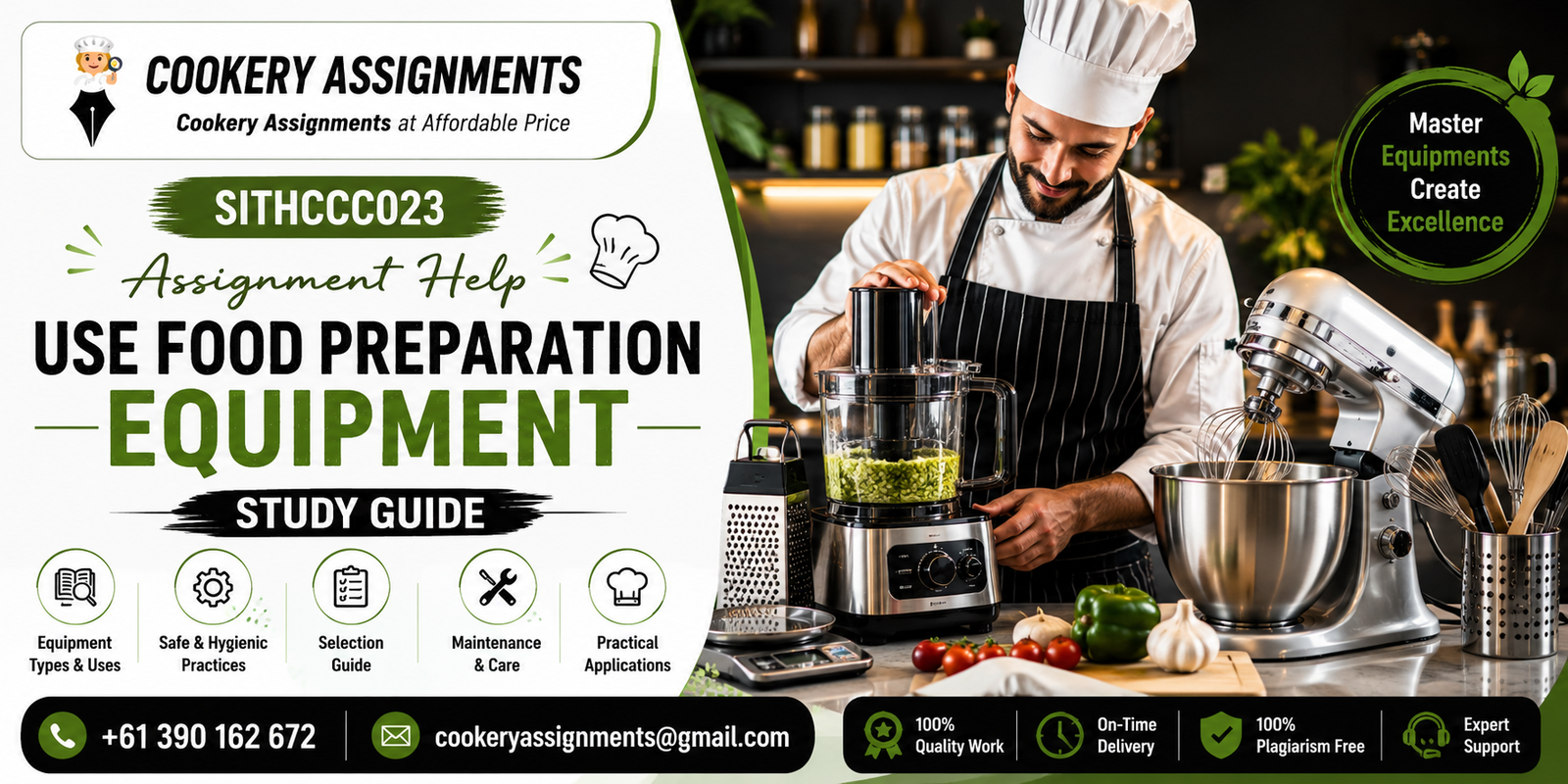
<h2>SITHCCC023 Assignment Help in Australia: Use Food Preparation Equipment Study Guide</h2><p>The unit <strong>SITHCCC023 Use food preparation equipment</strong> is one of the first practical units in the SIT30821 Certificate III in Commercial Cookery, and it underpins almost everything else you do in a professional kitchen. Before you can cook consistently, you need to select, use, clean and maintain commercial food preparation equipment safely and efficiently. This guide explains what the unit covers, the equipment you must master, what your assessor looks for, and how to prepare so you pass with genuine, job-ready skills.</p><h3>What is SITHCCC023 about?</h3><p>SITHCCC023 develops your ability to choose the correct equipment for a task, assemble and use it safely, and clean and maintain it to commercial standards. Employers and assessors treat this as a core safety unit: misusing a slicer, mandoline or food processor is one of the most common causes of kitchen injury, so the unit places real emphasis on safe handling, guards, and correct procedures. You will typically study it alongside food safety units such as SITXFSA005, because hygiene and equipment use go hand in hand.</p><h3>The food preparation equipment you must master</h3><p>Commercial kitchens use a wide range of equipment, and the unit expects you to be confident with the main categories below, including selecting the right tool for each job.</p><h4>Knives and hand tools</h4><ul><li><strong>Chef knife, paring knife, boning knife, filleting knife</strong> – each designed for a specific task. Correct grip, a sharp edge and safe cutting techniques (the claw grip) are essential.</li><li><strong>Peelers, zesters, graters and mandolines</strong> – speed up preparation but require care; a mandoline guard should always be used.</li></ul><h4>Weighing and measuring equipment</h4><ul><li><strong>Digital and platform scales, measuring jugs and spoons, thermometers</strong> – accuracy here directly affects recipe consistency and food safety.</li></ul><h4>Cutting and processing equipment</h4><ul><li><strong>Food processors</strong> – for chopping, blending, pureeing and making pastes. Blades must be handled carefully and the bowl locked correctly.</li><li><strong>Bench-mounted and electric slicers</strong> – for even, fast slicing; the guard and safe-feed technique are critical and heavily assessed.</li><li><strong>Blenders and stick blenders</strong> – for soups, sauces and emulsions.</li></ul><h4>Mixing equipment</h4><ul><li><strong>Planetary mixers</strong> – with whisk, paddle and dough hook attachments for batters, creams and doughs. Choosing the right attachment and speed is part of the assessment.</li></ul><h3>Selecting the right equipment for the task</h3><p>A key skill in this unit is choosing the most appropriate and efficient equipment for each job. For example, a food processor is ideal for quickly chopping large quantities, but a chef knife is better for precise, even dice on a small amount. Assessors want to see that you can justify your choices in terms of efficiency, food quality, safety and hygiene – not simply reach for whatever is closest.</p><h3>Using equipment safely</h3><p>Safety is the heart of SITHCCC023. You are expected to assemble equipment correctly, use all guards and safety features, keep hands and utensils clear of moving parts, never leave powered equipment unattended, and follow the manufacturer and workplace instructions. You should also report any faulty or damaged equipment rather than using it. Demonstrating calm, deliberate, safe handling is exactly what earns marks in the practical.</p><h3>Cleaning, sanitising and maintaining equipment</h3><p>After use, equipment must be dismantled where required, cleaned, sanitised and stored correctly. You should understand the difference between cleaning (removing visible dirt) and sanitising (reducing bacteria to safe levels), follow the correct order, and carry out basic maintenance such as checking and sharpening knives or reporting blunt blades. Correct cleaning prevents cross-contamination and extends the life of expensive equipment.</p><h3>What you will be assessed on</h3><p>SITHCCC023 assessment combines knowledge questions with a practical demonstration, usually supported by a logbook.</p><h4>1. Knowledge evidence</h4><p>Expect questions on the purpose and safe use of each piece of equipment, the correct cleaning and sanitising procedures, manufacturer instructions, and basic maintenance. You may be asked to match equipment to tasks or to describe the safety features of a slicer or mandoline.</p><h4>2. Performance evidence</h4><p>You must safely select, assemble, use, clean and store a range of equipment while completing real preparation tasks. Assessors watch your safety practices, efficiency, technique, and how you maintain a clean and organised station throughout.</p><h4>3. Logbook</h4><p>Many RTOs require a record of the equipment you used, the tasks completed, dates and supervisor sign-off. Keep it accurate and up to date.</p><h3>Study tips for SITHCCC023</h3><ul><li><strong>Learn each piece of equipment by purpose.</strong> Know what it does, when to use it, and its safety features.</li><li><strong>Practise safe handling until it is automatic.</strong> The claw grip, mandoline guard and slicer feed technique should feel natural.</li><li><strong>Memorise the clean-and-sanitise sequence.</strong> Be able to describe it clearly in writing.</li><li><strong>Keep your station organised.</strong> A tidy bench is both safer and assessed.</li><li><strong>Update your logbook as you go.</strong></li></ul><h3>Common mistakes that cost marks</h3><ul><li>Using a slicer or mandoline without the guard.</li><li>Choosing inefficient equipment for the task and not being able to justify the choice.</li><li>Poor cleaning that risks cross-contamination.</li><li>Leaving powered equipment unattended or assembling it incorrectly.</li><li>Incomplete logbooks missing dates or sign-off.</li></ul><h3>How to prepare effectively</h3><p>Spend time physically handling each piece of equipment in your training kitchen until selection, safe use and cleaning feel routine. Write short notes in your own words on the purpose, safety features and cleaning steps for each item. Then complete a mock practical where you select and use several pieces of equipment for a real task, and review anything that felt rushed or unsafe. Always confirm your RTO assessment instructions so you know exactly which equipment you must demonstrate.</p><h3>Frequently asked questions about SITHCCC023</h3><h4>Is SITHCCC023 a difficult unit?</h4><p>It is one of the more approachable practical units, but it is taken seriously because it is safety-focused. Confident, safe handling and clear knowledge of cleaning procedures are what you need.</p><h4>What equipment am I most likely to be assessed on?</h4><p>Knives and hand tools, scales, a food processor, a slicer or mandoline, and a planetary mixer are all common. Always check your RTO instructions.</p><h4>What is the difference between cleaning and sanitising?</h4><p>Cleaning removes visible dirt and food residue, while sanitising reduces bacteria to a safe level. In a commercial kitchen you clean first, then sanitise.</p><h4>What should I do with faulty equipment?</h4><p>Stop using it, label or isolate it if required, and report it to your supervisor. Never attempt to use damaged equipment.</p><h4>Where can I get help with SITHCCC023?</h4><p>If any part of the unit is unclear, our cookery tutors can help you understand the equipment, the safety procedures and the assessment requirements so you complete your own work confidently.</p><h3>Get study support for your cookery course</h3><p>At Cookery Assignments we help commercial cookery and hospitality students across Australia understand their units and prepare for assessment the right way. For guidance with SITHCCC023 or any other unit, call <strong>+61 390 162 672</strong> or email <strong>cookeryassignments@gmail.com</strong>. Find us on Google here: <a href="https://share.google/3vrmdLIN2qFOofR6I">Cookery Assignments on Google</a>.</p>
<h2>SITHCCC029 Prepare Stocks, Sauces and Soups Assignment Help in Australia</h2><p>The unit <strong>SITHCCC029 Prepare stocks, sauces and soups</strong> is one of the most respected practical units in the SIT30821 Certificate III in Commercial Cookery, because stocks, sauces and soups are the backbone of professional cooking. Get them right and almost every other dish improves; get them wrong and it shows immediately. This in-depth guide explains exactly what the unit covers, the classical theory behind stocks, the mother sauces and soup styles, what your assessor is looking for, the mistakes that cost marks, and a realistic plan to prepare with confidence.</p><p>SITHCCC029 rewards understanding more than memorisation. Once you grasp how a stock builds flavour, how a sauce is thickened, and how a soup is balanced, you can adapt to almost any recipe an assessor puts in front of you.</p><h3>What is SITHCCC029 about?</h3><p>SITHCCC029 develops your ability to prepare a range of stocks, sauces and soups to a commercial standard, working safely and hygienically, following standard recipes, and presenting the finished items correctly. You will be expected to control flavour, colour, consistency and temperature, and to store these items safely – an area that is heavily assessed, because stocks and soups are higher-risk foods if cooled and stored incorrectly. The unit usually builds on basic cookery methods (SITHCCC027) and food safety units such as SITXFSA005.</p><h3>Stocks: the foundation of flavour</h3><p>A stock is a flavoured liquid made by simmering bones, vegetables and aromatics. It is the base for most sauces and soups, so quality here flows through everything. The unit expects you to know the main types and how to make them correctly.</p><h4>Types of stock</h4><ul><li><strong>White stock</strong> – made from un-roasted bones (chicken, veal); pale and delicate.</li><li><strong>Brown stock</strong> – made from roasted bones and mirepoix; deep colour and rich flavour.</li><li><strong>Fish stock (fumet)</strong> – made quickly from fish bones; cooked only a short time to stay clean and fresh.</li><li><strong>Vegetable stock</strong> – made from vegetables and aromatics; light and versatile.</li></ul><h4>The components and method</h4><p>Most stocks use bones, a <strong>mirepoix</strong> (roughly two parts onion to one part each carrot and celery), and a <strong>bouquet garni</strong> or aromatics. The key principles are: start in cold water, bring slowly to a gentle simmer, never boil (boiling makes a stock cloudy and greasy), skim the surface regularly, and simmer for the correct time for the type. Strain gently, then cool rapidly and store safely.</p><h3>Sauces: the mother sauces and their derivatives</h3><p>Classical cookery organises sauces around five mother sauces, from which countless derivative (or small) sauces are made. Understanding this structure is one of the highest-value things you can learn for the unit.</p><ul><li><strong>Béchamel</strong> – milk thickened with a white roux. Derivatives include mornay (with cheese).</li><li><strong>Velouté</strong> – a light stock thickened with a blond roux. Base for many cream sauces.</li><li><strong>Espagnole</strong> – a brown sauce based on brown stock and brown roux; the base for demi-glace.</li><li><strong>Tomato sauce</strong> – a tomato-based sauce, sometimes lightly thickened.</li><li><strong>Hollandaise</strong> – an emulsion of egg yolk and clarified butter; the base for béarnaise.</li></ul><h3>Thickening agents and consistency</h3><p>You should understand the main thickening methods: <strong>roux</strong> (cooked flour and fat, in white, blond or brown stages), <strong>beurre manié</strong> (raw flour and butter), <strong>slurry</strong> (starch and cold liquid), <strong>liaison</strong> (egg yolk and cream), and <strong>reduction</strong> (simmering to concentrate). Correct consistency – a sauce that coats the back of a spoon (nappe) – is a classic assessment point.</p><h3>Soups: clear and thick styles</h3><p>Soups fall into two broad families, and the unit expects you to prepare examples of each to the right consistency, seasoning and temperature.</p><ul><li><strong>Clear soups</strong> – broths and consommé (a clarified, crystal-clear stock-based soup). Clarity and clean flavour are everything.</li><li><strong>Thick soups</strong> – purée soups, cream soups (often velouté-based), bisques (shellfish), and chowders. Smoothness, body and balance matter.</li></ul><p>Garnishes, correct service temperature (hot soups served hot, chilled soups properly cold) and accurate seasoning are all assessed.</p><h3>Food safety: cooling and storing correctly</h3><p>Stocks and soups are potentially hazardous foods. You must cool them rapidly through the temperature danger zone (5°C to 60°C) – for example using an ice bath or blast chiller – rather than leaving them at room temperature, and store them covered, labelled and dated. Reheating must be rapid and thorough. Expect written questions on safe cooling, storage times and reheating.</p><h3>Equipment you will use</h3><p>Stockpots, fine strainers (chinois), ladles, whisks, blenders or stick blenders for purée soups, and accurate scales and thermometers. Safe handling of hot liquids and heavy stockpots is part of the practical assessment.</p><h3>What you will be assessed on</h3><p>SITHCCC029 combines knowledge questions with a practical demonstration and usually a logbook.</p><h4>1. Knowledge evidence</h4><p>Expect questions on stock types and methods, the mother sauces and their derivatives, thickening agents, soup categories, correct consistencies, and the safe cooling and storage of stocks and soups. You may be asked why a stock should not boil, or how to fix a lumpy sauce.</p><h4>2. Performance evidence</h4><p>You must prepare a range of stocks, sauces and soups to standard recipes, across more than one service period and to a deadline. Assessors look for correct technique, flavour, colour and consistency, professional presentation, safe handling of hot liquids, clean work practices and good time management.</p><h4>3. Logbook</h4><p>Record each stock, sauce and soup you produce, with the method, date and supervisor sign-off, following your RTO template.</p><h3>A worked approach to the practical</h3><p>If you are asked to produce a stock, a derivative sauce and a soup in one session, plan the sequence around what takes longest. Start your stock first so it can simmer, prepare your mirepoix and mise en place while it cooks, build your roux and sauce in the middle of the session, and finish with the soup so it is hot and fresh at service. Taste and adjust seasoning at the end, check consistencies, and plate cleanly. Planning this order before you start is what turns a stressful practical into a controlled one.</p><h3>Study tips for SITHCCC029</h3><ul><li><strong>Memorise the five mother sauces and one derivative of each.</strong> This answers a huge share of theory questions.</li><li><strong>Understand roux stages.</strong> White, blond and brown roux suit different sauces.</li><li><strong>Never boil a stock.</strong> Know why – clarity and flavour.</li><li><strong>Practise the nappe consistency.</strong> Learn what a correctly thickened sauce feels like.</li><li><strong>Drill safe cooling.</strong> Be able to describe rapid cooling clearly in writing.</li><li><strong>Keep your logbook current.</strong></li></ul><h3>Common mistakes that cost marks</h3><ul><li>Boiling a stock and ending up with a cloudy, greasy result.</li><li>Lumpy sauces from adding hot liquid too fast to a roux, or roux that is too hot or cold.</li><li>Over-reducing and over-salting a sauce.</li><li>Soups served at the wrong temperature or with the wrong consistency.</li><li>Unsafe cooling – leaving stock at room temperature.</li><li>Incomplete logbooks.</li></ul><h3>Your preparation plan</h3><p>In your first week, learn the theory: write out the stock types, the five mother sauces with one derivative each, the thickening agents and the soup categories in your own words. In the second week, make a white and a brown stock, a roux-based sauce and a purée or cream soup, focusing on technique and consistency. In the final week, run a timed mock practical producing a stock, a sauce and a soup together, then review and refine. Always confirm your RTO assessment instructions for the exact items required.</p><h3>Frequently asked questions about SITHCCC029</h3><h4>What are the five mother sauces?</h4><p>Béchamel, velouté, espagnole, tomato and hollandaise. From these, most classical derivative sauces are made.</p><h4>Why should you never boil a stock?</h4><p>Boiling emulsifies fat and disturbs impurities, making the stock cloudy and greasy. A gentle simmer keeps it clear and clean-flavoured.</p><h4>What does nappe consistency mean?</h4><p>It describes a sauce thick enough to coat the back of a spoon evenly – a key target for correctly thickened sauces.</p><h4>How do I cool a stock safely?</h4><p>Cool it rapidly through the danger zone using an ice bath or blast chiller, then store it covered, labelled and dated under refrigeration.</p><h4>How many items will I need to prepare?</h4><p>This varies by RTO, but you will typically prepare several stocks, sauces and soups across more than one service period. Check your assessment instructions.</p><h4>Where can I get help with SITHCCC029?</h4><p>If any part of the unit is unclear, our cookery tutors can help you understand stocks, sauces, soups and the assessment requirements so you complete your own work with confidence.</p><h3>Get study support for your cookery course</h3><p>At Cookery Assignments we help commercial cookery and hospitality students across Australia understand their units and prepare for assessment the right way. For guidance with SITHCCC029 or any other unit, call <strong>+61 390 162 672</strong> or email <strong>cookeryassignments@gmail.com</strong>. Find us on Google here: <a href="https://share.google/3vrmdLIN2qFOofR6I">Cookery Assignments on Google</a>.</p>

<h2>SITHCCC028 Assignment Help in Australia for Prepare Appetisers and Salads</h2><p>The unit <strong>SITHCCC028 Prepare appetisers and salads</strong> is where presentation, freshness and balance come together. Appetisers and salads are often the first thing a guest sees and tastes, so they set the tone for the whole meal – which is exactly why this unit in the SIT30821 Certificate III in Commercial Cookery places so much weight on technique, food safety and visual appeal. This in-depth guide explains what the unit covers, the theory behind appetisers, salads and dressings, what your assessor is looking for, common mistakes, and how to prepare with confidence.</p><h3>What is SITHCCC028 about?</h3><p>SITHCCC028 develops your ability to prepare and present a range of appetisers and salads to a commercial standard. You will select ingredients, prepare them safely and hygienically, assemble dishes following standard recipes, make appropriate dressings and sauces, and present everything attractively within realistic time limits. Because many of these dishes contain raw or ready-to-eat ingredients, food safety is heavily emphasised. The unit builds on basic preparation skills (SITHCCC023, SITHCCC027) and food safety units such as SITXFSA005.</p><h3>Appetisers: small dishes that make a big impression</h3><p>An appetiser is a small dish served before or at the start of a meal, designed to stimulate the appetite. The unit expects you to understand the main styles and the principles behind them.</p><ul><li><strong>Canapés</strong> – small, bite-sized items on a base such as bread, pastry or a cracker, with a spread and garnish.</li><li><strong>Hors d’oeuvres</strong> – a selection of small savoury items served before a meal.</li><li><strong>Dips, spreads and pâtés</strong> – served with accompaniments such as crudités or bread.</li><li><strong>Antipasto</strong> – an Italian-style selection of cured meats, cheeses, marinated vegetables and olives.</li><li><strong>Bruschetta and tartlets</strong> – small, composed items combining a base, a topping and a garnish.</li></ul><p>Good appetisers are small, balanced in flavour, neat and visually appealing. Consistency of size and careful garnishing are exactly what assessors look for.</p><h3>Salads: understanding the structure</h3><p>Most salads can be broken down into four parts, and understanding this structure helps you build and assess any salad.</p><ul><li><strong>Base</strong> – usually leaves that line the plate or bowl.</li><li><strong>Body</strong> – the main ingredients (vegetables, proteins, grains).</li><li><strong>Dressing</strong> – ties the flavours together.</li><li><strong>Garnish</strong> – adds colour, texture and visual appeal.</li></ul><h4>Types of salad</h4><ul><li><strong>Simple (single) salads</strong> – built around one main ingredient.</li><li><strong>Compound (composed) salads</strong> – carefully arranged combinations of several ingredients.</li><li><strong>Warm salads</strong> – combining warm and cold elements, dressed just before service.</li></ul><h3>Dressings and dipping sauces</h3><p>Dressings make or break a salad, so the unit expects solid knowledge here.</p><ul><li><strong>Vinaigrette</strong> – a temporary emulsion, classically around three parts oil to one part acid, seasoned to taste.</li><li><strong>Emulsified dressings</strong> – such as mayonnaise, where egg yolk stabilises a permanent emulsion of oil and acid.</li></ul><p>Understanding what an emulsion is, and why mayonnaise can split, is a common knowledge-evidence question.</p><h3>Presentation principles</h3><p>Appetisers and salads are judged with the eyes first. Assessors look for clean plating, balanced colour and texture, appropriate height and arrangement, consistent portion sizes, and garnishes that are edible and relevant. Avoid overcrowding the plate and wipe rims before service.</p><h3>Food safety with raw and ready-to-eat foods</h3><p>Because many appetisers and salads are not cooked before serving, contamination cannot be cooked out later. You must prevent cross-contamination (separate boards and utensils for raw and ready-to-eat items), maintain the cold chain by keeping ingredients below 5°C, wash salad ingredients properly, manage allergens, and observe the temperature danger zone. Expect written questions on safe handling of ready-to-eat foods.</p><h3>Equipment you will use</h3><p>Knives and boards, peelers and mandolines, whisks and bowls for dressings, blenders for purees and emulsions, and scales for accurate quantities. Safe knife skills and correct board separation are part of the assessment.</p><h3>What you will be assessed on</h3><p>SITHCCC028 combines knowledge questions with a practical demonstration and usually a logbook.</p><h4>1. Knowledge evidence</h4><p>Expect questions on appetiser styles, salad structure and types, dressings and emulsions, presentation principles, and the safe handling of raw and ready-to-eat foods. You may be asked to explain the parts of a salad or why mayonnaise splits.</p><h4>2. Performance evidence</h4><p>You must prepare and present a range of appetisers and salads to standard recipes, across more than one service period and to a deadline. Assessors look for fresh, correctly prepared ingredients, balanced dressings, attractive and consistent presentation, safe food handling and good time management.</p><h4>3. Logbook</h4><p>Record each appetiser and salad you produce, with the method, date and supervisor sign-off, following your RTO template.</p><h3>A worked approach to the practical</h3><p>If you are asked to produce several appetisers and salads in one session, prepare your dressings and any cooked components first, keep all ready-to-eat ingredients chilled, and assemble and dress salads as close to service as possible so leaves stay crisp. Plate appetisers neatly and consistently, garnish last, and wipe plate rims before they go out. Dressing a salad too early is one of the most common avoidable mistakes.</p><h3>Study tips for SITHCCC028</h3><ul><li><strong>Memorise the four parts of a salad.</strong> Base, body, dressing, garnish answers many questions.</li><li><strong>Understand emulsions.</strong> Know the difference between temporary and permanent emulsions.</li><li><strong>Practise consistent plating.</strong> Uniform size and neat arrangement earn marks.</li><li><strong>Drill safe handling of ready-to-eat foods.</strong> Board separation and the cold chain.</li><li><strong>Dress salads at the last minute.</strong></li></ul><h3>Common mistakes that cost marks</h3><ul><li>Dressing salads too early, leaving them soggy and wilted.</li><li>Split mayonnaise from adding oil too quickly.</li><li>Inconsistent appetiser sizes and cluttered plating.</li><li>Cross-contamination between raw and ready-to-eat items.</li><li>Ingredients left out of refrigeration too long.</li><li>Incomplete logbooks.</li></ul><h3>Your preparation plan</h3><p>In your first week, learn the theory: the appetiser styles, the four parts of a salad, salad types, and how vinaigrettes and emulsified dressings work. In the second week, make a vinaigrette and a mayonnaise, build simple and compound salads, and practise neat plating. In the final week, run a timed mock service producing several appetisers and salads, then review presentation, balance and safety. Always confirm your RTO assessment instructions for the exact items required.</p><h3>Frequently asked questions about SITHCCC028</h3><h4>What are the four parts of a salad?</h4><p>Base, body, dressing and garnish. Understanding this structure helps you build and evaluate any salad.</p><h4>What is the classic ratio for a vinaigrette?</h4><p>Traditionally about three parts oil to one part acid, adjusted to taste. It is a temporary emulsion that needs mixing before use.</p><h4>Why does mayonnaise split, and how do you fix it?</h4><p>It splits when oil is added too quickly or the emulsion is overwhelmed. You can often rescue it by slowly whisking the split mixture into a fresh egg yolk.</p><h4>Why is food safety so important for this unit?</h4><p>Many appetisers and salads are served raw or ready-to-eat, so any contamination is not cooked out. Safe handling, board separation and the cold chain are essential.</p><h4>How many items will I need to prepare?</h4><p>This varies by RTO, but you will typically prepare a range of appetisers and salads across more than one service period. Check your assessment instructions.</p><h4>Where can I get help with SITHCCC028?</h4><p>If any part of the unit is unclear, our cookery tutors can help you understand appetisers, salads, dressings and the assessment requirements so you complete your own work with confidence.</p><h3>Get study support for your cookery course</h3><p>At Cookery Assignments we help commercial cookery and hospitality students across Australia understand their units and prepare for assessment the right way. For guidance with SITHCCC028 or any other unit, call <strong>+61 390 162 672</strong> or email <strong>cookeryassignments@gmail.com</strong>. Find us on Google here: <a href="https://share.google/3vrmdLIN2qFOofR6I">Cookery Assignments on Google</a>.</p>

<h2>SITHCCC030 Prepare Vegetarian and Vegan Dishes Assignment Help</h2><p>The unit <strong>SITHCCC030 Prepare vegetable, fruit, egg and farinaceous dishes</strong> covers an enormous amount of everyday cooking, which is why it carries real weight in the SIT30821 Certificate III in Commercial Cookery. Vegetables, fruit, eggs and starches (farinaceous items such as pasta, rice and grains) appear on almost every menu, so mastering them makes you genuinely useful in any kitchen. This in-depth guide explains what the unit covers across all four food groups, what your assessor is looking for, the mistakes that cost marks, and a realistic plan to prepare.</p><h3>What is SITHCCC030 about?</h3><p>SITHCCC030 develops your ability to select, prepare, cook and present dishes using vegetables, fruit, eggs and farinaceous ingredients, working safely and hygienically and following standard recipes. Because it spans four very different food groups, the unit tests your breadth: precise vegetable cuts, correct egg cookery, perfectly cooked pasta and rice, and attractive presentation. It builds on basic methods (SITHCCC027) and food safety (SITXFSA005).</p><h3>Vegetables: cuts, colour and cooking</h3><p>Vegetable work is where knife skills and cooking judgement show most clearly. The unit expects you to know the classical cuts and how to cook vegetables while keeping colour, texture and nutrients.</p><ul><li><strong>Classical cuts</strong> – julienne (fine sticks), brunoise (small dice), macedoine (larger dice), batonnet, paysanne and chiffonade. Uniform cuts mean even cooking and professional presentation.</li><li><strong>Cooking methods</strong> – boiling, steaming, roasting, grilling, sautéing and braising, each suited to different vegetables.</li><li><strong>Retaining quality</strong> – blanch and refresh green vegetables to keep their colour, avoid overcooking, and cook to order where possible.</li></ul><h3>Fruit: preparation and use</h3><p>Fruit appears in both savoury and sweet dishes. The unit expects you to prepare fruit correctly – washing, peeling, coring and cutting – and to understand uses such as salads, garnishes, sauces and accompaniments. Preventing browning (for example with acidulated water) and handling soft fruit gently are typical points.</p><h3>Eggs: one of the most tested skills</h3><p>Egg cookery is a classic test of control, because eggs overcook quickly. You should be confident with the main methods and the principles behind them.</p><ul><li><strong>Boiled</strong> – soft, medium or hard, timed precisely.</li><li><strong>Poached</strong> – in gently simmering water with a little acid; fresh eggs hold together best.</li><li><strong>Fried</strong> – sunny side up, over easy and similar styles.</li><li><strong>Scrambled</strong> – cooked slowly over low heat for a soft, creamy result.</li><li><strong>Omelettes</strong> – folded or rolled, cooked quickly so they stay tender.</li></ul><p>The key principle is gentle, controlled heat: high heat makes eggs rubbery. Eggs are also a food-safety focus because of the risk of salmonella, so correct storage and handling matter.</p><h3>Farinaceous dishes: pasta, rice and grains</h3><p>Farinaceous simply means starch-based. The unit expects you to cook these staples correctly.</p><ul><li><strong>Pasta</strong> – cooked in plenty of salted boiling water to <i>al dente</i> (firm to the bite), then drained and dressed promptly.</li><li><strong>Rice</strong> – by methods such as boiling/absorption, pilaf (sautéed then simmered) and risotto (stirred with gradual additions of stock).</li><li><strong>Other grains and starches</strong> – polenta, couscous and gnocchi, each with its own technique.</li></ul><h3>Equipment you will use</h3><p>Knives and boards for cuts, pots for boiling and blanching, sauté pans for eggs and vegetables, colanders and strainers, and accurate timers and thermometers. Safe knife skills and confident pan control are part of the practical assessment.</p><h3>Food safety to watch</h3><p>Two areas come up often: <strong>eggs</strong> (store cold, handle carefully, be aware of salmonella risk in dishes using raw or lightly cooked egg) and <strong>cooked rice</strong> (cool rapidly and store correctly, because <i>Bacillus cereus</i> can grow in rice left in the danger zone). Use correct terminology in written answers.</p><h3>What you will be assessed on</h3><p>SITHCCC030 combines knowledge questions with a practical demonstration and usually a logbook.</p><h4>1. Knowledge evidence</h4><p>Expect questions on vegetable cuts and cooking methods, retaining colour and nutrients, fruit preparation, egg cookery methods and principles, pasta and rice techniques, and relevant food safety. You may be asked to name classical cuts or explain why eggs should be cooked gently.</p><h4>2. Performance evidence</h4><p>You must prepare a range of vegetable, fruit, egg and farinaceous dishes to standard recipes, across more than one service period and to a deadline. Assessors look for accurate cuts, correct cooking, good colour and texture, attractive presentation, safe handling and time management.</p><h4>3. Logbook</h4><p>Record each dish with the method, date and supervisor sign-off, following your RTO template.</p><h3>A worked approach to the practical</h3><p>If you must produce dishes from several of these groups in one session, start anything that needs blanching or par-cooking early, cook eggs and dress pasta as close to service as possible so they stay at their best, and keep your vegetable cuts uniform for even cooking and neat plating. Cook delicate items to order, taste and season at the end, and plate with attention to colour and balance.</p><h3>Study tips for SITHCCC030</h3><ul><li><strong>Learn the classical cuts by name and size.</strong> They appear in both theory and practical.</li><li><strong>Master gentle egg cookery.</strong> Low, controlled heat is the secret.</li><li><strong>Cook pasta to al dente and dress it immediately.</strong></li><li><strong>Blanch and refresh green vegetables</strong> to keep their colour.</li><li><strong>Know the food-safety points for eggs and rice.</strong></li><li><strong>Keep your logbook current.</strong></li></ul><h3>Common mistakes that cost marks</h3><ul><li>Uneven vegetable cuts leading to uneven cooking.</li><li>Overcooked, dull green vegetables.</li><li>Rubbery eggs from heat that is too high.</li><li>Overcooked, sticky pasta or rice.</li><li>Unsafe handling or storage of eggs and cooked rice.</li><li>Incomplete logbooks.</li></ul><h3>Your preparation plan</h3><p>In your first week, learn the theory: the classical cuts, vegetable cooking methods, egg methods and principles, and pasta and rice techniques, plus the egg and rice food-safety points. In the second week, practise your cuts for uniformity, cook eggs by each method, and make a pasta and a rice dish. In the final week, run a timed mock service covering several food groups, then review your cuts, cooking and presentation. Always confirm your RTO assessment instructions for the exact dishes required.</p><h3>Frequently asked questions about SITHCCC030</h3><h4>What are the classical vegetable cuts?</h4><p>Common ones include julienne, brunoise, macedoine, batonnet, paysanne and chiffonade. Uniform cuts give even cooking and a professional look.</p><h4>Why do eggs turn rubbery?</h4><p>Because they are cooked at too high a heat for too long. Gentle, controlled heat keeps them tender.</p><h4>What does al dente mean?</h4><p>It means pasta cooked until firm to the bite – cooked through but not soft. Drain and dress it promptly.</p><h4>Why is cooked rice a food-safety concern?</h4><p><i>Bacillus cereus</i> spores can survive cooking and grow if rice is left in the temperature danger zone, so cool rice rapidly and store it correctly.</p><h4>How many dishes will I need to prepare?</h4><p>This varies by RTO, but you will typically prepare dishes from across the vegetable, fruit, egg and farinaceous groups over more than one service period. Check your assessment instructions.</p><h4>Where can I get help with SITHCCC030?</h4><p>If any part of the unit is unclear, our cookery tutors can help you understand vegetable, fruit, egg and farinaceous cookery and the assessment requirements so you complete your own work with confidence.</p><h3>Get study support for your cookery course</h3><p>At Cookery Assignments we help commercial cookery and hospitality students across Australia understand their units and prepare for assessment the right way. For guidance with SITHCCC030 or any other unit, call <strong>+61 390 162 672</strong> or email <strong>cookeryassignments@gmail.com</strong>. Find us on Google here: <a href="https://share.google/3vrmdLIN2qFOofR6I">Cookery Assignments on Google</a>.</p>

<h2>SITHCCC031 Assignment Help: Prepare Vegetarian and Vegan Dishes</h2><p>The unit <strong>SITHCCC031 Prepare vegetarian and vegan dishes</strong> has become one of the most relevant practical units in the SIT30821 Certificate III in Commercial Cookery. Plant-based eating is now a mainstream expectation, and every professional kitchen needs cooks who can prepare vegetarian and vegan dishes that are flavourful, nutritionally sound and safe from cross-contamination. This in-depth guide explains what the unit covers, the dietary definitions and protein sources you must know, what your assessor is looking for, common mistakes, and a clear plan to prepare.</p><h3>What is SITHCCC031 about?</h3><p>SITHCCC031 develops your ability to prepare and present a range of vegetarian and vegan dishes to a commercial standard. You will select suitable ingredients, apply appropriate cooking methods to plant proteins and vegetables, make suitable substitutions, present dishes attractively, and prevent cross-contamination with animal products. It builds on basic cookery skills (SITHCCC027) and food safety (SITXFSA005).</p><h3>Know your dietary definitions</h3><p>A common assessment point is understanding exactly what each diet allows, because serving the wrong ingredient is a serious error.</p><ul><li><strong>Lacto-vegetarian</strong> – includes dairy, excludes eggs and meat.</li><li><strong>Ovo-vegetarian</strong> – includes eggs, excludes dairy and meat.</li><li><strong>Lacto-ovo vegetarian</strong> – includes dairy and eggs, excludes meat, poultry and seafood.</li><li><strong>Pescatarian</strong> – includes seafood; often grouped in dietary requests.</li><li><strong>Vegan</strong> – excludes all animal products, including dairy, eggs, honey and gelatine.</li></ul><h3>Plant proteins and key ingredients</h3><p>Replacing meat well means understanding plant protein sources and how to cook them.</p><ul><li><strong>Legumes</strong> – beans, lentils and chickpeas; high in protein and fibre.</li><li><strong>Tofu</strong> – pressed soybean curd; takes on flavour well and can be fried, grilled, braised or blended.</li><li><strong>Tempeh</strong> – fermented soybeans with a firm texture and nutty flavour.</li><li><strong>Seitan</strong> – wheat gluten with a chewy texture (not gluten-free).</li><li><strong>Nuts, seeds and whole grains</strong> – add protein, texture and richness.</li></ul><h3>Nutrition and balance</h3><p>Vegetarian and vegan dishes still need to be nutritionally balanced. Combining plant proteins such as legumes with grains provides a fuller range of amino acids, and you should be aware of nutrients that need attention in plant-based diets, such as protein, iron, calcium and vitamin B12.</p><h3>Substitutions and adapting dishes</h3><p>A core skill is adapting recipes. Common substitutions include plant milks for dairy, oil or vegan margarine for butter, aquafaba or commercial egg replacers for eggs, and nutritional yeast for a savoury note. Knowing which substitution works in which dish is exactly what the unit assesses.</p><h3>Preventing cross-contamination</h3><p>This is the most important food-safety point in the unit. A vegan dish prepared with equipment, oil or surfaces that touched animal products is no longer vegan. Use clean, separate boards, utensils and pans, avoid shared fryer oil, store ingredients separately, and communicate with the team.</p><h3>Equipment you will use</h3><p>Knives and boards kept separate from animal products, pans for frying and braising plant proteins, blenders for purees and plant-based creams, and accurate scales. Hygienic handling and clear separation are part of the assessment.</p><h3>What you will be assessed on</h3><p>SITHCCC031 combines knowledge questions with a practical demonstration and usually a logbook.</p><h4>1. Knowledge evidence</h4><p>Expect questions on dietary definitions, plant protein sources and how to cook them, suitable substitutions, nutritional balance, and preventing cross-contamination.</p><h4>2. Performance evidence</h4><p>You must prepare a range of vegetarian and vegan dishes to standard recipes, across more than one service period and to a deadline. Assessors look for correct ingredient selection, well-cooked and well-seasoned plant proteins, attractive presentation, strict separation from animal products and good time management.</p><h4>3. Logbook</h4><p>Record each dish with the method, date and supervisor sign-off, following your RTO template.</p><h3>A worked approach to the practical</h3><p>Set up a dedicated, clean station with separate boards and utensils first. Prepare components that take longer (soaking or cooking legumes, pressing and marinating tofu) early, build flavour with herbs, spices, acids and umami ingredients so dishes are not bland, and plate with attention to colour and texture. Double-check every component of a vegan dish is genuinely free of animal products before service.</p><h3>Study tips for SITHCCC031</h3><ul><li><strong>Memorise the dietary definitions</strong>, especially what vegans exclude.</li><li><strong>Learn how to cook each plant protein.</strong> Tofu, tempeh, legumes and seitan all behave differently.</li><li><strong>Build flavour deliberately</strong> with seasoning, acid and umami.</li><li><strong>Drill cross-contamination control.</strong></li><li><strong>Know your substitutions.</strong></li></ul><h3>Common mistakes that cost marks</h3><ul><li>Serving a dish with a hidden animal product such as honey or gelatine.</li><li>Bland, under-seasoned plant-based food.</li><li>Poorly cooked tofu or legumes.</li><li>Cross-contamination from shared boards, pans or fryer oil.</li><li>Unbalanced plates lacking protein or substance.</li><li>Incomplete logbooks.</li></ul><h3>Your preparation plan</h3><p>In week one, learn the dietary definitions, plant protein sources, substitutions and cross-contamination rules. In week two, cook tofu, tempeh and a legume dish, and adapt a familiar recipe to be vegan. In the final week, run a timed mock service producing several vegetarian and vegan dishes, then review seasoning, balance and separation. Confirm your RTO assessment instructions for the exact dishes required.</p><h3>Frequently asked questions about SITHCCC031</h3><h4>What is the difference between vegetarian and vegan?</h4><p>Vegetarians avoid meat, poultry and seafood but may include dairy and/or eggs. Vegans exclude all animal products, including dairy, eggs, honey and gelatine.</p><h4>What are good plant protein sources?</h4><p>Legumes, tofu, tempeh, seitan, nuts, seeds and whole grains. Combining legumes and grains improves the amino acid profile.</p><h4>How do you replace eggs in cooking?</h4><p>Depending on the dish, options include aquafaba, commercial egg replacers, mashed banana, or flax and chia mixtures. The right choice depends on the egg’s role.</p><h4>Why is cross-contamination so important here?</h4><p>A single contact with an animal product makes a vegan or vegetarian dish unsuitable. Separate boards, utensils, pans and oil are essential.</p><h4>How many dishes will I need to prepare?</h4><p>This varies by RTO, but you will typically prepare a range of vegetarian and vegan dishes across more than one service period. Check your assessment instructions.</p><h4>Where can I get help with SITHCCC031?</h4><p>If any part of the unit is unclear, our cookery tutors can help you understand plant-based cookery and the assessment requirements so you complete your own work with confidence.</p><h3>Get study support for your cookery course</h3><p>At Cookery Assignments we help commercial cookery and hospitality students across Australia understand their units and prepare for assessment the right way. For guidance with SITHCCC031 or any other unit, call <strong>+61 390 162 672</strong> or email <strong>cookeryassignments@gmail.com</strong>. Find us on Google here: <a href="https://share.google/3vrmdLIN2qFOofR6I">Cookery Assignments on Google</a>.</p>

<h2>Prepare Meat Dishes Study Guide: SITHCCC036 Assignment Help in Australia</h2><p>The unit <strong>SITHCCC036 Prepare meat dishes</strong> is one of the cornerstone practical units in the SIT30821 Certificate III in Commercial Cookery. Meat is often the most expensive ingredient in a kitchen and the centrepiece of many dishes, so cooking it correctly – choosing the right cut, the right method and the right degree of doneness – is a skill every employer values. This in-depth guide explains what the unit covers, the theory of meat cuts and cookery, what your assessor is looking for, the mistakes that cost marks, and how to prepare with confidence.</p><h3>What is SITHCCC036 about?</h3><p>SITHCCC036 develops your ability to select, prepare, cook and present meat dishes to a commercial standard, working safely and hygienically and following standard recipes. You will be expected to identify cuts, match them to suitable cooking methods, cook to the correct degree of doneness, rest and carve meat correctly, and handle it safely throughout. It builds on basic cookery methods (SITHCCC027) and food safety (SITXFSA005).</p><h4>Meat types and cuts</h4><p>The single most useful piece of knowledge in this unit is how a cut’s location on the animal affects how you cook it.</p><ul><li><strong>Tender cuts</strong> – from muscles that do little work (for example loin and rib), best suited to fast, dry-heat methods like grilling and roasting.</li><li><strong>Tougher cuts</strong> – from hard-working muscles (for example shoulder, shin and brisket), best suited to slow, moist methods like braising and stewing that break down connective tissue.</li><li><strong>Common meats</strong> – beef, lamb, pork and veal, each with their own primal and secondary cuts.</li></ul><h3>Matching the cut to the cooking method</h3><p>Getting this match right is the heart of the unit. Tender cuts cooked quickly stay juicy; tough cuts cooked slowly become meltingly tender as collagen converts to gelatine. Cooking a tough cut quickly (or a tender cut slowly) is a classic mistake that produces dry or chewy results. The main methods you should know are grilling, roasting, pan-frying and sautéing (for tender cuts), and braising and stewing (for tougher cuts).</p><h3>Degrees of doneness</h3><p>For red meats you should understand the stages from rare to well done, how they look and feel, and the approximate internal temperatures for each. Using a probe thermometer is the reliable way to check, and is good practice both for quality and food safety. Pork and poultry must be cooked thoroughly, while beef and lamb can be served at various degrees depending on the dish and the guest’s preference.</p><h3>Resting and carving</h3><p>Resting meat after cooking lets the juices redistribute, so the meat stays moist when cut. Carving against the grain shortens the muscle fibres and makes the meat more tender to eat. Both are assessed and both are easy marks if you remember them.</p><h3>Preparation skills</h3><p>Before cooking, you may need to trim, portion, tie, or marinate meat. Accurate, consistent portioning matters for both presentation and cost control, and clean trimming improves the finished dish. Safe knife skills are assessed throughout.</p><h3>Food safety with meat</h3><p>Meat is a potentially hazardous food. Store it correctly and at the right temperature, keep raw meat separate from ready-to-eat foods, use separate boards and utensils to prevent cross-contamination, cook to safe internal temperatures where required, and cool and store cooked meat safely. Expect written questions on safe handling and minimum cooking temperatures.</p><h3>Equipment you will use</h3><p>Knives for trimming and portioning, grills, ovens, pans for searing and frying, heavy pots for braising, and a probe thermometer for checking doneness. Safe handling of hot pans and sharp knives is part of the practical assessment.</p><h3>What you will be assessed on</h3><p>SITHCCC036 combines knowledge questions with a practical demonstration and usually a logbook.</p><h4>1. Knowledge evidence</h4><p>Expect questions on meat types and cuts, matching cuts to cooking methods, degrees of doneness and internal temperatures, resting and carving, and safe handling. You may be asked which method suits a tough cut, or why resting matters.</p><h4>2. Performance evidence</h4><p>You must prepare a range of meat dishes to standard recipes, across more than one service period and to a deadline. Assessors look for correct cut selection, appropriate method, accurate doneness, proper resting and carving, attractive presentation, safe handling and good time management.</p><h4>3. Logbook</h4><p>Record each meat dish with the method, date and supervisor sign-off, following your RTO template.</p><h3>A worked approach to the practical</h3><p>If you must produce several meat dishes in one session, start any braise or slow-cooked item first so it has time, sear and roast tender cuts to order, and use a thermometer to hit your target doneness. Rest meat while you finish accompaniments, carve against the grain, and plate cleanly. Planning around the longest-cooking item keeps the whole service under control.</p><h4>Study tips for SITHCCC036</h4><ul><li><strong>Learn which cuts are tender and which are tough</strong>, and the method each suits.</li><li><strong>Memorise the degrees of doneness</strong> and approximate internal temperatures.</li><li><strong>Always rest meat</strong> and carve against the grain.</li><li><strong>Use a probe thermometer</strong> for accuracy and safety.</li><li><strong>Drill safe handling and cross-contamination control.</strong></li></ul><h4>Common mistakes that cost marks</h4><ul><li>Cooking a tough cut quickly, leaving it chewy.</li><li>Overcooking tender cuts so they dry out.</li><li>Skipping the rest, so juices run out on the plate.</li><li>Carving with the grain instead of against it.</li><li>Cross-contamination from shared boards or utensils.</li><li>Incomplete logbooks.</li></ul><h3>Your preparation plan</h3><p>In week one, learn the cuts, the cut-to-method matches, degrees of doneness and safe handling. In week two, practise searing and roasting a tender cut to a target temperature, and braising a tougher cut until tender. In the final week, run a timed mock service producing several meat dishes, then review your doneness, resting and presentation. Confirm your RTO assessment instructions for the exact dishes required.</p><h3>Frequently asked questions about SITHCCC036</h3><h4>How do I know which cooking method to use for a cut of meat?</h4><p>Tender cuts from low-work muscles suit fast, dry-heat methods; tougher cuts from hard-working muscles suit slow, moist methods that break down connective tissue.</p><h4>Why do you rest meat after cooking?</h4><p>Resting lets the juices redistribute through the meat, so it stays moist when carved rather than losing juice onto the board.</p><h4>Why carve against the grain?</h4><p>Carving across the muscle fibres shortens them, making each slice more tender to eat.</p><h4>How do I check meat is cooked correctly?</h4><p>A probe thermometer is the reliable way to check internal temperature for both quality and food safety, especially for pork and poultry which must be well cooked.</p><h4>How many dishes will I need to prepare?</h4><p>This varies by RTO, but you will typically prepare a range of meat dishes across more than one service period. Check your assessment instructions.</p><h4>Where can I get help with SITHCCC036?</h4><p>If any part of the unit is unclear, our cookery tutors can help you understand meat cookery and the assessment requirements so you complete your own work with confidence.</p><h3>Get study support for your cookery course</h3><p>At Cookery Assignments we help commercial cookery and hospitality students across Australia understand their units and prepare for assessment the right way. For guidance with SITHCCC036 or any other unit, call <strong>+61 390 162 672</strong> or email <strong>cookeryassignments@gmail.com</strong>. Find us on Google here: <a href="https://share.google/3vrmdLIN2qFOofR6I">Cookery Assignments on Google</a>.</p>

<h2>SITHCCC037 Prepare Seafood Dishes Assignment Help: Complete Study Guide</h2><p>The unit <strong>SITHCCC037 Prepare seafood dishes</strong> tests precision and freshness like few others in the SIT30821 Certificate III in Commercial Cookery. Seafood is delicate, highly perishable and easy to overcook, so it rewards careful handling and good judgement. This in-depth guide explains what the unit covers, how to select and prepare seafood, the cooking methods that suit it, the food-safety points assessors focus on, common mistakes, and a clear plan to prepare with confidence.</p><h3>What is SITHCCC037 about?</h3><p>SITHCCC037 develops your ability to select, prepare, cook and present seafood dishes to a commercial standard, working safely and hygienically and following standard recipes. Because seafood deteriorates quickly and is a major allergen, the unit places strong emphasis on freshness, correct storage and careful cooking. It builds on basic cookery methods (SITHCCC027) and food safety (SITXFSA005).</p><h4>Types of seafood</h4><ul><li><strong>Finfish</strong> – round fish (such as snapper and salmon) and flat fish (such as flounder), sold whole or as fillets.</li><li><strong>Crustaceans</strong> – prawns, crabs, lobster and similar; firm flesh that cooks quickly.</li><li><strong>Molluscs</strong> – including bivalves (mussels, oysters, scallops) and cephalopods (squid, octopus).</li></ul><h3>Selecting fresh seafood</h3><p>Knowing the signs of freshness is a core assessment point. Fresh fish has clear, bright eyes, red gills, firm and elastic flesh, shiny skin and a clean, sea-like smell – never a strong fishy or ammonia odour. Live shellfish such as mussels and oysters should be closed or close when tapped. Being able to describe these checks in writing is commonly required.</p><h3>Preparation skills</h3><p>Depending on the dish you may need to scale, gut, fillet and pin-bone fish, peel and devein prawns, or clean squid. Accurate, clean preparation and consistent portioning are assessed, as is safe knife work. Keep seafood cold throughout preparation.</p><h3>Cooking methods for seafood</h3><p>Seafood cooks fast, so method and timing are everything. The unit expects you to apply suitable methods and avoid overcooking.</p><ul><li><strong>Poaching and steaming</strong> – gentle, moist methods ideal for delicate fish and shellfish.</li><li><strong>Grilling and pan-frying</strong> – quick, dry-heat methods that add colour; watch the timing closely.</li><li><strong>Deep-frying</strong> – for battered or crumbed seafood, at the correct oil temperature.</li><li><strong>Baking</strong> – gentle oven cooking, often with moisture to prevent drying.</li></ul><p>The most common fault is overcooking, which makes seafood dry, rubbery or tough. Cooking just to the point of doneness is the skill being assessed.</p><h3>Food safety and allergens</h3><p>Seafood is highly perishable and must be kept cold (ideally on ice), used quickly, and kept strictly separate from other foods to prevent cross-contamination. Shellfish is one of the major food allergens, so allergen awareness and clear communication are essential. Some fish can also develop histamine if mishandled, which is why temperature control matters so much. Expect written questions on storage, the cold chain and allergens.</p><h3>Equipment you will use</h3><p>Filleting and other knives, scalers, pans for frying, steamers and poaching pans, and accurate timers and thermometers. Safe knife skills and careful handling of delicate flesh are part of the assessment.</p><h3>What you will be assessed on</h3><p>SITHCCC037 combines knowledge questions with a practical demonstration and usually a logbook.</p><h4>1. Knowledge evidence</h4><p>Expect questions on seafood types, signs of freshness, preparation techniques, suitable cooking methods, and food safety including the cold chain and allergens. You may be asked how to tell if fish is fresh, or why seafood overcooks so easily.</p><h4>2. Performance evidence</h4><p>You must prepare a range of seafood dishes to standard recipes, across more than one service period and to a deadline. Assessors look for fresh ingredient selection, clean preparation, correctly cooked (not overcooked) seafood, attractive presentation, safe cold-chain handling and good time management.</p><h4>3. Logbook</h4><p>Record each seafood dish with the method, date and supervisor sign-off, following your RTO template.</p><h3>A worked approach to the practical</h3><p>Keep all seafood on ice until the last moment. Prepare accompaniments and sauces first so the seafood can be cooked to order at the end and served immediately. Cook to just-done – fish should be opaque and just flake, prawns just turn pink and firm – then plate straight away. Cooking seafood too early or holding it too long is the fastest way to lose marks.</p><h3>Study tips for SITHCCC037</h3><ul><li><strong>Memorise the signs of freshness</strong> for fish and live shellfish.</li><li><strong>Practise gentle, quick cooking.</strong> Learn what just-done looks like.</li><li><strong>Keep seafood cold</strong> at every stage.</li><li><strong>Know shellfish as a major allergen.</strong></li><li><strong>Cook seafood to order</strong> and serve immediately.</li></ul><h3>Common mistakes that cost marks</h3><ul><li>Overcooking, leaving seafood dry and rubbery.</li><li>Using seafood that is past its best, or storing it incorrectly.</li><li>Breaking the cold chain during preparation.</li><li>Cross-contamination or poor allergen awareness.</li><li>Cooking too early and holding too long before service.</li><li>Incomplete logbooks.</li></ul><h3>Your preparation plan</h3><p>In week one, learn the seafood types, freshness checks, preparation techniques and food-safety points. In week two, practise filleting a fish and cooking seafood by gentle and quick methods, focusing on not overcooking. In the final week, run a timed mock service producing several seafood dishes cooked to order, then review freshness, doneness and presentation. Confirm your RTO assessment instructions for the exact dishes required.</p><h3>Frequently asked questions about SITHCCC037</h3><h4>How can I tell if fish is fresh?</h4><p>Look for clear bright eyes, red gills, firm elastic flesh, shiny skin and a clean sea smell. Avoid fish with a strong fishy or ammonia odour.</p><h4>Why does seafood overcook so easily?</h4><p>Seafood has delicate proteins and little connective tissue, so it cooks quickly. A short extra time on the heat can turn it dry and rubbery.</p><h4>How should seafood be stored?</h4><p>Keep it very cold, ideally on ice, use it quickly, and store it separately from other foods to avoid cross-contamination.</p><h4>Why is allergen awareness important for this unit?</h4><p>Shellfish is one of the major food allergens, so you must handle it carefully, avoid cross-contact and communicate clearly with the team.</p><h4>How many dishes will I need to prepare?</h4><p>This varies by RTO, but you will typically prepare a range of seafood dishes across more than one service period. Check your assessment instructions.</p><h4>Where can I get help with SITHCCC037?</h4><p>If any part of the unit is unclear, our cookery tutors can help you understand seafood cookery and the assessment requirements so you complete your own work with confidence.</p><h3>Get study support for your cookery course</h3><p>At Cookery Assignments we help commercial cookery and hospitality students across Australia understand their units and prepare for assessment the right way. For guidance with SITHCCC037 or any other unit, call <strong>+61 390 162 672</strong> or email <strong>cookeryassignments@gmail.com</strong>. Find us on Google here: <a href="https://share.google/3vrmdLIN2qFOofR6I">Cookery Assignments on Google</a>.</p>

<h2>Commercial Cookery for PR in Australia – Eligibility, Courses & PR Pathway 2026</h2><p>For thousands of students each year, studying <strong>commercial cookery in Australia</strong> is about far more than learning to cook – it is a recognised pathway toward skilled migration and permanent residency (PR). Australia has long faced shortages of skilled chefs and cooks, and the hospitality industry across Sydney, Melbourne, Brisbane, Perth and Adelaide continues to need qualified kitchen professionals. This complete guide explains how commercial cookery connects to PR, the qualifications and skills assessment involved, the realistic steps and timeframes, and the questions students ask most.</p><p><strong>Important:</strong> migration rules change regularly and your individual circumstances matter. Everything below is general education information, not migration advice. Always confirm current requirements with the Department of Home Affairs and a registered migration agent (MARA-registered) before making decisions.</p><h3>Is commercial cookery a PR pathway in Australia?</h3><p>Yes – commercial cookery can form part of a skilled migration pathway, because occupations such as <strong>Chef</strong> and <strong>Cook</strong> have frequently appeared on Australia’s skilled occupation lists. A person who becomes a qualified chef, gains the right experience and passes a skills assessment may be eligible to apply for certain skilled visas that can lead to permanent residency. It is not automatic, however: a qualification alone does not grant PR. It is one piece of a larger process that also involves a skills assessment, work experience, English language requirements, a points test for some visas, and visa availability at the time you apply.</p><h3>Why commercial cookery is popular with international students</h3><p>Several factors make commercial cookery attractive for students considering long-term settlement in Australia. The training is practical and job-focused, the hospitality industry offers widespread employment, and the qualifications are nationally recognised. Many students begin with a Certificate III, progress to a Certificate IV and then a Diploma of Hospitality Management, building both their skills and their visa options along the way. Because cooking roles exist in every city and regional town, graduates have flexibility about where they live and work – and regional study or work can carry additional migration benefits under some programs.</p><h3>The qualifications you typically need</h3><ul><li><strong>SIT30821 Certificate III in Commercial Cookery</strong> – the core trade qualification developing your fundamental cooking skills.</li><li><strong>SIT40521 Certificate IV in Kitchen Management</strong> – builds supervisory and kitchen-management skills on top of the trade.</li><li><strong>SIT50422 Diploma of Hospitality Management</strong> – often added to meet the Australian study requirement and broaden management knowledge.</li></ul><p>Each qualification is made up of many units of competency, assessed through knowledge questions, practical demonstrations, logbooks, projects and third-party workplace reports. Completing these assessments properly – and genuinely learning the skills – is essential, because your skills assessment later depends on demonstrating real competence.</p><h3>The skills assessment</h3><p>For migration purposes, chefs and cooks generally need a skills assessment from the relevant assessing authority (historically Trades Recognition Australia, TRA). This often involves a program confirming your qualification matches your practical experience and that you can perform at the required standard in a real workplace. The assessment is rigorous and designed to confirm you are genuinely job-ready, not simply that you hold a certificate. This is why authentic learning during your course matters so much – shortcuts in your studies tend to surface later when you must demonstrate skills in person.</p><h3>Work experience and the Australian study requirement</h3><p>Skilled migration pathways usually expect a period of relevant work experience, and some visas require study completed in Australia over a minimum duration. Work placements that form part of your cookery course are valuable here: they build the hours and the practical evidence you will rely on. Keeping accurate records – your logbook and any workplace reports – is genuinely useful beyond passing your course, because this evidence supports your later applications.</p><h3>A simplified step-by-step pathway</h3><ol><li>Enrol in and complete a Certificate III in Commercial Cookery, then typically a Certificate IV and Diploma.</li><li>Complete your work placements and gain paid kitchen experience.</li><li>Apply for the appropriate skills assessment for your occupation.</li><li>Meet English language and any points-test requirements.</li><li>Apply for a relevant skilled or graduate visa, depending on your circumstances and current policy.</li></ol><p>This is a multi-year journey for most people, and the exact route depends heavily on your situation and on migration settings at the time. A registered migration agent can map the current options for you.</p><h3>Costs and timeframes</h3><p>Course fees, living costs, skills-assessment fees and visa fees all add up, and timeframes vary widely depending on the qualifications you complete and the experience you gain. Rather than relying on figures that quickly date, budget carefully and confirm current costs directly with your chosen RTO and official government sources. Treat the pathway as a genuine investment of time and money, planned over several years.</p><h3>Common challenges students face</h3><ul><li>Underestimating how practical and demanding the cookery assessments are.</li><li>Falling behind on logbooks and work-placement records.</li><li>Assuming a qualification alone guarantees PR – it does not.</li><li>Not keeping up with changing migration rules.</li><li>Struggling with written and theory components alongside long kitchen hours.</li></ul><p>This last point is where many students look for genuine study support – help understanding their units, structuring written answers, and preparing for assessment so they can perform with confidence.</p><h3>How RPL can fit in</h3><p>If you already have significant kitchen experience, Recognition of Prior Learning (RPL) may let you gain a qualification faster by recognising skills you already hold. RPL is assessed just as rigorously as classroom study. Explore the underlying skills in our unit guides such as <a href="https://cookeryassignments.com/blogs/sithccc027-assignment-help-a-complete-study-guide-to-basic-methods-of-cookery">SITHCCC027 basic methods of cookery</a> and <a href="https://cookeryassignments.com/blogs/sithccc036-assignment-help-prepare-meat-dishes-study-guide">SITHCCC036 prepare meat dishes</a>, or browse all our guides on the <a href="https://cookeryassignments.com/blog">Cookery Assignments blog</a>.</p><h3>Frequently asked questions</h3><h3>Is commercial cookery good for PR in Australia?</h3><p>It can be a strong pathway because chef and cook occupations have often been in demand, but PR is never guaranteed by a qualification alone. It depends on your skills assessment, experience, English, points and current visa settings.</p><h4>Which qualification do I need for the chef PR pathway?</h4><p>Most students complete a Certificate III in Commercial Cookery, then a Certificate IV in Kitchen Management, and often a Diploma of Hospitality Management to meet study requirements. Confirm specifics with a migration agent.</p><h4>How long does the commercial cookery PR pathway take?</h4><p>It is usually a multi-year journey covering study, work experience, skills assessment and the visa process. Timeframes vary with your circumstances and policy at the time.</p><h4>Do I need a skills assessment?</h4><p>Chefs and cooks generally need a skills assessment from the relevant authority, confirming your qualification and practical experience meet the required standard.</p><h4>Does studying in a regional area help?</h4><p>Some migration programs offer additional benefits for regional study or work. Check current regional incentives with official sources and a migration agent.</p><h4>Where can I get help with my cookery course?</h4><p>Our tutors help students across Australia understand their units, prepare for assessment and keep their logbooks on track so they genuinely build the skills their pathway depends on.</p><h4>Get study support for your cookery course</h4><p>At Cookery Assignments we help commercial cookery and hospitality students across Australia – including Sydney, Melbourne, Brisbane, Perth and Adelaide – understand their units and prepare for assessment the right way. For guidance with any unit or qualification on your pathway, call <strong>+61 390 162 672</strong> or email <strong>cookeryassignments@gmail.com</strong>. Find us on Google here: <a href="https://share.google/3vrmdLIN2qFOofR6I">Cookery Assignments on Google</a>. For official migration information, always refer to the Department of Home Affairs and a registered migration agent.</p>
<h2>How to Get an RPL Certificate III in Commercial Cookery in Australia</h2><p>If you already have real experience working in a professional kitchen, you may not need to sit through every class to gain a formal qualification. <strong>Recognition of Prior Learning (RPL) for the Certificate III in Commercial Cookery (SIT30821)</strong> is a process that lets a registered training organisation (RTO) formally recognise the skills and knowledge you have already gained through work and life experience. This in-depth guide explains what RPL is, who it suits, the evidence you need, how the process works, how it compares with studying the full course, and the questions students ask most – so you can decide whether it is the right route for you.</p><p><strong>Note:</strong> RPL outcomes and any migration uses depend on your circumstances and on the RTO and current rules. This is general education information; confirm specifics with a registered RTO and, for migration, a registered migration agent.</p><h3>What is RPL?</h3><p>RPL is an assessment process – not a shortcut that skips assessment. It evaluates your existing skills and knowledge against the requirements of each unit of competency in the qualification. If your evidence shows you already meet the standard for a unit, the RTO can recognise that unit without you completing the usual classroom learning. The Australian Qualifications Framework describes RPL as assessing an individual’s formal, informal and non-formal learning to determine how much of a qualification they have effectively already achieved.</p><h3>Who is RPL suitable for?</h3><p>RPL is ideal for people who have worked in commercial kitchens – as cooks, kitchen hands who progressed, or chefs trained overseas – but who do not hold the formal Australian qualification. If you can genuinely demonstrate the competencies through your work history, RPL can be faster and more convenient than studying everything from scratch. It is not suitable for someone with little or no real kitchen experience, because the evidence simply will not be there.</p><h3>The Certificate III in Commercial Cookery at a glance</h3><p>To attain SIT30821, a learner must complete 25 units of competency (a mix of core and elective units), covering food safety, basic cookery methods, stocks and sauces, meat, seafood, vegetables, kitchen operations and more. Through RPL, each of these units can potentially be recognised if your evidence demonstrates competence. You can see what several of these units actually involve in our guides to <a href="https://cookeryassignments.com/blogs/sithccc027-assignment-help-a-complete-study-guide-to-basic-methods-of-cookery">SITHCCC027 basic methods of cookery</a>, <a href="https://cookeryassignments.com/blogs/sithccc029-assignment-help-prepare-stocks-sauces-and-soups-study-guide">SITHCCC029 stocks, sauces and soups</a> and <a href="https://cookeryassignments.com/blogs/sithccc036-assignment-help-prepare-meat-dishes-study-guide">SITHCCC036 meat dishes</a>.</p><h3>What evidence do you need for RPL?</h3><p>Evidence is the heart of RPL. The stronger and more varied your evidence, the smoother the process. Commonly accepted evidence includes:</p><ul><li><strong>Employment records</strong> – references, contracts, payslips and position descriptions showing your kitchen roles.</li><li><strong>A current résumé</strong> detailing your cookery experience and responsibilities.</li><li><strong>Photos and videos</strong> of you working in a kitchen and of dishes you have produced.</li><li><strong>Third-party reports</strong> from employers or supervisors verifying your skills.</li><li><strong>Certificates</strong> from any prior training, including overseas qualifications.</li><li><strong>Work samples</strong> such as menus, recipes or food-safety documents you have used.</li></ul><p>Some RTOs also conduct a practical demonstration or a competency conversation, where an assessor confirms your skills in person or by discussion.</p><h3>How the RPL process works</h3><ol><li><strong>Initial check</strong> – you discuss your experience with the RTO to see if RPL is viable.</li><li><strong>Self-assessment</strong> – you map your experience against the units.</li><li><strong>Evidence gathering</strong> – you collect the documents, photos, references and samples above.</li><li><strong>Assessment</strong> – an assessor reviews your evidence, and may hold a competency conversation or practical demonstration.</li><li><strong>Outcome</strong> – units you can demonstrate are recognised; any gaps may require gap training.</li></ol><h3>RPL versus studying the full course</h3><p>Studying the full course suits people who are new to the field and want structured learning and supervised practice. RPL suits experienced workers who want recognition for what they can already do. RPL can be quicker and may cost less than full study, but it requires solid evidence and is assessed just as rigorously. Importantly, the standard is the same either way – RPL does not lower the bar, it simply recognises competence you already have.</p><h3>RPL and migration – an important caution</h3><p>Many people pursue cookery qualifications for skilled migration. RPL can form part of that picture, but migration skills assessments are separate and rigorous, and the rules change. Do not assume an RPL certificate alone satisfies a migration requirement. Always verify with the relevant assessing authority and a registered migration agent before relying on RPL for a visa outcome.</p><h3>Tips for a smooth RPL application</h3><ul><li>Start collecting evidence early and keep it organised by unit.</li><li>Get written references and third-party reports from supervisors while you can.</li><li>Be honest – only claim units you can genuinely demonstrate.</li><li>Keep clear photos and videos of your work.</li><li>Be ready for a competency conversation about your real experience.</li></ul><h3>Common mistakes to avoid</h3><ul><li>Submitting thin or disorganised evidence.</li><li>Overstating experience you cannot back up.</li><li>Assuming RPL guarantees a migration outcome.</li><li>Leaving evidence-gathering until the last minute.</li></ul><h3>Frequently asked questions</h3><h3>What is RPL for Certificate III in Commercial Cookery?</h3><p>It is an assessment process where an RTO recognises the cookery skills and knowledge you already have from work experience, so you may not need to complete the full course.</p><h4>Who is eligible for RPL?</h4><p>People with genuine commercial kitchen experience who can provide evidence of their skills. It is not suitable for those without real experience.</p><h4>What evidence do I need?</h4><p>Employment references, payslips, position descriptions, a résumé, photos and videos of your work, third-party reports and any prior certificates.</p><h4>How long does RPL take?</h4><p>It varies by RTO and by how complete your evidence is, but it is often faster than studying the full course. Gather evidence early to speed things up.</p><h4>Is an RPL certificate valid for migration?</h4><p>An RPL qualification may form part of a migration pathway, but migration skills assessments are separate. Always confirm with the assessing authority and a migration agent.</p><h4>Where can I get help with RPL or my cookery units?</h4><p>Our tutors can help you understand the unit requirements and organise your evidence and study so you can demonstrate competence with confidence.</p><h3>Get study and RPL support</h3><p>At Cookery Assignments we help commercial cookery and hospitality students and workers across Australia – including Sydney, Melbourne, Brisbane, Perth and Adelaide – understand their units, organise RPL evidence and prepare for assessment. For guidance, call <strong>+61 390 162 672</strong> or email <strong>cookeryassignments@gmail.com</strong>. Find us on Google here: <a href="https://share.google/3vrmdLIN2qFOofR6I">Cookery Assignments on Google</a>. For RPL and migration decisions, always confirm with a registered RTO and migration agent.</p>
<h2>Cookery Course for International Students in Australia: The Complete 2026 Guide</h2><p>Australia has become one of the most popular destinations in the world for international students who want to train as chefs, and <strong>commercial cookery courses for international students</strong> are among the most in-demand vocational programs in the country. The combination of high-quality training, a thriving hospitality industry, the chance to gain real workplace experience, and a recognised pathway toward skilled migration makes cookery an attractive choice for students from India, Nepal, the Philippines, Vietnam, China and many other countries. This comprehensive guide explains everything an international student needs to understand about studying commercial cookery in Australia – from entry requirements and visas to course structure, costs, work rights, challenges and how to succeed.</p><p><strong>Please note:</strong> visa conditions, fees and study requirements change regularly and depend on your individual circumstances. The information below is general guidance for education purposes. Always confirm current details with your chosen registered provider, the official Study Australia and Department of Home Affairs websites, and where relevant a registered migration agent.</p><h3>Why international students choose commercial cookery in Australia</h3><p>There are several practical reasons cookery is so popular with international students. First, the training is hands-on and job-focused, which suits learners who prefer doing over purely theoretical study. Second, Australia’s hospitality sector – hotels, restaurants, cafes, resorts and catering companies in Sydney, Melbourne, Brisbane, Perth, Adelaide and regional towns – consistently needs qualified kitchen staff, which means strong employment prospects during and after study. Third, the qualifications are nationally recognised and can form part of a skilled migration pathway, since chef and cook occupations have frequently appeared on Australia’s skilled occupation lists. Finally, compared with some longer university degrees, vocational cookery qualifications can be a more affordable and faster route to a career.</p><h3>Can international students study commercial cookery in Australia?</h3><p>Yes. International students can study commercial cookery at registered training organisations (RTOs) and colleges that offer courses approved for overseas students. To study on campus in Australia, most international students need a Student visa (subclass 500), and they must enrol in a course that is registered on CRICOS – the Commonwealth Register of Institutions and Courses for Overseas Students. Only CRICOS-registered courses at approved providers can legally enrol international students, which is why checking CRICOS registration is one of the most important steps when choosing where to study.</p><h4>Entry requirements</h4><p>While exact requirements vary by provider, international students typically need to meet several conditions:</p><ul><li><strong>English language proficiency</strong> – usually demonstrated through tests such as IELTS or PTE, with a minimum score set by the provider and visa rules.</li><li><strong>Academic background</strong> – generally completion of secondary schooling equivalent to the Australian standard.</li><li><strong>Minimum age</strong> – most providers require students to be at least 18.</li><li><strong>Financial capacity</strong> – evidence that you can cover tuition and living costs.</li><li><strong>Genuine Student requirement</strong> – you must satisfy the authorities that you intend to study genuinely.</li></ul><p>Because these requirements are tied to both the provider and current visa policy, always confirm the latest criteria directly before applying.</p><h3>The cookery qualifications available</h3><p>International students usually progress through a sequence of qualifications, each building on the last:</p><ul><li><a href="https://cookeryassignments.com/service/sit30821-certificate-iii-in-commercial-cookery"><strong>SIT30821 Certificate III in Commercial Cookery</strong></a> – the core trade qualification covering fundamental cooking skills, food safety, and a wide range of kitchen units. You can see what individual units involve in guides such as <a href="https://cookeryassignments.com/blogs/sithccc027-assignment-help-a-complete-study-guide-to-basic-methods-of-cookery">SITHCCC027 basic methods of cookery</a>.</li><li><strong>SIT40521 Certificate IV in Kitchen Management</strong> – adds leadership, supervision and kitchen-management skills.</li><li><strong>SIT50422 Diploma of Hospitality Management</strong> – broadens into management and is often chosen to meet study-duration requirements.</li><li><strong>SIT60322 Advanced Diploma of Hospitality Management</strong> – the highest level, focused on senior management.</li></ul><p>Many students package these together (for example a Certificate III plus Certificate IV plus Diploma) to build both their skills and their longer-term options.</p><h3>Why CRICOS registration matters</h3><p>CRICOS registration is your assurance that a course and provider are approved to deliver education to international students and meet Australia’s quality and consumer-protection standards. Enrolling in a non-CRICOS course can jeopardise your visa and your investment. Before paying any fees, confirm the course’s CRICOS code, check the provider’s reputation and reviews, and make sure the qualification matches your goals. This single check protects you from many common problems.</p><h3>Course structure and assessment</h3><p>Commercial cookery courses combine classroom theory with extensive practical kitchen training. Assessment is competency-based, meaning you must demonstrate you can perform tasks to industry standard rather than simply pass an exam. Typical assessment methods include knowledge questions and written assignments, practical demonstrations in a training kitchen, a logbook documenting the dishes and tasks you complete, projects and case studies, and third-party reports from supervisors during work placement. Because the courses are practical, attendance and hands-on participation are essential – you cannot learn knife skills or service timing from a textbook alone.</p><h3>Work placement and work rights</h3><p>Most cookery qualifications include a compulsory work placement in a commercial kitchen, giving you real industry experience, networking opportunities and the practical hours your assessments and future skills assessment rely on. Separately, the Student visa generally allows limited paid work, with caps on the hours you can work while your course is in session and more flexibility during breaks. These caps change, so always check the current limit and never breach your visa conditions, as doing so can have serious consequences. Keeping accurate records of your placement and work is valuable both for your course and for any future migration application.</p><h3>Understanding the costs</h3><p>Studying in Australia involves several costs: tuition fees for your course, Overseas Student Health Cover (OSHC), living expenses such as accommodation, food and transport, and visa and application fees. Costs vary significantly by provider and city – living in Sydney or Melbourne is generally more expensive than in regional areas. Rather than relying on figures that quickly date, request a full fee schedule from your provider and budget carefully for the whole duration of your study. Treat your education as a multi-year investment and plan your finances accordingly.</p><h3>The pathway toward permanent residency</h3><p>For many international students, commercial cookery is attractive partly because it can contribute to a skilled migration pathway. While a qualification alone never guarantees permanent residency, becoming a qualified chef, gaining experience and passing a skills assessment can open certain visa options. We cover this in detail in our guide to <a href="https://cookeryassignments.com/blogs/commercial-cookery-for-pr-in-australia-a-complete-2026-guide">commercial cookery for PR in Australia</a>. Always verify migration details with official sources and a registered migration agent, because rules change.</p><h3>Challenges international students commonly face</h3><p>Studying cookery in a new country is rewarding but demanding. Common challenges include adapting to English-language theory and written assessments, balancing part-time work with study and long kitchen hours, adjusting to Australian kitchen standards and food-safety expectations, managing finances, and coping with homesickness. The written and theory components in particular catch many students off guard, because they expect a purely practical course and then face knowledge questions, reports and logbooks that must be completed to a standard. This is where genuine study support can make a real difference.</p><h3>Tips to succeed in your cookery course</h3><ul><li><strong>Keep your logbook up to date</strong> from day one rather than rushing it later.</li><li><strong>Build your English for the kitchen</strong> – learn the technical terms and food-safety language used in assessments.</li><li><strong>Practise your practical skills</strong> regularly so technique becomes second nature.</li><li><strong>Manage your time</strong> carefully between study, placement and any paid work.</li><li><strong>Ask for help early</strong> if you are struggling with theory or written tasks.</li><li><strong>Stay within your visa conditions</strong>, especially work-hour limits.</li></ul><h3>How we help international cookery students</h3><p>Many international students are confident in the kitchen but find the written assignments, knowledge questions and logbook documentation harder, especially in a second language. Our tutors help you understand exactly what each unit and assessment requires, how to structure clear written answers, and how to keep your evidence organised – so you genuinely learn the material and can demonstrate your competence with confidence.</p><h3>Frequently asked questions</h3><h3>Can international students study commercial cookery in Australia?</h3><p>Yes, by enrolling in a CRICOS-registered course at an approved provider, usually on a Student visa (subclass 500). Always confirm current visa and provider requirements.</p><h4>What are the entry requirements?</h4><p>Typically English proficiency (IELTS/PTE), completion of equivalent secondary schooling, a minimum age, evidence of financial capacity, and meeting the genuine-student requirement. Exact requirements vary by provider.</p><h4>How much does a cookery course cost for international students?</h4><p>Costs vary widely by provider and city and include tuition, OSHC, living expenses and visa fees. Request a full fee schedule from your provider and budget for the whole course.</p><h4>Can I work while studying cookery?</h4><p>The Student visa generally allows limited paid work, with caps that change over time. Always check the current limit and stay within your visa conditions.</p><h4>Does a cookery course lead to PR?</h4><p>It can form part of a skilled migration pathway, but PR is never guaranteed by study alone. It depends on your skills assessment, experience, English, points and current policy.</p><h4>Why is CRICOS registration important?</h4><p>Only CRICOS-registered courses can legally enrol international students and meet Australia’s quality standards. Always confirm the CRICOS code before enrolling.</p><h3>Where can I get help with my cookery assignments?</h3><p>Our tutors help international students understand their units, prepare for assessment and complete their logbooks so they build genuine skills and confidence.</p><h4>Get study support for your cookery course</h4><p>At Cookery Assignments we help international commercial cookery and hospitality students across Australia – including Sydney, Melbourne, Brisbane, Perth and Adelaide – understand their units, prepare for assessment and stay on track with logbooks and written tasks. For guidance with any unit or qualification, call <strong>+61 390 162 672</strong> or email <strong>cookeryassignments@gmail.com</strong>. Find us on Google here: <a href="https://share.google/3vrmdLIN2qFOofR6I">Cookery Assignments on Google</a>. For official study and visa information, always refer to Study Australia, your registered provider and the Department of Home Affairs.</p>

<h2><strong>Cookery Assignments at Affordable Rate: Get Expert Commercial Cookery Assignment Help in Australia</strong></h2><p>Commercial Cookery is one of the most practical and rewarding courses of study in Australia. Each year, thousands of students from Australia and overseas study Certificate III, Certificate IV, Diploma and Advanced Diploma courses to pursue a career in restaurants, hotels, resorts, cruise ships, cafes and the hospitality industry. The courses offer great career opportunities but students will have to complete challenging assignments, assessments, menu planning projects, food safety reports, recipe development tasks and kitchen management case studies.</p><p>Juggling academic studies with hands-on kitchen work, part-time jobs, internships, and personal obligations can be daunting. Many students find it difficult to meet tight deadlines and maintain the quality expected by Australian colleges and training organisations. So this is where Commercial Cookery Assignment Help is a helpful academic support service.</p><p>Our cheap assignment help is just for those students who are into commercial cookery in Australia. If you are studying in TAFE, private college or university with hospitality programs, our experts write professional written assignments meeting Australian standards of education without a strain on your pocket.</p><p>If you are looking for Cookery Assignment Help Australia then you are at the right place.</p><h3>Why Cooking Tasks for Business Are Difficult</h3><p>Many academic subjects are based on theoretical concepts but commercial cookery is a combination of practical skills and detailed written assessments. Students should be able to demonstrate professional knowledge and culinary expertise.</p><p>Typical commercial cookery assignments require students to explain food preparation methods, analyse cooking techniques, prepare standard recipes, discuss food safety legislation, calculate food costs, manage kitchen operations and evaluate customer service practices.</p><p>These positions require more than cooking. Students must research, reference Australian hospitality standards, organise information professionally and present their work according to institutional guidelines.</p><p>The usual problems are:</p><p>• Understanding the assessment criteria </p><p>• Racing against multiple deadlines </p><p>• Research skills are limited </p><p>• Referencing style issues </p><p>• Foreign students face language barriers </p><p>• lack of practical experience in industry </p><p>• Juggling work and study commitments </p><p>These challenges have resulted in thousands of students seeking professional Commercial Cookery Assignment Help to improve their academic performance and reduce stress.</p><h3>Reasons why Students Seek Cookery Assignment Help Australia</h3><p>Australian hospitality courses are very practical but academic writing is just as important.</p><p>Students often ask professionals for help because they face problems like:</p><p>Time is limited</p><p>Many hospitality students do part-time work in restaurants, cafes, hotels or catering companies. There is often limited time for completion of assignments in shift work.</p><p>Professional Cookery Assignment Help Students can do quality work and at the same time not compromise their employment commitments in Australia.</p><h4>Advanced Assessment Criteria</h4><p>Commercial Cookery students are frequently asked to:</p><p>• Analyze recipes from commercial </p><p>• Create menus </p><p>• Discuss cooking methods </p><p>• Compare food production systems </p><p>• Assess safety procedures in the work environment </p><p>• Preparation of costing reports </p><p>• Discuss Australian Food Standards </p><p>These assessments demand a level of detailed knowledge that many students are still developing.</p><h4>Issues in the English Language</h4><p>Australia is home to thousands of international students every year.</p><p>Many of these students have great cooking skills but have difficulty articulating technical knowledge in academic English.</p><p>Professional writers help you structure your thoughts into clear, well-organized assignments, all the while keeping to academic standards.</p><h4>Deadlines are tight</h4><p>Hospitality courses can have assessments with multiple deadlines.</p><p>Students may be asked to submit:</p><p>• Observations in practice </p><p> • Kitchen reports </p><p>• Food safety documentation </p><p>• Recipe breakdown </p><p>• Case studies . </p><p>• Journals of reflection </p><p>Without support, it is difficult to meet all the deadlines.</p><h3>Why is it worth getting Affordable Commercial Cookery Assignment Help?</h3><p>Many students feel that professional academic help is too expensive.</p><p>But quality doesn’t always come with a premium price tag.</p><p>Affordable Commercial Cookery Assignment Help focuses on value for money with a combination of expert knowledge, quality writing, on-time delivery and affordable prices.</p><p>Benefits of students:</p><p>• Professional hospitality writers </p><p>• Language of origin </p><p>• Australian format </p><p>• Correct citations made </p><p>• Inexpensive pricing </p><p>• Quick delivery </p><p>• Discreet service </p><p>• Unlimited changes </p><p>Students can afford to get academic help without financial strain by choosing cheap services.</p><h3>Who Can Take Advantage of Our Services?</h3><p>We provide academic assistance for:</p><p>• Foreign students </p><p>• Students at home </p><p>• TAFE students </p><p>• Private university students </p><p>• College students </p><p>•Students </p><p>• Students of hospitality </p><p>• Students of diploma </p><p>• Students with a Certificate III </p><p>• Students in Certificate IV </p><p>Regardless of your level of qualification, expert Assignment Help Australia can boost both confidence and academic performance.</p><h3>Why Professional Commercial Cookery Assignment Help Makes a Difference</h3><p>The hospitality industry calls for precision, consistency and professionalism. Assignments in commercial cookery are subject to the same standards. Every assessment should be able to demonstrate your understanding of food preparation techniques, hygiene regulations, menu planning, customer service, workplace safety and commercial kitchen operations. A well-written assignment shows that you have not only academic knowledge but also that you are ready to work in Australia’s hospitality industry.</p><p>A lot of students don’t appreciate the importance of written assessments. Practical skills in the kitchen are important but you will also be assessed on your ability to describe cooking methods, justify menu choices, determine food costs, analyse workplace situations and apply food safety Australian legislation. Professional <a href="https://cookeryassignments.com/">Commercial Cookery Assignment Help</a> makes sure that each task is properly structured, informative and meets the assessment criteria.</p><h3>Why is Affordable Assignment Help a Smart Choice</h3><p>Many students have the misconception that good academic support is expensive. But affordable services can deliver the same level of expertise without burning a hole in your pocket. It's not just about getting an assignment done, but also about allowing students to understand complex concepts and create work they can confidently learn from.</p><p>Our Affordable Commercial Cookery Assignment Help is specially designed for students who want to have professional guidance without spending a huge amount of money. Our writers are experienced in the field of hospitality education and Australian academic standards, and they prepare every assignment.</p><p>Benefits: • Prices to suit all budgets • Academic writing of a high standard </p><p>• Delivery on time </p><p>• Australia formatting standards </p><p>• Plagiarism-free and original content </p><p>• Professional hospitality writers </p><p>• Unlimited revisions (if applicable) </p><p>• Confidential education assistance </p><p>The combination of affordability and quality makes our services the perfect choice for students studying at TAFE institutes, Registered Training Organisations (RTOs) and universities throughout Australia.</p><h3>Common Types of Commercial Cookery Assignments</h3><p>Assessment types in commercial cookery courses are diverse. Each requires different research, writing and analytical skills.</p><h4>Food Safety Assignments</h4><p>They describe food handling procedures, contamination risks, HACCP principles, hygiene regulations, temperature control and Australian Food Standards .</p><h4>Menu Planning Projects </h4><p>The assignments include creating balanced menus, considering dietary requirements, nutrition, seasonal ingredients, customer preferences, and profitability.</p><h4>Recipe Development</h4><p>Students prepare standard recipes, calculate ingredient quantities, modify dishes for dietary needs, and explain cooking methods. <br>Kitchen Management Reports </p><p>The reports examine staff management, workflow efficiency, stock control, waste reduction and commercial kitchen operations.</p><h4>Cost Control Tasks</h4><p>Students will calculate food costs, labour costs, gross profit margins and menu pricing strategies.</p><h4>Journals of Reflections</h4><p>The learners discuss their experiences in the kitchen, the problems faced, the changes implemented and the lessons learnt during the practice.</p><h4>Case report</h4><p>Students analyse real hospitality situations and offer practical solutions using commercial cookery knowledge.</p><p>With assignments getting more technical, many students seek Commercial Cookery Assessment Answers written by seasoned professionals who understand Australian vocational education.</p><h3>How Our Experts Ensure The Quality Of Assignments</h3><p>Quality assignments require more than writing skills. Our specialists follow a detailed quality assurance process before each submission.</p><h4>Each assignment is:</h4><p>• Good research </p><p>• From respected academic sources </p><p>• Arranged in a logical order </p><p>• Grammar correction </p><p>• Referenced correctly </p><p>• Plagiarism free </p><p>• Easy to comprehend </p><p>• Written in line with Australian academic standards </p><p>All documents are proofread before delivery to correct errors and improve readability. Such attention to detail makes it possible for students to confidently submit professional assignments.</p><h3>Examples of Commercial Cookery Portfolio Tasks</h3><p>Our experts have assisted students with the following projects. The following examples demonstrate the diversity of assignments undertaken across a range of commercial cookery topics.</p><h4>Portfolio Example 1: Planning a Veggie Menu</h4><p>Qualification: Certificate III in Commercial Cookery </p><p>Task: </p><p>Design a three course vegetarian menu for a commercial restaurant taking into account nutrition, food costing and dietary requirements.</p><h4>Solution Included: </h4><p>• Choice of entrée </p><p>• Planning for main dish </p><p>•Creating a dessert </p><p>•Cost of ingredients </p><p>• Analysis of nutrition </p><p>• Kitchen workflow description </p><p>• Source ingredients sustainably </p><p>Result ;Student successfully completed assessment requirements and gained better understanding of commercial menu planning.</p><h4>Example 2: Food Safety Assessment Portfolio</h4><p>Qualification: Cert IV Hospitality – Kitchen Management</p><p>Task:</p><p>A report on food contamination hazards and hygiene practices in the workplace</p><p>Assignment included:</p><p>• Personal hygiene. </p><p>• Other contamination sources </p><p>• Temperature danger range </p><p>• Storage procedures </p><p>• Cleaning processes </p><p>• Principles of the HACCP </p><p>• Australia’s food safety legislation </p><p>The assignment was academically well received for its structured approach and industry relevant content.</p><h4>Portfolio Example 3: Commercial Kitchen Operations </h4><p>Qualification: Diploma in Hospitality Management</p><p>The project included:</p><p>• Analysis of kitchen layout </p><p>• Deployment of personnel </p><p>• Selection of equipment </p><p>• Workflow improvements </p><p>• Inventory control </p><p>• Strategies for reducing waste </p><p>Students appreciated the practical examples woven throughout the report.</p><h4>Portfolio Sample 4: Controlling Food Cost</h4><p>Topics for assignment:</p><p>• Recipe costings </p><p>• Serving size </p><p>• Comparison of suppliers </p><p>• Gross profit calculation </p><p>• Prices of the menu </p><p>Students understood financial management in commercial kitchens with the help of professional calculations and clear explanations.</p><h4>Sample Portfolio 5: Customer Service Case Study</h4><p>Students worked on customer complaints in a restaurant setting and made practical suggestions including:</p><p>• Communication skills </p><p>• Recovery of service </p><p>• Team coordination • </p><p>• Satisfaction of the customer </p><p>• Hospitality: Professionalism </p><p>• Why Australian students seek help from our assignment writers</p><p>Every semester thousands of hospitality students need academic assistance. Our reputation is based on reliability, professionalism and knowledge.</p><h3>Students select us because we provide:</h3><p>The Industry Experts</p><p>Our writers understand commercial kitchens, Australian hospitality, and vocational education requirements.</p><h4>Original Assignment</h4><p>Each project is developed from scratch after the evaluation instructions are followed.</p><h4>Low prices</h4><p>Affordable services that are not a financial strain and provide quality help to students.</p><h4>Fast Shipping</h4><p>Urgent assignments are completed before the deadline.</p><h4>Student Assistance</h4><p>We are always here to help you, answering any questions and providing updates as you work through the assignment.</p><h4>Confidential Service </h4><p>Your personal information and assignment details are 100% secure.</p><p>These benefits make us the best provider of Online Commercial Cookery Assignment Help Australia..</p><h3>Commercial Cookery Assignment Help – FAQs</h3><p>Answering common student questions helps your readers and improves your chances of being included in Google’s AI Overviews and featured snippets. Here are some of the most common questions asked by hospitality students in Australia.</p><h4>1. Help with Commercial Cookery Assignment</h4><p>Commercial Cookery Assignment Help is an academic service to help students who are doing Certificate III, Certificate IV, Diploma or Advanced Diploma in Commercial Cookery. Experts assist with assignments, reports, case studies, menu planning, food safety assessments, kitchen management tasks, and hospitality projects in accordance with Australian academic standards.</p><h4>2. Who Can Avail Cookery Assignment Help Australia?</h4><p>Our services are good for:</p><p>• Overseas students </p><p>• Students at home </p><p>• TAFE learners</p><p>• Students of university </p><p>• Students of private universities </p><p>• Apprentices in hospitality </p><p>• Students in Certificate III Students of diploma </p><p>• Students of kitchen management. </p><p>Are you a full-time student? Or working and studying? Cookery Assignment Help Australia can help you manage your academic workload more effectively.</p><h4>3. Are the Assignments Plagiarized?</h4><p>Yup. Each order is prepared from scratch according to your assessment needs. Our writers conduct original research, using authentic references and ensuring that the final work is unique before delivery.</p><p>Originality is a very important factor in Australian education and we take it very seriously.</p><h4>4. Can I avail Urgent Assignment Help?</h4><p>No problem.</p><p>Many hospitality students work long hours in restaurants, cafés, hotels and commercial kitchens. Schedules can be unpredictable and make it difficult to finish assignments on time.</p><p>Our experts offer urgent Online Commercial Cookery Assignment Help Australia maintaining academic quality.</p><h4>5. Do you teach all commercial cookery subjects?</h4><p>Yes. </p><p>We assist with assignments such as:</p><p>• Production of Food •</p><p>• Commercial Kitchen Operations </p><p>• food Security </p><p>• HACCP </p><p>• Vegetarian Dishes </p><p>• Vegan food </p><p>• Bakery Products </p><p>• Planning menus </p><p>• Managing Kitchen </p><p>• Food Cost Control </p><p>• Hospitality Management </p><p>• Sustainable working practices. </p><p>• Supporto al Cliente </p><p>• Inventory control </p><p>• Preparing Desserts </p><p>Our professional writers have a thorough knowledge of theoretical concepts as well as practical hospitality needs.</p><h4>6. Why Do You Require Cheap Commercial Cookery Assignment Help?</h4><p>Often students have to face tuition fees, accommodation costs, transport and living expenses. Our Low Cost Commercial Cookery Assignment Help gives you access to professional academic advice without compromising on quality.</p><p>You will get:</p><p>• Professional hospitality writers </p><p>• Affordable rates </p><p>• Delivery on time </p><p>• Australian academic standards </p><p>• Assistance from a private source </p><p>• High quality research </p><p>It makes it easier for every student to succeed academically.”</p><h3>What sets our academic experts apart</h3><p>It’s not easy to find a trustworthy assignment service. Many sites promise quality but don't deliver well-researched content that meets Australian assessment criteria.</p><p>Our team is characterized by a dedication to excellence.</p><h4>Hospitality SMEs Subject Matter Experts</h4><p>Unlike general assignment writers, our professionals have specialised knowledge of commercial cookery, hospitality operations, food safety, kitchen management and Australian vocational education.</p><h4>Student Centered Approach</h4><p>Each paper is specifically written for the student’s college, degree, and assessment brief.</p><h4>Effective Communication</h4><p>We keep our students informed throughout the writing process and deliver each project as per expectations.</p><h4>Academic Honesty</h4><p>We aim to offer educational support that helps students grasp difficult subjects and improve their academic performance.</p><h3>How Commercial Cookery Assignment Help Supports Career Development</h3><p>Academics are only part of your journey to success. A solid performance in assignments is also part of your professional development.</p><p>Through the completion of high quality assessments, students will build their understanding of:</p><p>• Commercial kitchen operations </p><p>• Food safety regulations </p><p>• Leadership skills </p><p>• Menu design engineering </p><p>• Food production for commercial use </p><p>• Hospitality Communication </p><p>• Customer Satisfaction </p><p>• Work in a team </p><p>• Business management </p><p>• Operations of restaurant </p><p>These skills will help you when you are applying for jobs in hospitality, in Australia and overseas.</p><h3>Common Mistakes Found in Student Assignments for Commercial Cookery</h3><p>Avoiding common pitfalls can make a huge difference to your grades.</p><h4>Ignoring Instructions for Assessment</h4><p>Many students start writing not really knowing what is required for the assessment.</p><h4>Bad Research</h4><p>Assignments can be of poor quality if you rely on unreliable websites instead of academic resources.</p><h4>Fragile Framework</h4><p>Assignments need to include a logical introduction, clear headings, a detailed discussion, an analysis supported by evidence and a strong conclusion.</p><h4>Incorrect reference</h4><p>Loss of marks and academic integrity issues can arise from incorrect citations.</p><h4>Zero practical examples</h4><p>Commercial cookery assignments need to show the understanding of the industry with the help of relevant hospitality examples.</p><h4>Last minute submission</h4><p>Rush jobs suffer from spelling mistakes, formatting errors and lack of research.</p><p>Professional Commercial Cookery Assignment Help helps the students to avoid these common academic mistakes.</p><h3>Our Commitment to Australian Students</h3><p>The Australian hospitality industry is known throughout the world for its high standards.</p><p>Our assignment experts understand these expectations and create content that is in line with current industry practices.</p><p>We keep updating our knowledge based on:</p><p>• Hospitality law in Australia </p><p>• Commercial kitchen operation </p><p>• Food safety regulations </p><p>• Frameworks for educational assessment </p><p>• Trends in the hospitality industry </p><p>• Cooking techniques that are sustainable </p><p>This ensures that students get the right and relevant academic support.</p><h3>Why You Need to Invest in Professional Assignment Help</h3><p>Education is an investment for your future career.</p><p>High-quality assignments can lead to: 1.</p><p>• higher grades </p><p>• Academic self-confidence increases </p><p>• Enhanced understanding of the subject </p><p>• Enhance practical knowledge </p><p>• Improved time management </p><p>• Less academic pressure </p><p>• Greater employability </p><p>Students can receive support for written assessments with professional support and focus on practical training.</p><h3>In Conclusion</h3><p>Studying commercial cookery in Australia can open the door to exciting jobs in restaurants, hotels, catering companies, resorts, cruise lines and international hospitality businesses. But it can be hard to juggle academic assessments alongside the practical training of the kitchen.Ready to </p><h3>Get Affordable Commercial Cookery Assignment Help?</h3><p>Don't let difficult assignments, tight deadlines, or academic pressure affect your performance.</p><p>Our experienced hospitality experts are here to help you with well-researched, plagiarism-free, and affordable assignment solutions tailored to Australian academic standards.</p><h4>Why Choose Us?</h4><p>✔ Affordable Prices</p><p>✔ Expert Commercial Cookery Writers</p><p>✔ 100% Original Content</p><p>✔ On-Time Delivery</p><p>✔ Australian Academic Standards</p><p>✔ Unlimited Revisions*</p><p>✔ Confidential Service</p><p>✔ 24/7 Student Support</p><p>Whether you need help with Commercial Cookery Assignment Help, Cookery Assignment Help Australia, Affordable Commercial Cookery Assignment Help, Online Commercial Cookery Assignment Help Australia, or Commercial Cookery Assessment Answers, we're here to support your academic success.</p><p>Contact Us Today:<br><strong>📞 +61 390 162 672</strong><br><strong>📧 cookeryassignments@gmail.com</strong></p><p> </p>

<h2>Best Commercial Cookery Coursework Help for International Students in Australia</h2><p>If you study commercial cookery in Australia it can be a great adventure, but for many international students, it's also a time of academic pressure. Students are expected to meet high standards in practical kitchen assessments and theory-based coursework, all while juggling part-time jobs, language barriers and strict submission deadlines. Commercial Cookery Coursework Help is not merely an optional service but an essential support system.</p><p>Whether you are in Certificate III in Commercial Cookery, Certificate IV in Kitchen Management or Diploma of Hospitality Management, your coursework directly impacts your academic performance. Australian colleges and TAFEs require students to show practical skills, critical thinking, menu planning, food safety knowledge, costing techniques and professional documentation. Missing just one requirement can affect your grades.</p><p>If you are looking for reliable Cookery Coursework Help Australia, you are not alone. Each year thousands of international students seek professional academic assistance to overcome the difficulties of coursework and submit high-quality assignments on time.</p><h3>Why International Students Struggle with Commercial Cookery Coursework</h3><p>Commercial cookery is more than cooking tasty foods. It brings together theory, practical assessments, business understanding and industry standards in one qualification. Many students think they'll just be doing kitchen work, but they soon realise the course involves detailed research, technical writing, referencing and adherence to Australian hospitality standards.</p><h4>Some of the Biggest Challenges</h4><ul><li>Understanding Australian assessment standards</li><li>Managing practical classes and written coursework together</li><li>Not knowing how to write academically and reference correctly</li><li>Language barriers causing difficulty in understanding trainer instructions</li><li>Part-time work while meeting tight submission deadlines</li><li>Fear of plagiarism and AI-generated content detection</li><li>Advanced topics such as food costing, menu engineering, HACCP and workplace hygiene</li></ul><p>These problems often lead students to seek Commercial Cookery Coursework Help for International Students, where expert guidance can prove to be a real game-changer.</p><h3>The Reality of Commercial Cookery Coursework</h3><p>Many students believe that practical skills are enough to succeed. Unfortunately, Australian colleges test more than just cooking ability.</p><h4>Typical Coursework Includes</h4><ul><li>Planning menus</li><li>Analysis of kitchen workflow</li><li>Records of food safety</li><li>Reports on cost control</li><li>Stock control</li><li>Kitchen sustainability practices</li><li>Hospitality laws</li><li>Customer service scenarios</li><li>Recipe standardisation</li><li>Workplace documentation</li></ul><p>All assessments need to meet Australian academic standards and demonstrate industry knowledge. As a result, many students fall short even if they perform well in practical classes.</p><h3>Typical Mistakes Students Make</h3><p>One of the main reasons students lose marks is not because they do not understand cooking, but because they do not understand what the assessors want.</p><p>Common Errors</p><h4>Disregarding Assessment Criteria</h4><p>Many students give general answers to questions and do not really cover all the marking criteria.</p><h4>Poor Research</h4><p>Assignments based on obsolete or unreliable sources tend to be graded down.</p><h4>Weak Referencing</h4><p>Poor APA or Harvard referencing can result in unnecessary mark deductions.</p><h4>Late Submission</h4><p>Working and studying students often do their assignments at the last minute, reducing the quality of work.</p><h4>Plagiarism</h4><p>Copying material from the internet or poorly editing AI-generated text can result in academic sanctions.</p><p>Professional Commercial Cookery Assignment Help helps students avoid these mistakes and improves the quality of their submissions.</p><h3>Why Is It So Hard to Find the Right Coursework Help?</h3><p>When students go online, they find hundreds of websites claiming to provide the "best assignment help." Unfortunately, not all providers understand Australian commercial cookery qualifications.</p><h4>Common Problems</h4><ul><li>Generic content scraped from the web</li><li>Writers without a hospitality background</li><li>Delayed delivery</li><li>Poor communication</li><li>Unexpected costs</li><li>AI-generated assignments that do not pass quality tests</li><li>Not understanding Australian RTO or TAFE requirements</li></ul><p>Students often feel frustrated and worried about their academic future.</p><h3>Why Thousands of Students Choose Cookery Assignments</h3><p>At Cookery Assignments, we know that every commercial cookery assessment is different. We don't provide generic assignments but rather personalised academic solutions based on your unit requirements, assessment instructions and Australian educational standards.</p><h4>What Makes Us Different</h4><h4>Experts on Hospitality</h4><p>We are not a general assignment provider, but a commercial cookery and hospitality education specialist team. This allows us to better understand the language of industry, assessment expectations and practical applications.</p><h4>Support for Students</h4><p>Each student has different struggles. Some need help with references, others need help with the whole coursework. We provide flexible support to fit your academic needs.</p><h4>Original Academic Work</h4><p>Quality counts. All assignments are prepared from scratch, with proper research and formatting to guarantee originality and academic integrity.</p><h4>Delivered on Time</h4><p>Deadlines are very important in Australia. We have a structured workflow and deliver assignments before the deadline, giving students ample time to review their work.</p><h4>Competitive Prices</h4><p>International students are generally responsible for paying tuition fees, accommodation and their daily expenses. We offer student-friendly pricing to ensure quality without breaking the bank.</p><h3>Our Goal: More Than Just Finishing Assignments</h3><p>We don't just help students submit coursework. Our aim is to help students:</p><ul><li>Comprehend complex topics</li><li>Enhance academic writing skills</li><li>Build self-confidence</li><li>Lower the stress of assignments</li><li>Build on assessments in the future</li></ul><p>This teaching method is one of the reasons why a lot of students continue to choose Cookery Coursework Help Australia throughout their studies.</p><h3>What Can We Do for You?</h3><p>Our academic experts walk you through coursework in:</p><ul><li>Commercial Cookery activities</li><li>Coursework in Catering Management</li><li>Hospitality Management Assessment</li><li>Reports on Menu Planning</li><li>Assignments on Food Safety</li><li>Projects for Cost Control</li><li>Observation Reports of Practice</li><li>Records of Workplace Assessment</li><li>HACCP Reports</li><li>Operations of the Sustainable Kitchen</li></ul><p>Whether your assessment is simple or highly technical, our experts follow your college guidelines.</p><h3>Why Commercial Cookery Students Trust Cookery Assignments</h3><p>It is not easy to find reliable academic help. Most students look online, compare a few sites, read reviews and still don't know who to trust. The reason is simple: many assignment services do not understand the commercial cookery curriculum of Australia, yet still promise good results. At <a href="https://cookeryassignments.com/">Cookery Assignments,</a> we believe that students deserve more than just getting their assignments done — they need expert guidance to understand their coursework and enhance their academic performance. That is why we have hundreds of returning students using our services.</p><h3>We Know Australian Hospitality Courses</h3><p>Unlike general assignment writing companies, our academic experts are well familiar with Australian hospitality qualifications, including:</p><ul><li>Cert III in Commercial Cookery</li><li>Cert IV in Kitchen Management</li><li>Diploma in Hospitality Management</li><li>Advanced Diploma in Hospitality Management</li><li>Commercial Kitchen Management</li><li>Food Safety & Hygiene</li><li>Menu Planning</li><li>Costing of Food</li><li>Kitchen Management</li><li>Hospitality Business Operations</li></ul><p>This subject knowledge helps us prepare assignments that meet Australian assessment standards rather than generic online content.</p><h3>How Cookery Assignments Can Help You Improve Your Academic Performance</h3><p>At Cookery Assignments, we care not only about doing your coursework but about making your whole academic journey easier, more organised and less stressful. Our subject specialists are experts on Australian commercial cookery qualifications and will walk you through the process to help you meet your assessment requirements.</p><h4>Customised Coursework Help</h4><p>Every TAFE, college and university has different assessment requirements. We don't use ready-made templates — we prepare coursework that meets your unit requirements, marking rubrics and submission guidelines.</p><h4>Full Academic Content</h4><p>Good coursework relies on good research. Our experts write well-structured and informative assignments that contain reliable academic references, Australian hospitality standards and industry best practices.</p><h4>Proper Referencing & Formatting</h4><p>Mistakes in your citations can affect your grade. We format your coursework in the referencing style required by your institution, be it APA, Harvard or any other style.</p><h4>On-Time Delivery</h4><p>Deadlines are very important in Australian education. We have a streamlined workflow that ensures your coursework is completed and delivered on time, so you have plenty of time to review it before submission.</p><h4>Study Tips for Commercial Cookery</h4><p>If you are studying anything related to food production, menu planning, kitchen operations, food safety, hospitality management or cost control, our experts can help with a range of topics in commercial cookery.</p><h4>Quality Check Process</h4><p>Your assignment is quality checked multiple times before we deliver it to you. We understand how crucial it is to have well-structured assignments that are easy to follow and meet your assessment needs.</p><h4>Academic Support That Cares</h4><p>Need help with your assessment brief or assignment requirements? Our support team is here to assist you along the way. We believe that good communication helps students feel more confident in their studies.</p><h3>Why Cookery Assignments Help Is Best</h3><p>At Cookery Assignments Help, we believe that quality academic help comes from having subject knowledge, a keen eye for detail and a real understanding of student academic needs. We are not a general-purpose writing service — we develop coursework to Australian College, TAFE and RTO standards as commercial cookery and hospitality training specialists.</p><p>We write every assignment from zero and read your assessment brief thoroughly, to ensure the content is relevant, structured and tailored to the specific requirements of your unit. We care about quality, not quantity — we don't copy content or use generic templates. Our experts carry out thorough research, follow proper academic style and referencing, and make sure each piece of coursework is clear, informative and original.</p><p>We understand the importance of deadlines for international students, and our service is designed for timely delivery and regular communication. Besides doing the assignments, we also offer academic coaching to help students learn their course better. Our experienced team offers one-to-one support on menu planning, food safety, running your kitchen, hospitality management and commercial cookery assessments — giving students the confidence to hand in good work.</p><p>This student-first and dedicated approach is what makes Cookery Assignments a trusted source of commercial cookery coursework help in Australia.</p><h3>Coursework Portfolio Work Samples</h3><p>We can assist with all kinds of appraisals. Some of the common project types are:</p><h4>Sample 1 — Food Costing Assignment</h4><p>Students calculate ingredient costs, selling prices, gross profit percentages and food cost percentages. We guide you through costing methods with clear calculations and industry practices.</p><h4>Sample 2 — Menu Planning Coursework</h4><p>Students create menus that reflect:</p><ul><li>Food needs</li><li>Seasonality</li><li>Food safety</li><li>Kitchen equipment</li><li>Profit margin</li></ul><p>Our experts help students develop researched, professional menu plans.</p><h4>Sample 3 — HACCP Evaluation</h4><p>Students often struggle to understand Hazard Analysis Critical Control Points (HACCP). We help explain:</p><ul><li>Food hazards</li><li>Critical control points (CCP)</li><li>Monitoring procedures</li><li>Corrective actions</li><li>Documentation requirements</li></ul><h4>Sample 4 — Kitchen Workflow Report</h4><p>Students learn how commercial kitchens work. Typical tasks include:</p><ul><li>Flowcharts</li><li>Employee duties</li><li>Production organisation</li><li>Equipment operation</li><li>Efficiency improvements</li></ul><h4>Sample 5 — Hospitality Case Study</h4><p>Students examine real-world hospitality situations such as:</p><ul><li>Customer complaints</li><li>Conflict at work</li><li>Food contamination</li><li>Recovery of service</li><li>Leadership</li></ul><p>We help students apply their industry knowledge to real-world situations.</p><h3>Our Coursework Help Covers Every Step</h3><p>Whether you are just starting your qualification or preparing your final assessments, we can help with:</p><ul><li>Theory exams</li><li>Practical observation reports</li><li>Log books at work</li><li>Portfolio building</li><li>Reflection reports</li><li>Kitchen management duties</li><li>Food production and menu costing assignments</li><li>Hygiene records</li><li>Hospitality research projects</li></ul><h3>Our Process</h3><ol><li>Send us your assessment brief.</li><li>Our hospitality specialists review your needs.</li><li>Research begins from reputable academic and industry sources.</li><li>Your coursework is designed to Australian academic standards.</li><li>Quality checks are completed before delivery.</li></ol><p>This structured process reduces errors and builds student confidence prior to submission.</p><h3>The Power of Academic Support</h3><p>Commercial cookery is a practical trade, but academic achievement is also a big part of it. Good academic support helps students:</p><ul><li>Understand industry concepts</li><li>Improve technical skills</li><li>Develop research skills</li><li>Improve report writing skills</li><li>Be ready for job duties</li></ul><p>Academic support should not replace learning — it should make learning easier and more successful.</p><h3>Why International Students Recommend Cookery Assignments</h3><p>We are repeatedly contacted by returning students because we focus on quality, communication and subject expertise in everything we do. Reasons students choose us include:</p><ul><li>Experienced hospitality writers</li><li>High-quality, well-researched content</li><li>Quick delivery</li><li>Low prices for students</li><li>Help with correct referencing</li><li>Effective communication</li><li>Support for multiple commercial cookery units</li><li>Emphasis on Australian standards of education</li></ul><p>We do not do generic assignment writing — we provide meaningful academic support to help students feel confident in their studies.</p><h3>Why Cookery Assignments Is the Best Commercial Cookery Coursework Help in Australia</h3><p>The right kind of academic support can make a world of difference to your learning experience. With so many assignment help websites online, it is often a struggle for students to know which service really understands Australian commercial cookery qualifications.</p><p>Cookery Assignments specialises in commercial cookery and hospitality education. We do not offer cookie-cutter assignment writing services — we want to be an academic support system that meets the standards of the Australian assessment system and helps students deepen their understanding of the subject.</p><h3>That Is Why Students Continue to Come Back to Us</h3><h4>Hospitality-Based Academic Experts</h4><p>Our team of commercial cookery coursework experts understand what Australian colleges, TAFEs and RTOs are looking for. This subject knowledge allows us to generate relevant, well-structured coursework that meets the assessment criteria.</p><h4>Custom Coursework Help</h4><p>We offer individual support to every student based on the assessment brief, unit code, marking rubric and institutional guidelines. We don't use one-size-fits-all templates.</p><h4>Thoroughly Researched & Well Written</h4><p>Research needs integrity. All assignments are written from scratch and formatted according to your assessment guidelines, with the right referencing style.</p><h4>Cost-Effective Pricing</h4><p>We know it can be tough for many international students to get by while studying in Australia. We offer quality academic help at affordable rates.</p><h4>On-Time Delivery</h4><p>Success in academics is all about deadlines. Our systematic workflow helps ensure coursework is completed on time, giving students enough time to review it before submission.</p><h4>Friendly Academic Support</h4><p>Our support team can help you through the process — from understanding assessment requirements and referencing styles to coursework structure.</p><h3>Our Commitment to Quality Education</h3><p>Cookery Assignments believes that academic help should be more than just helping students with their assignments — it should also help create a better understanding, increased confidence and better academic performance.</p><p>All coursework projects are developed with thorough research, logical organisation and attention to detail. This project aims to provide students with the knowledge to achieve the standards of Australian hospitality institutions.</p><p>Our experts are committed to giving you guidance that aids your learning journey and coursework. Whether it's a menu planning report, food safety assessment, kitchen management project, or hospitality case study, we are here to help you.</p><h3>Frequently Asked Questions</h3><h4>What is Commercial Cookery Coursework Help?</h4><p>Commercial Cookery Coursework Help is a service that offers academic assistance to students for research, report writing, menu planning, food safety assignments, kitchen management tasks, hospitality projects and all other coursework related to commercial cookery qualifications in Australia.</p><h4>Who can apply for Cookery Coursework Help Australia?</h4><p>Students studying Certificate III, Certificate IV, Diploma or Advanced Diploma hospitality and commercial cookery courses at Australian colleges, universities, TAFEs and RTOs can receive professional advice on their coursework.</p><h4>Can international students avail commercial cookery coursework help?</h4><p>Yes. Many international students need academic support in understanding the assessment requirements in Australia, improving their academic writing and completing their coursework as per university guidelines.</p><h4>What do you assist with?</h4><p>Our experts can help with a variety of commercial cookery and hospitality topics such as food hygiene and safety, kitchen operations, menu planning, food pricing, hospitality management, commercial kitchen management, sustainable work practices, technical support, inventory management, and practical assessment reports.</p><h4>Why choose Cookery Assignments over a general assignment writing service?</h4><p>Cookery Assignments is not the same as general assignment websites, because we specialise in commercial cookery and hospitality education. As subject specialists, we can offer coursework help that meets Australian academic and industry standards.</p><h4>Will you deliver plagiarism-free coursework?</h4><p>Yes. All your coursework solutions are written to the highest academic standards of referencing and research, so your coursework is both original and academically sound.</p><h4>Need help with coursework due on a tight deadline?</h4><p>Yes. Depending on the assessment requirements and the time available, our team can assist students with urgent coursework while still maintaining quality standards.</p><h4>How do I get started?</h4><p>Visit our website, upload your assessment brief, and our hospitality experts will check your requirements and provide you with the right academic support.</p><h3>Summary</h3><p>Commercial cookery courses in Australia are not just about practical kitchen skills. Students also need to demonstrate their ability to research, write academically, understand industry practice and apply knowledge of Australian hospitality standards.</p><p>If you need help with your Commercial Cookery Coursework, opting for a dedicated academic support service will make your learning journey easier and more organised.</p><p>Cookery Assignments is here to give you personalised, quality academic support so you can feel confident about your coursework. Our experts are here to help you succeed in your academic journey every step of the way, from menu planning and food safety to hospitality management and kitchen operations.</p><p>Need Help with Cookery Coursework in Australia? Or Commercial Cookery Coursework Help for International Students? Or Commercial Cookery Assignment Help? We are here to provide you with reliable and student-focused solutions for your academic needs.</p><h3>Contact Us</h3><p>Need help with commercial cookery coursework in Australia? At <a href="https://cookeryassignments.com/">Cookery Assignments Help</a>, we offer tailored academic support to international students taking commercial cookery and hospitality courses. Our experienced team understands Australian academic standards and works hard to produce high-quality coursework that meets your assessment requirements.</p><p>If you need help with Commercial Cookery Coursework Help, Commercial Cookery Assignment Help, Cookery Coursework Help Australia or any hospitality-related assessments, we're here to help you achieve your academic goals with confidence.</p><p><strong>Get in Touch</strong></p><p><strong>Tel: +61 390 162 672 </strong></p><p><strong>Email: cookeryassignments@gmail.com</strong></p><p><strong>Website: </strong><a href="https://www.cookeryassignments.com/"><strong>https://www.cookeryassignments.com/</strong></a></p><p>Cookery Assignments Help is of the opinion that each student should have access to expert assistance, quality academic support and a stress-free learning experience. Contact our team today and let us guide you to complete your commercial cookery coursework with confidence and distinction.</p>

<h2><strong>Commercial Cookery Essay Help: How to Write a High-Scoring Commercial Cookery Essay (Complete Student Guide 2026)</strong></h2><p>Imagine it's 11.30pm and your commercial cookery essay is due in the morning. You have done your practical kitchen work, you know food safety, and you know the basics of commercial kitchens but when it comes to putting that knowledge down in a well structured academic essay you don't know where to start.</p><p>If this sounds familiar to you, you're not alone.</p><p>Every semester, thousands of hospitality students across Australia find themselves in the same dilemma. They are good with practical assessments but find essay writing difficult as it involves research, critical thinking, correct referencing and proper academic structure. This is where Commercial Cookery Essay Help can really be of great help.</p><p>If you are studying Certificate III in Commercial Cookery, Certificate IV in Kitchen Management or undertaking the Diploma of Hospitality Management, learning how to write a commercial cookery essay is a skill that will enhance your grades and increase your confidence throughout your course.</p><p>This complete guide will show you the best ways to write essays, what you should avoid doing, real examples and tips from experts to make essay writing easier than you ever thought possible.</p><h3><strong>The Importance of Commercial Cookery Essays and How They Can Help You</strong></h3><p>Practical performance is the key thing in hospitality, many students believe. Colleges also want to know if you can explain culinary concepts, analyse situations and communicate in a professional manner through academic writing. So yes, kitchen skills matter. But it's about more than that.</p><p>Your instructor isn't just testing if you can whip up the perfect dish. They are testing to find out if you know:</p><ul><li>Food safety regulations</li><li>Kitchen operation</li><li>Strategies to manage costs</li><li>Menu planning</li><li>Sustainable cooking practices</li><li>Nutrition Principles</li><li>Commercial Kitchen Collaboration</li><li>Service standards to customers</li></ul><p>A good essay demonstrates your ability to connect theory to practical knowledge – a skill that is highly valued by employers within the hospitality industry.</p><h3><strong>What Is So Unique About a Commercial Cookery Essay?</strong></h3><p>Commercial cookery essays are not general essays, but are based on real hospitality situations.</p><p>You are required to express your opinions, but you must also back up your arguments with industry standards, Australian hospitality regulations, classroom learning and practical examples.</p><p>For example, your teacher can ask you to talk about:</p><ul><li>HACCP criteria</li><li>Safe handling of food</li><li>Commercial Kitchen Flow</li><li>Disposal of waste</li><li>Sustainable food production</li><li>Knife safety</li><li>Customer satisfaction</li><li>The kitchen manager</li></ul><p>We need clear explanations of each topic, with reliable sources and real world application.</p><h3><strong>Before You Write: Understand Your Assignment</strong></h3><p>The biggest reason why students lose marks is simple: they begin writing before they have fully interpreted the question.</p><p>Take five minutes and find out:</p><p><strong>What Is the Verb of Action?</strong></p><p>Is your teacher making you do:</p><ul><li>Describe</li><li>Comparison</li><li>Evaluate</li><li>Research</li><li>Reviewed</li><li>Justify</li></ul><p>Each command requires a different writing style.</p><p><strong>Subject Identification</strong></p><p>For example, "Explain the importance of food safety procedures in commercial kitchens."</p><p>Your essay should be about food safety, not customer service, nutrition, or menu planning.</p><p><strong>Check Assessment Criteria</strong></p><p>Most Australian colleges have a marking rubric.</p><p>Read it carefully as it will show you exactly where marks are awarded.</p><h3><strong>Step by Step Guide on How to Write a Commercial Cookery Essay</strong></h3><p>It is so much easier to write when you have a simple structure.</p><h4><strong>Step 1: Conduct Research Like a Hospitality Pro</strong></h4><p>Don't just rely on Google.</p><p>Consult reliable sources such as:</p><ul><li>Australian Food Standards</li><li>Cookery books</li><li>Government publications</li><li>Trade magazines</li><li>College study material</li></ul><p>The better your research, the better your case.</p><h4><strong>Step 2: Create a Simple Outline</strong></h4><p>Don't write right away. Make a roadmap.</p><p>Sample outline: [URL]</p><p><strong>Introduction</strong> – Presented by Scott A Shikora, MD</p><p>State the importance of the topic and introduce it.</p><p>There are many different views on how much control the government should have over the media. People think that the government should have a lot of control in the media so the media is responsible and does not spread misinformation. Others argue that the government should have little control over the media in order to protect freedom of speech and expression.</p><p><strong>Background information</strong></p><ol><li>Paragraph of the body 4.1 Key discussion The third body paragraph Practical application 4th Paragraph Issues and resolutions</li></ol><p><strong>Abstract</strong></p><p>Summary of the main findings.</p><p>This easy plan saves time and organises your thoughts.</p><h4><strong>Step 3: Create an Interesting Introduction</strong></h4><p>A good introduction will answer these three questions:</p><ul><li>What is the subject?</li><li>Why does it matter?</li><li>What the essay will be about.</li></ul><p><strong>Example:</strong></p><p>Keeping food safe is one of the most important jobs of a commercial kitchen. For every hospitality professional, proper food handling procedures are essential in order to prevent contamination and protect customers. In this essay I will discuss the importance of food safety, industry regulations and best practice used in the Australian commercial kitchens.</p><p>The intro immediately sets the reader up for what to expect.</p><h3><strong>How to Write Good Body Paragraphs</strong></h3><p>Each paragraph follows a simple formula.</p><p><strong>Point.</strong> Bring the idea up-to-date.</p><p><strong>Evidence.</strong> Support this with facts or references.</p><p><strong>Description:</strong> Why does it matter?</p><p><i>Image Credit: Illustration</i></p><p>And put it in context of a real commercial kitchen.</p><p><strong>Link.</strong> Go to next paragraph.</p><p>This structure is easier to read and also looks impressive to the assessors.</p><h4><strong>The Body Paragraphs — Subject: Hygiene in the Kitchen</strong></h4><p>Good hygiene is the single most important factor in preventing foodborne illness in commercial kitchens. Good cleaning procedures lessen the chances of contamination and increase the quality of the food. Colour-coded chopping boards keep raw meat separate from vegetables and help avoid cross-contamination. Running commercial kitchens under Australian food safety standards will help create a safer environment for staff and customers.</p><p>Simple. Sure. Artisan.</p><p><strong>Student Example in Use</strong></p><p>Let us compare two beginnings.</p><p><strong>Bad Example</strong></p><p>"Food safety is important. Everyone should wash their hands."</p><p>Very simple. No information was provided. Not scholarly.</p><p><strong>Example Improved</strong></p><p>Food safety practices are the backbone of all successful commercial kitchens. Good hygiene practices will reduce contamination, improve customer confidence and meet Australian food safety legislation. Such knowledge allows hospitality professionals to maintain high standards of quality and protect public health.</p><p>Which would get the better score? The answer is clear.</p><h3><strong>Common Mistakes Students Make That Cost Them Points</strong></h3><p>Students try very hard but lose marks for mistakes they could easily have avoided.</p><p>Here are some of the most common:</p><p><strong>Freewriting</strong></p><p>It's easy to just jump right in and come up with an essay that's all over the place and full of repeated ideas.</p><p>First, always make an outline.</p><p><strong>Ignoring Citations</strong></p><p>Many students do good work, but they don't cite well.</p><p>Plagiarism can occur due to wrong referencing.</p><p><strong>Use of Casual Language</strong></p><p>Don't say:</p><ul><li>"I guess"</li><li>"You know"</li><li>"Stuff"</li><li>"A lot"</li></ul><p>Academic writing needs to be professional, but also readable.</p><p><strong>Writing Big Paragraphs</strong></p><p>Large blocks of text can be a turn-off for readers.</p><p>Use short tight paragraphs, each with one main idea.</p><p><strong>Adding Unrelated Information</strong></p><p>Read the question for the essay.</p><p>Additional information that does not answer the question will not be rewarded with extra marks.</p><p><strong>Theory and Practice: Portfolio Example</strong></p><p>Imagine you have this topic: "Discuss sustainable practices in industrial kitchens."</p><p>Don't just write definitions, write real examples.</p><p>For instance:</p><p>Careful portion planning, alternative uses for ingredients still fit for use and segregating organic waste for composting can help a restaurant reduce food waste. Locally sourced produce and energy-efficient kitchen equipment can also help to reduce operating costs and promote environmentally responsible hospitality practices.</p><p>This method is critical thinking, not just rote learning.</p><h3><strong>Commercial Cookery – When Students Need Help With Essays</strong></h3><p>Each student learns in a different way.</p><p>Some need help with research.</p><p>Others have difficulty with grammar, or essay structure.</p><p>Commercial Cookery Essay Help is not about finding a way out of work but learning how to do it well and what the teachers are expecting from you.</p><p>Professional guidance can help students to:</p><ul><li>Understand the task requirements</li><li>Improved essay structure</li><li>Craft better arguments</li><li>Cite correctly</li><li>Write with greater confidence</li><li>Finish work on time</li></ul><p>For many Australian hospitality students, expert support is more than just an editing service, it's a valuable learning resource.</p><h3><strong>Why Hospitality Essays Are a Challenge for Australian Students</strong></h3><p>Many subjects are theoretical. Hospitality is practical learning, assessed academically.</p><p>Students are taught how to use a knife, how to cook food or serve a customer for hours and still have trouble writing an essay. This is because it requires analytical thinking and formal communication.</p><p>So many students look for cookery assignment help, assignment help australia and cookery assignment help australia for their tough assessment. It's about more than just doing a job. It's knowing the concepts so well that you can actually use them in a real commercial kitchen.</p><h3><strong>A Simple Guide You Can Use For Any Essay on Commercial Cookery</strong></h3><p>All assignment questions are different but the structure of a high quality essay is almost always similar. Let this blueprint be your starting point rather than just sitting there staring blankly at a page.</p><h4><strong>Introduction (10%)</strong></h4><p>A short introduction to the subject, its importance in the hospitality industry and what the essay will deal with.</p><h4><strong>Main Discussion (70%)</strong></h4><p>Break your essay down into sections. Each paragraph should have one main idea and it should be backed up with evidence, examples or common practices in the industry.</p><h4><strong>Practical Use (10%)</strong></h4><p>Theory in action in a real commercial kitchen. This is where you show that you understand academic concepts and work place expectations.</p><h4><strong>Conclusion (10%)</strong></h4><p>Discuss your key findings. Do not introduce new ideas in this section. Conclude with a concise takeaway, highlighting the significance of the subject matter.</p><p>This is a simple way to address issues such as food safety, menu development, kitchen operation, sustainable cooking, nutrition, customer service and commercial kitchen operation.</p><h3><strong>Commercial Cookery Essay Example Format</strong></h3><p>Your lecturer asks you: <strong>"The Importance of Food Safety in Commercial Kitchens"</strong></p><p>This could be a good essay like this:</p><h4><strong>Introduction</strong></h4><ul><li>Health safety — what is it</li><li>Hospitality position</li><li>Introduction to the subject</li></ul><h4><strong>Body Paragraph 1</strong></h4><ul><li>What is contamination of food?</li><li>Types of risk</li><li>Australian food safety standards</li></ul><h4><strong>Body Paragraph 2</strong></h4><ul><li>Personal cleanliness</li><li>Procedures for hand washing</li><li>Protective clothing</li></ul><h4><strong>Body Paragraph 3</strong></h4><ul><li>Temperature management</li><li>Storage of food</li><li>Prevent cross contamination</li></ul><h4><strong>Body Paragraph 4</strong></h4><ul><li>Food safety observation benefits</li><li>Satisfaction of customers</li><li>Legal compliance</li><li>Business reputation</li></ul><h4><strong>Conclusion</strong></h4><ul><li>Describes key points</li><li>Stress the importance of food safety in all commercial kitchens</li></ul><p>You can see how each section feeds into the next so there is a logical flow for the assessors to follow.</p><h3><strong>Think Like a Hospitality Professional, Not a Student</strong></h3><p>Writing from the professional standpoint is one of the easiest ways to improve your essay.</p><p>Don't just define, but ask:</p><ul><li>How would this operate in a busy restaurant?</li><li>How important is the process to the customer?</li><li>What are the consequences if these standards are not met?</li><li>What would a kitchen manager do in such a situation?</li></ul><p>For example, when you discuss stock rotation, do not stop at explaining the FIFO (First In First Out) method. It cuts down on waste, enhances the quality of food and helps restaurants manage their costs.</p><p>A bit of practical know-how can take an average essay and make it impressive.</p><h3><strong>AI Can Help — But Can't Do All The Heavy Lifting</strong></h3><p>Artificial intelligence is a great resource for learning but hospitality students must use their AI wisely.</p><p>AI can help with:</p><ul><li>Brainstorming</li><li>Outlining</li><li>Corrected grammar</li><li>Making the complex simple</li><li>Questions to practice</li></ul><p>But the final essay has to be your own work. All work must be your own and demonstrate your knowledge of commercial cookery and must not be plagiarized or too generic.</p><p>Best essays are the result of your own critical thinking, your classroom learning and your independent research.</p><h3><strong>A Quick Checklist Before You Send Your Essay</strong></h3><p>Take 5 minutes to proofread your work before you hit submit.</p><ul><li>✔ Is the subject stated clearly in your introduction?</li><li>✔ Have you answered all parts of the assignment question?</li><li>✔ Each paragraph has one idea?</li><li>✔ Have you supported your points with credible sources?</li><li>✔ Have you checked your references?</li><li>✔ Corrected grammar and spelling?</li><li>✔ Does the conclusion review the discussion effectively?</li><li>✔ Did you read the whole document?</li></ul><p>Often it is this final look that distinguishes a good mark from an excellent one.</p><h3><strong>Expert Tips To Increase Your Marks Now</strong></h3><p>Most students believe that the longer the essay, the better the grade. In fact, QUANTITY does not matter, QUALITY does.</p><p>Some of the habits of successful hospitality students are:</p><ul><li>Read the question twice before you start to write. If you know what you're doing, you don't make unnecessary mistakes.</li><li>Use terminology correctly. Words such as HACCP, mise en place, cross-contamination, stock rotation, portion control and food safety management show knowledge of the subject.</li><li>Use examples to support your ideas. Your arguments will be more powerful and more understandable in real life.</li><li>Avoid repetition of the same points. Each paragraph should add something new and useful.</li><li>Allow time for editing. If you have written a well-researched essay, small grammatical or formatting errors can cost you marks.</li></ul><h3><strong>How Professional Help Can Help</strong></h3><p>Writing down the facts is not enough when writing a commercial cookery essay. It requires planning, research, critical thinking and a clear understanding of what is required academically.</p><p>Most of the students request help with Commercial Cookery Essay because they want to learn how to structure ideas, develop arguments and write information in a professional way.</p><p>Things can get overwhelming between practical kitchen classes, part time work and multiple assessments but getting expert guidance can help you stay organized while improving your academic writing skills.</p><p>Similarly, students looking for cookery assignment help, assignment help Australia or cookery assignment help Australia, are mostly looking for help that helps them understand difficult concepts and not just complete an assignment.</p><p>The right guidance boosts confidence and leads to long term academic success.</p><h3><strong>Why Opt for Cookery Assignments Help?</strong></h3><p>We are trained on commercial cookery and hospitality education only. At Cookery Assignments Help, we know the struggles of the hospitality students.</p><p>What sets us apart:</p><ul><li>Academic and hospitality writing experts</li><li>Supporting Australian Colleges and Training Providers</li><li>Content is 100% original and plagiarism free</li><li>Assistance with essays, reports, case studies and assignments</li><li>Reference sources correctly in APA, Harvard and other styles</li><li>Student and time based support delivery</li><li>Support that educates rather than only submits something</li></ul><p>We want to remove the pressure from academic writing so that you can focus on developing the practical skills that you will need for your future career in hospitality.</p><h3><strong>Common Questions</strong></h3><h4><strong>What is a commercial cookery essay?</strong></h4><p>The commercial cookery essay is an assessment of the student's knowledge of hospitality theories such as food safety, kitchen operations, menu planning, nutrition, customer service and commercial kitchen management.</p><h4><strong>How to write a commercial cookery essay?</strong></h4><ol><li>Be clear about the question you are answering.</li><li>Locate credible sources.</li><li>Create an outline.</li><li>Provide a clear introduction.</li><li>Back up your ideas with evidence.</li><li>Conclude with a brief summary.</li></ol><p>Logical structure makes your essay easier to read and evaluate.</p><h4><strong>Cookery Essay Help Australia Commercial — Where Can I Get Help?</strong></h4><p>In Australia, a huge number of students seek academic help from specialised hospitality assignment help services who assist with research, structure, referencing and editing that supports original learning.</p><h4><strong>What do I write in my commercial cookery essay?</strong></h4><p>Good essays have an introduction, good body paragraphs, practical examples, evidence from reliable sources, correct referencing and a conclusion that reiterates your main points.</p><h4><strong>Looking for help with your assignment from experts?</strong></h4><p>Yes. A professional will guide you through the assessment requirements, help you develop your writing style, organise your ideas effectively and develop stronger academic skills for future assignments.</p><h3><strong>Conclusions</strong></h3><p>Writing a commercial cookery essay is not just about word count. This is your chance to show your knowledge of hospitality practices, to put into practice what you have learnt in the classroom in real life situations and to communicate your ideas with confidence.</p><p>If you are writing a commercial cookery essay for the first time or if you want to improve your grades, having the right structure, detailed research and practical examples will lead to a better assignment.</p><p>And if you ever feel like you're in over your head, remember that asking for help with your Commercial Cookery Essay is a smart move to help you improve your writing skills, expand your knowledge and face every assignment with more confidence.</p><h3><strong>Do You Need Help With Your Professional Commercial Cookery Essay?</strong></h3><p>Struggling to complete your commercial cookery essay before the deadline? Whether you need help with research, essay structure, referencing, proofreading, or complete assignment guidance, <a href="https://cookeryassignments.com/"><strong>Cookery Assignments Help</strong></a> is here to support students across Australia.</p><p>Our experienced hospitality assignment experts provide high-quality academic assistance tailored to your course requirements, helping you submit well-structured and original work with confidence.</p><p><strong>📞 Call Us:</strong> +61 390 162 672</p><p><strong>📧 Email Us:</strong> <a href="mailto:cookeryassignments@gmail.com">cookeryassignments@gmail.com</a></p><p>Don't let tight deadlines or complex assignments affect your grades. Contact <strong>Cookery Assignments Help</strong> today and get expert support for your commercial cookery essays and hospitality assignments.</p><p> </p>

<h2>Commercial Cookery Dissertation Help: The Complete Guide (2026)</h2><p>Imagine months of acquiring professional culinary skills, food safety practices, and hands-on kitchen evaluations. Just when you think you're at the end of your course your lecturer gives you one last challenge, a dissertation in commercial cookery.</p><p>For many hospitality students in Australia, this is the most difficult academic task of their qualification. Dissertations are not assignments or practical assessments, they involve a lot of research work, critical thinking, evidence-based analysis and professional writing. It's meant to measure not only what you've learned, but how well you can apply that knowledge to real-world problems in hospitality.</p><p>This is where Commercial Cookery Dissertation Help is useful. A Certificate IV, Diploma or Advanced Diploma hospitality qualification. Learn how to research, structure and write a dissertation. It can make a big difference to your academic performance.</p><p>This guide will assist you to learn all the steps from selecting the right research topic to writing a well-structured dissertation that conforms to the professional standards of hospitality. Along the way, you'll also find useful tips, common pitfalls to avoid and examples that make the whole process easier to understand.</p><h3>What Is a Dissertation on Commercial Cookery</h3><p>Before you start writing it is important that you know well what is a commercial cookery dissertation?</p><p>A commercial cookery dissertation is a comprehensive academic research project that explores a particular issue, trend or challenge in the hospitality and commercial kitchen industry. Dissertations are not standard assignments, you have to work out a topic, with solid research, evidence from industry and critical analysis.</p><p>You are not to describe a subject. You are to answer a research question, analyze different points of view and draw meaningful conclusions based on facts.</p><h4>Common Themes for Dissertations</h4><ul><li>Hygiene and food safety compliance</li><li>Commercial Kitchens and Sustainability</li><li>Strategies for Minimizing Food Waste</li><li>Running the kitchen and the staff</li><li>Guest Satisfaction in Hospitality</li><li>Planning menus and managing costs</li><li>Commercial Kitchen Technology</li><li>Inventory management system</li></ul><p>A good thesis shows that you can think like a hospitality professional and not just like a student.</p><h3>Why Dissertations in Commercial Cookery Are So Important</h3><p>Many students wonder why they need to do a research project that takes so long when they have already passed the practical assessments.</p><p>The answer is simple.</p><p>Hospitality professionals today are asked to not only prepare food but to solve problems, make informed decisions and improve business operations.</p><p>The dissertation gives assessors the opportunity to judge if you can:</p><ul><li>Analyse hospitality challenges (Higher Education research)</li><li>Industry statistics analysis</li><li>Offer practical recommendations</li><li>Report professional results</li><li>Write academically to express yourself</li></ul><p>These are the skills required of future chefs, supervisors, kitchen managers and leaders in the hospitality sector.</p><h3>Choosing a Good Dissertation Topic</h3><p>One of the biggest causes of students suffering is that they choose a topic that is too broad or too narrow.</p><h4>What Makes for a Good Dissertation Topic</h4><ul><li>✔ Commercial cooking ready</li><li>✔ You may like</li><li>✔ Has enough research material to back up</li><li>✔ Hospitality industry suitable</li><li>✔ Sufficiently focused to answer clearly</li></ul><p>Rather than talking about: <i>"Food safety"</i></p><p>choose something more particular: <i>"Effect of HACCP Practices on Food Safety in Commercial Kitchens."</i></p><p>If the topic is narrow enough, research will be easier to do and conclusions will be stronger.</p><h3>How to Start a Commercial Cookery Dissertation</h3><p>Getting started is often the toughest part.</p><p>Instead of starting with a blank document and hoping ideas will come, break the project into achievable phases.</p><h4>Step 1 – Understand Your Assessment Needs</h4><p>Different dissertation guidelines for each Australian college.</p><p>Read these before you write:</p><ul><li>Assessment Standards</li><li>Word Count</li><li>Citation style</li><li>Submission Deadline</li><li>What you will learn</li><li>Marking scheme</li></ul><p>Getting to know these expectations can save you time later on.</p><h4>Step 2 – Do Some Good Research</h4><p>Evidence is the basis of a thesis.</p><p>Don't rely on random websites.</p><p>Instead, collect information from:</p><ul><li>Academic journals</li><li>Books on Hospitality</li><li>Resources for Food Safety in Government</li><li>Trade report</li><li>Scientific databases</li><li>Trade publications in the hospitality industry</li></ul><p>Citing credible sources only makes your points and arguments stronger and you more credible.</p><h4>Step 3 – Develop a Focused Research Question</h4><p>A good dissertation always begins with a question.</p><p>For instance:</p><ul><li>How do commercial kitchens cut down on food waste?</li><li>What is the secret of customer satisfaction in hospitality?</li><li>Why is it important to train staff for food safety compliance?</li><li>What role does technology play in commercial kitchen management?</li></ul><p>Your research throughout the dissertation should answer this question.</p><h3>Professional Structuring of Your Thesis</h3><p>Many students believe hard writing receives better grades.</p><p>The fact is, work assessors like to be logical and organised.</p><p>A typical dissertation in commercial cookery would be comprised of:</p><h4>Introduction</h4><p>Begin by introducing the topic and explaining why it is important, then state your research aims.</p><h4>Review of Literature</h4><ul><li>Previous research and industry findings</li><li>Identify gaps in research</li><li>Compare ideas, don't just list sources</li></ul><h4>Research Methodology</h4><p>Where did you find your information?</p><p>As an example:</p><ul><li>Questionnaires</li><li>Interviews</li><li>Observations</li><li>Secondary research</li><li>Case study analysis</li></ul><p>This section will give readers a feeling for how reliable your results are.</p><h4>Discussion and Results</h4><p>Share your research results.</p><p>Analyse what the evidence shows, don't just repeat information.</p><h4>Recommendations</h4><p>Based on your findings, suggest practical improvements.</p><p>I would like to propose a new way to handle this:</p><ul><li>More employee training</li><li>Better stocking systems</li><li>Enhanced food safety management</li><li>Green Practices for the Kitchen</li></ul><h4>Conclusion</h4><p>The research is summarized briefly and no new information is given.</p><h3>Commercial Cookery Dissertation Writing Tips</h3><p>Once your research is done, the next hurdle is to present your ideas in a professional way. A good dissertation isn't about using big words, it's about explaining your findings clearly, logically and with evidence.</p><p>Here are some tips to help you write a good dissertation.</p><h4>Support Each Argument With Evidence</h4><p>Don't talk shit you can't back up.</p><p>In place of writing: <i>"Staff training will boost kitchen performance."</i></p><p>And the fact this is backed up by: <i>Continuous training of staff results in higher compliance with food safety standards, fewer errors in the workplace, better team work and uniformity of food quality in commercial kitchen operations.</i></p><p>This is analytical thinking and adds to your academic credibility.</p><h4>Practical Industry Solutions Are the Focus</h4><p>Assessors like recommendations that hospitality businesses can actually act on.</p><p>For example, if your research is on inventory management, propose concrete improvements such as:</p><ul><li>Digital inventory management software</li><li>Inventory system First In First Out</li><li>Weekly Shares</li><li>Waste Monitoring Reports</li><li>Staff Training Courses</li></ul><p>The recommendations are a testament to the relevance of your research to professional commercial kitchen practice.</p><h3>How to Prepare a Good Dissertation Proposal</h3><p>At many colleges, students must submit a proposal before they can begin the full dissertation.</p><p>A strong proposal should include:</p><h4>Title of the Research</h4><p>Your article title should be descriptive and specific.</p><p>Sample:</p><p><i>Training Commercial Kitchen Workers to Enhance Food Safety Compliance</i></p><h4>Aim of the Research</h4><p>What do you want to look at?</p><p>For instance:</p><p><i>To examine the influence of employee training on food safety standards in Australian commercial kitchens.</i></p><h4>Purpose of Study</h4><p>Let your research be guided by your goals, like:</p><ul><li>Review existing food safety procedures</li><li>Workplace challenges</li><li>See how your team is trained</li><li>Suggest practical things</li></ul><h4>Methodology – How Information Will Be Collected</h4><p>This could include:</p><ul><li>Literature Review of Industry Report</li><li>Case studies</li><li>Surveys</li><li>Interviews</li><li>Analysis of secondary data</li></ul><p>A good proposal will inform the rest of your dissertation.</p><h3>Example Portfolio: How I Found a Dissertation Topic That Fixed a Real Hospitality Problem</h3><h4>Impact of Green Kitchen Practices on Restaurant Revenues</h4><p>A hospitality student wanted to know if green kitchen practices can also improve business performance.</p><p>The student said:</p><ul><li>Waste disposal systems for restaurants</li><li>Energy-saving kitchen appliances</li><li>Sustainable procurement practices</li><li>Staff awareness training</li><li>Customer's Perspective</li></ul><p>The dissertation examined industry reports and academic studies and found that sustainable kitchen practices resulted in reduced environmental impact, lower operational costs and increased customer satisfaction.</p><p>The student gave practical advice, not general advice. For example:</p><ul><li>Now featuring seasonal menus</li><li>Food waste is checked each week</li><li>Train staff in sustainable food preparation</li><li>Train staff in energy efficient cooking equipment</li></ul><p>The feedback on the dissertation was very good as the recommendations were realistic and research based.</p><h3>Think You're Well-Read? Reconsider.</h3><p>Many students lose valuable marks when they do not use proper referencing.</p><p>If you are asked to use APA, Harvard or some other style of referencing, it is important that you are consistent.</p><p>Make sure to:</p><ul><li>Please make sure to cite all sources that you used</li><li>Add in text quotations</li><li>All references should be listed in full</li></ul><p>Correctly citing your sources is a sign of academic integrity and adds credibility to your research.</p><h3>Last Check Before Sending</h3><p>Before you upload your dissertation, ask yourself these questions:</p><ul><li>✅ Did I answer my research question?</li><li>✅ Is the organization reasonable? Does it follow easily?</li><li>✅ Are the recommendations supported by evidence?</li><li>✅ Have I checked my grammar and spelling?</li><li>✅ Can I trust my sources?</li><li>✅ Does the conclusion adequately summarize the research?</li></ul><p>And, looking over your work in advance can make a huge difference.</p><h3>Why Opt for Cookery Assignments Help?</h3><p>At Cookery Assignments Help we understand that dissertations require detailed planning, comprehensive research and quality academic writing. Our experts have helped hospitality students all over Australia with a range of commercial cookery assessments.</p><h4>Why Our Students Trust Us</h4><ul><li>✔ Professional Help for Commercial Cookery Dissertation</li><li>✔ Literature Research & Review Assist</li><li>✔ Dissertation Structure – Supported by APA and Harvard citations</li><li>✔ 100% Unique Content With In-depth Research</li><li>✔ Student Rate - Budget Friendly</li><li>✔ On-Time Delivery</li><li>✔ Helpful Academic Assistance</li></ul><p>Whether you are working on a dissertation, report, case study or practical assessment, our experts are dedicated to helping you achieve your academic goals with confidence.</p><h3>FAQs (Frequently Asked Questions)</h3><h4>What is a commercial cookery dissertation?</h4><p>A dissertation for commercial cookery is a long academic research paper. It is made up of research, evidence and critical analysis and practical recommendations on a hospitality related issue.</p><h3>How to choose a good topic for a dissertation in commercial cookery?</h3><p>Choose a topic that interests you, is relevant to commercial cookery, has enough research and is a real hospitality industry issue.</p><h4>Where can you get help with commercial cookery dissertation in Australia?</h4><p>Many students in Australia seek professional academic support to enhance the quality of their work by offering assistance with dissertation planning, research, editing, referencing and writing.</p><h4>What to include in a dissertation on commercial cookery?</h4><p>A typical complete dissertation may consist of:</p><ul><li>Introduction</li><li>Literature Review</li><li>Results of the research</li><li>Design</li><li>Discussion of Recommendations</li><li>Summary</li><li>References</li></ul><h4>Can I get an expert to help me with my dissertation?</h4><p>Yeah. Academic guidance helps learners to better understand research requirements, build better structures, make more compelling arguments, communicate information more effectively and develop valuable research skills.</p><h3>Conclusion</h3><p>A Dissertation in Commercial Cookery is one of the biggest milestones in any hospitality qualification. It can be difficult at first, but with some planning good research and writing techniques it can be much easier.</p><p>By understanding the focus of a commercial cookery dissertation and selecting the right research topic with evidence-based recommendations, you are able to develop an academic piece of excellence and practical hospitality knowledge.</p><p>Dissertation Help in Commercial Cookery, Dissertation Help Australia in Commercial Cookery, Assignment Help in Commercial Cookery. If you are unsure of where to start, Commercial Cookery Dissertation Help can give you the guidance you need to tackle your dissertation with confidence.</p><p>A successful dissertation is not just an academic requirement, but a demonstration of your capacity to think critically, find solutions to industry problems and prepare for a rewarding career in Australia's hospitality sector.</p><h3>Looking for Expert Assistance with Your Commercial Cookery Dissertation?</h3><p>Don't let a tough dissertation get in the way of your academic success. <a href="https://cookeryassignments.com/">Cookery Assignments Help</a> is a trusted support to the hospitality students of Australia to complete their dissertations, research projects, reports, essays and assignments with confidence.</p><p>If you need help selecting a topic, conducting research, structuring your dissertation or refining your final draft, our expert academics can help.</p><p>📞 Call us today!</p><p>📞 Contact us: +61 390 162 672</p><p>📧 Email: <a href="mailto:cookeryassignments@gmail.cpm">cookeryassignments@gmail.cpm</a></p><p>Get Commercial Cookery Dissertation Help for Australian hospitality courses and take your next step to improve academic results with Cookery Assignments Help.</p><p> </p>

<h2><strong>Complete GEN Institute Assignment Help for Academic Success</strong></h2><p>Gen Institute students pursuing demanding culinary and hospitality education often face significant financial pressures. Balancing tuition, living expenses, and the need for quality academic support can be challenging, especially when managing a tight budget. This guide provides practical strategies and resources to secure quality assignment assistance without overspending, ensuring academic success remains within reach.</p><p>Affordable assignment help does not equate to compromised quality. Instead, it requires a strategic approach to resource allocation and a clear understanding of what Gen Institute assignments demand. Our goal is to empower students to make informed decisions that support their academic journey and future careers.</p><h3><strong>Understanding What Makes Gen Institute Assignments Unique</strong></h3><p>Gen Institute assignments, particularly in culinary and hospitality programs, differ significantly from general academic coursework, requiring specialized expertise that generic services often lack. The curriculum emphasizes practical application, industry-specific knowledge, and adherence to professional standards in areas like food safety, menu costing, and service management.</p><p>Generic assignment services frequently miss the mark because they lack writers with direct experience in the culinary or hospitality sectors. For instance, a theoretical essay on sustainable sourcing requires an understanding of intricate supply chains specific to food service, not just general academic research. Specialized expertise is crucial for tasks like HACCP plans, detailed costing sheets, and operational reports, which are core to Gen Institute's unit-based competency model, as outlined in the GEN Institute Student Handbook.</p><ul><li>Gen Institute employs a unit-based curriculum, focusing on practical competency.</li><li>Assignments include written tests, case studies, projects, and hands-on tasks.</li><li>Industry-specific knowledge, such as food science and safety regulations, is critical.</li><li>Generic services often fail to meet the specific formatting and content requirements.</li></ul><p>The cost implications of specialized versus general assistance are notable; while general undergraduate assignment help averages around $55 USD per 1,000 words, culinary-specific assignments can be 15-40% more expensive due to their technical nature and the need for expert writers.</p><h4><strong>Strategy 1: Leverage Free and Low-Cost University Resources First</strong></h4><p>Maximizing Gen Institute's internal academic support services is the first and most cost-effective step for students on a tight budget. These resources are designed to enhance learning and offer foundational assignment assistance without any direct financial outlay.</p><p>Gen Institute likely provides tutoring centers, writing labs, and instructor office hours that offer personalized feedback and guidance. Engaging with peer study groups and assignment review exchanges can also be highly effective, fostering collaborative learning and providing diverse perspectives on coursework. Additionally, many free online resources specific to culinary and hospitality studies exist, such as industry journals, government food safety guidelines, and professional association toolkits.</p><ul><li>Utilize Gen Institute's writing center for essay structure and grammar review.</li><li>Attend instructor office hours for clarification on complex assignment requirements.</li><li>Form peer study groups to review concepts and proofread each other's work.</li><li>Access free online databases and culinary forums for specialized research.</li></ul><p>These free resources are sufficient for many assignments, particularly for conceptual understanding or basic drafting. However, when faced with highly technical reports or complex case studies requiring deep industry application, paid specialized help may become necessary to achieve optimal academic outcomes.</p><h3><strong>Strategy 2: Choose Specialized Services Like Cookery Assignments for Maximum Value</strong></h3><p>For Gen Institute students, highly specialized services like Cookery Assignments offer unparalleled value by directly addressing the unique demands of culinary and hospitality coursework. Unlike generic platforms, Cookery Assignments employs writers with direct industry experience, ensuring accuracy and relevance in every assignment.</p><p>Cookery Assignments prioritizes culinary-specific expertise at accessible price points, understanding the financial constraints of students. This specialization significantly reduces the need for multiple revision cycles, saving both time and money in the long run, as 78% of students reported improved results after mentor guidance. Transparent pricing models at Cookery Assignments mean students know exactly what to expect, making budgeting straightforward.</p><figure class="table"><table><thead><tr><th><strong>Service Type</strong></th><th><strong>Typical Cost Range</strong></th><th><strong>Gen Institute Specialization</strong></th><th><strong>Quality Indicators</strong></th><th><strong>Best For</strong></th></tr></thead><tbody><tr><td><strong>Cookery Assignments (Specialized Culinary Service)</strong></td><td>$12.50 - $29.50 USD per 250 words (AUD rates vary)</td><td><strong>High: Dedicated culinary/hospitality experts</strong></td><td>Industry-specific content, HACCP/menu costing accuracy, Turnitin-verified, 0% AI guarantee</td><td>High-stakes practical reports, complex case studies, thesis support, ensuring industry relevance</td></tr><tr><td>General Academic Writing Services</td><td>$10.80 - $11.40 USD per page</td><td>Low: Generalist writers, may lack industry context</td><td>Grammar, basic structure, plagiarism checks (sometimes)</td><td>General essays, literature reviews for non-specialized topics, basic proofreading</td></tr><tr><td>University Tutoring Centers (Free)</td><td>Free (included in tuition)</td><td>Medium: General academic support, instructor knowledge</td><td>Direct feedback, conceptual understanding, writing mechanics</td><td>Initial drafting, understanding assignment guidelines, general academic skill building</td></tr><tr><td>Freelance Platforms (Fiverr, Upwork)</td><td>$5 - $50+ USD per hour/project (highly variable)</td><td>Variable: Depends on individual freelancer's background</td><td>Portfolio, ratings, direct communication with writer (risky without vetting)</td><td>Small tasks, editing, or if a highly specialized freelancer can be found and vetted thoroughly</td></tr><tr><td>Peer Study Groups (Free)</td><td>Free (time investment)</td><td>High: Shared course context and instructor expectations</td><td>Mutual understanding, diverse perspectives, peer review</td><td>Brainstorming, concept clarification, proofreading, collaborative learning</td></tr><tr><td>AI Writing Tools (Low Cost)</td><td>$0 - $20 USD per month (Perplexity Pro is $0/mo for students, others vary)</td><td>Low: Lacks human understanding of culinary nuances</td><td>Speed, grammar, basic information synthesis (high risk of plagiarism/AI detection)</td><td>Brainstorming ideas, rephrasing sentences, initial outlines (must be heavily edited)</td></tr></tbody></table></figure><p>Students often find that investing in specialized help from the outset prevents costly revisions and resubmissions. For example, a student needing help with a commercial cookery assignment in Australia might pay A$114.89 for a 1,000-word "Pass" level work, but opting for a "Distinction" level might cost A$189.89, reflecting the deeper expertise. This upfront investment ensures the assignment is completed correctly the first time, aligning with academic integrity and specific course requirements.</p><h3><strong>Strategy 3: Strategic Timing and Planning to Reduce Costs</strong></h3><p>Effective time management is a critical factor in minimizing the cost of assignment help, as rush fees can significantly inflate prices. Proactive planning allows students to leverage standard delivery rates, which are substantially lower than expedited services.</p><p>Submitting an assignment help request with 7-10 days of advance notice can reduce costs by as much as 50% compared to 24-hour rush orders. A 2025 survey found that 70% of college students use assignment writing services primarily for time management, highlighting the pervasive issue of last-minute requests. Bundling multiple assignments or establishing an ongoing relationship with a service provider like Cookery Assignments can also unlock discounts and loyalty programs.</p><ul><li>Submit assignment requests at least one week in advance to avoid rush fees.</li><li>Plan a semester budget that anticipates major assignment deadlines.</li><li>Inquire about bulk discounts for multiple assignments or ongoing support.</li><li>Utilize a digital calendar to track all assignment due dates and plan backward.</li></ul><p>Creating a semester budget plan for anticipated assignment needs enables students to allocate funds strategically and avoid impulsive, expensive decisions. This approach ensures that the highest-stakes assignments receive the necessary specialized support without financial strain.</p><h3><strong>Strategy 4: Partial Help vs. Full Service - Choosing What You Need</strong></h3><p>Understanding the different tiers of assignment assistance allows Gen Institute students to optimize their spending by selecting only the services they truly need. Not every assignment requires full writing support; often, targeted help can be more effective and budget-friendly.</p><p>Service tiers typically range from basic proofreading and editing to outline development, partial drafting, and full assignment writing. For instance, academic proofreading costs $0.015 - $0.035 per word for standard turnaround, significantly less than full writing services. Students confident in their subject knowledge but struggling with structure or academic English might benefit most from outline assistance or editing, learning valuable skills in the process.</p><ul><li>Outline/structure help: Ideal for organizing thoughts and ensuring logical flow.</li><li>Editing/proofreading: Focuses on grammar, punctuation, and academic tone.</li><li>Partial drafting: Assists with challenging sections or complex data presentation.</li><li>Full writing: Comprehensive support for assignments where expertise is critical.</li></ul><p>By choosing partial services strategically, students can learn and develop their own skills while receiving essential support. This tiered approach ensures that investment aligns directly with specific needs, maximizing both academic and financial efficiency.</p><h3><strong>Strategy 5: Alternative Funding and Payment Options</strong></h3><p>Exploring alternative funding and flexible payment options can significantly ease the financial burden of academic assistance for Gen Institute students. Many reputable services, including Cookery Assignments, offer solutions designed to accommodate student budgets.</p><p>Payment plans and installment options allow students to spread the cost of services over time, making larger assignments more manageable. Student discount programs and referral credits can further reduce out-of-pocket expenses; for example, some AI tools offer 50-85% discounts for verified students. Part-time work opportunities that align with Gen Institute studies, such as catering gigs or assistant roles in local restaurants, can provide dedicated funds for academic support.</p><ul><li>Inquire about installment payment plans directly with your chosen service provider.</li><li>Look for student discount codes or referral bonuses when signing up.</li><li>Consider part-time work in the hospitality industry to cover educational expenses.</li><li>Utilize budgeting apps and financial planning tools to track and manage expenses.</li></ul><p>The Repayment Assistance Plan (RAP), effective July 1, 2026, also shows a broader trend towards flexible financial solutions for students, with payments calculated as 1-10% of annual adjusted gross income. This indicates an industry-wide recognition of the need for financial flexibility among students.</p><h3><strong>Red Flags: Avoiding False Economy with Too-Cheap Services</strong></h3><p>While affordability is crucial, opting for suspiciously low-priced assignment help services often leads to a false economy, carrying significant risks for Gen Institute students. Prices significantly below the market rate for specialized culinary or hospitality assignments are a major red flag.</p><p>Such services frequently deliver plagiarized content, rely heavily on unqualified writers, or use unedited AI-generated text, which can lead to severe academic integrity issues. A shocking 86% of college students admit to some form of cheating, and while AI detection is improving, relying on low-quality AI outputs can result in grade declines by 0.2 SD on average due to lack of originality. The hidden costs of poor quality include failed assignments, academic penalties, and the need for costly resubmissions, ultimately costing more than a legitimate service.</p><ul><li>Be wary of services advertising prices significantly lower than the industry average ($12.50-$29.50 USD per 250 words for specialized content).</li><li>Check for transparent writer credentials and subject matter expertise.</li><li>Demand a plagiarism report and AI-free guarantee.</li><li>Avoid services that guarantee specific grades, as this is unethical and unrealistic.</li></ul><p>Evaluating provider credentials and quality indicators before committing is essential. The true cost of academic dishonesty, which can range from failing an assignment to expulsion, far outweighs any perceived savings from cheap, unreliable services.</p><h3><strong>The Budget Allocation Framework for Gen Institute Assignment Help</strong></h3><p>To navigate assignment help costs effectively, Gen Institute students can implement the Budget Allocation Framework, a decision-making model designed specifically for limited resources. This framework strategically distributes the budget across various support categories, ensuring comprehensive yet affordable assistance.</p><p>The framework allocates 40% of assignments to free university resources, 30% to partial help (outlines/editing), 20% to full specialized service (Cookery Assignments) for high-stakes tasks, and reserves 10% for an emergency fund. This structured approach prevents overspending on routine tasks while ensuring critical assignments receive expert attention. For instance, a student budgeting $200 per month for assignment help would allocate $80 to free resources (time investment), $60 to editing, $40 to full writing, and keep $20 in reserve.</p><ol><li><strong>Free University Resources (40% of Assignments):</strong> Utilize academic support centers, writing labs, and instructor office hours for foundational understanding and basic drafting.</li><li><strong>Partial Help (30% of Assignments):</strong> Invest in outline development, editing, or proofreading for assignments where core content is strong but structure or presentation needs refinement.</li><li><strong>Full Specialized Service (20% of Assignments):</strong> Reserve services like Cookery Assignments for high-stakes, complex assignments that require deep culinary or hospitality expertise and cannot be compromised.</li><li><strong>Emergency Reserve (10% of Budget):</strong> Maintain a small emergency fund for unexpected, urgent needs or unforeseen challenges with critical coursework.</li></ol><p>This framework provides a concrete strategy for academic support. It transitions from generic "save money" advice to actionable, percentage-based allocations, supporting students in making sustainable choices throughout their academic year.</p><h4><strong>Key Takeaways</strong></h4><ul><li>Gen Institute students face unique financial pressures and require specialized, affordable assignment help.</li><li>Leveraging free university resources and proactive planning significantly reduces overall costs.</li><li>Specialized services like Cookery Assignments provide superior value for culinary and hospitality assignments, minimizing revision needs.</li><li>Strategic choice between partial and full services optimizes spending based on assignment complexity and personal skill level.</li><li>Flexible payment plans and student discounts are available to alleviate immediate financial strain.</li><li>Avoiding suspiciously cheap services prevents academic integrity risks and hidden costs from poor quality work.</li><li>The Budget Allocation Framework offers a structured approach to managing assignment help expenses sustainably.</li></ul><h3><strong>Conclusion: Building Your Sustainable Assignment Support Strategy</strong></h3><p>Navigating the costs of Gen Institute assignment help on a tight budget requires a multi-faceted approach, combining internal resources with specialized external support. By understanding the unique demands of culinary and hospitality education, students can make informed decisions that prioritize both quality and affordability.</p><p>Implementing strategies like early planning, choosing specialized services, and utilizing flexible payment options transforms assignment assistance from a potential financial burden into a manageable investment. Investing wisely in quality help is an investment in career preparation, ensuring academic success without compromising financial stability. Cookery Assignments stands as a specialized, affordable solution, designed to meet the specific needs of Gen Institute students, providing expert support that aligns with academic integrity and budget constraints.</p><p>We encourage students to create a personalized budget, identify upcoming assignments, and proactively choose their primary resources. This strategic foresight ensures that every academic challenge is met with confidence and competence.</p><h3><strong>Frequently Asked Questions</strong></h3><h4><strong>How much does Gen Institute assignment help typically cost?</strong></h4><p><a href="https://cookeryassignments.com/blogs/gen-institute-assignment-help">Gen Institute assignment help</a> typically costs between $12.50 to $29.50 USD per 250 words for specialized culinary or hospitality content, reflecting the need for expert writers. Factors like urgency, complexity, and length can influence the final price, with editing services being considerably less expensive than full writing.</p><h4><strong>Is Cookery Assignments affordable for students on a tight budget?</strong></h4><p>Yes, <a href="https://cookeryassignments.com/">Cookery Assignments</a> is designed to be affordable for students on a tight budget through competitive pricing, transparent models, and often offers payment plans or discounts. Its specialized nature also saves money long-term by reducing revision cycles and ensuring higher quality from the outset.</p><h4><strong>What is the cheapest way to get help with Gen Institute assignments?</strong></h4><p>The cheapest way to get help with Gen Institute assignments is by maximizing free university resources, such as tutoring centers, writing labs, and instructor office hours. These internal supports provide foundational assistance, with affordable paid services like Cookery Assignments becoming a necessary investment for specialized or high-stakes tasks.</p><h4><strong>How can I tell if an assignment help service is too cheap to be legitimate?</strong></h4><p>An <a href="https://www.punjabassignmenthelp.com/"><strong>assignment help service</strong></a> is likely too cheap to be legitimate if its prices are significantly below the market rate of $12.50-$29.50 USD per 250 words for specialized content, or if it lacks transparent writer credentials. Red flags also include services that guarantee specific grades, rely heavily on unedited AI content, or do not offer plagiarism reports, all of which pose risks to academic integrity.</p><h4><strong>Do assignment help services offer payment plans for students?</strong></h4><p>Yes, many reputable assignment help services, including <a href="https://cookeryassignments.com/contact-us">Cookery Assignment Help</a>, offer payment plans and installment options to accommodate student budgets. Students should inquire directly with the service provider about available flexible payment arrangements and student discount programs.</p><h4><strong>How far in advance should I request assignment help to get the best price?</strong></h4><p>You should request assignment help at least 7-10 days in advance to secure the best price and avoid significant rush fees, which can increase costs by 50% or more. Proactive planning allows for standard delivery rates and better allocation of resources.</p><h4><strong>What is the difference between editing help and full assignment writing services?</strong></h4><p>Editing help focuses on refining existing content for grammar, punctuation, style, and coherence, typically costing $0.015 - $0.035 per word, while full <a href="https://www.punjabassignmenthelp.com/"><strong>assignment writing services</strong></a> involve comprehensive content creation from scratch. Students should choose editing for polished drafts and full writing for complex tasks requiring expert content generation.</p><h4><strong>Can I get discounts on assignment help as a returning Gen Institute student?</strong></h4><p>Yes, many services, including <a href="https://www.cookeryassignments.com/">Cookery Assignment help</a>, offer loyalty programs, referral credits, or bulk assignment discounts for returning students. Establishing an ongoing relationship can often lead to reduced rates and customized support packages.</p><h4><strong>Are there free resources specifically for Gen Institute culinary assignments?</strong></h4><p>Yes, Gen Institute typically offers free internal academic support such as writing labs, subject-specific tutoring, and instructor office hours. Additionally, free online culinary education resources, industry journals, and government food safety guidelines are valuable, with specialized paid help necessary for complex applications.</p><h4><strong>Is using affordable assignment help services considered cheating at Gen Institute?</strong></h4><p>Using legitimate, affordable assignment help for academic assistance, such as tutoring, editing, or guidance, is not considered cheating if it adheres to academic integrity guidelines. Services like <a href="https://cookeryassignments.com/">Cookery Assignments</a> provide ethical support by offering expert guidance and well-referenced content that students can learn from and adapt into their own work, rather than promoting direct submission of purchased content.</p><p> </p><p> </p>

<h2><strong>William Angliss Assignment Help Australia – Expert Academic Support</strong></h2><p>Navigating academic life at William Angliss Institute, especially within demanding culinary, hospitality, and tourism programs, often requires students to seek additional support. The challenge lies in leveraging assignment help ethically, ensuring it enhances learning without crossing the line into academic misconduct.</p><p>This guide from <a href="https://cookeryassignments.com/"><strong>Cookery Assignments</strong></a> outlines legitimate avenues for academic assistance, empowering students to maintain integrity while excelling in their studies.</p><h3><strong>Understanding William Angliss Institute's Academic Integrity Policy</strong></h3><p>William Angliss Institute maintains a clear stance on academic integrity, defining various forms of misconduct and their consequences. The Academic Integrity VET Procedure 2022–2025 is the governing document, classifying breaches into three severity levels, which can lead to penalties as severe as permanent expulsion for Level 3 infractions.</p><p>Students must understand the nuances of these policies to avoid inadvertent violations.</p><ul><li><strong>Plagiarism:</strong> Submitting work written by another person as one’s own, including online content or using a friend’s work without proper citation <a href="https://www.angliss.edu.au/siteassets/pdf-files/policy/academic-integrity-vet-procedure-2022---2025.pdf">according to William Angliss's policy</a>.</li><li><strong>Collusion:</strong> Unauthorized collaboration on individual work, where students might submit identical or highly similar assignments without permission as outlined in the VET Procedure.</li><li><strong>Contract Cheating:</strong> Employing a third party to complete assessments on a student’s behalf, a serious breach that can result in permanent expulsion as per William Angliss guidelines.</li><li><strong>AI Content:</strong> While not explicitly defined in the 2022–2025 policy, AI-generated content is an emerging form of plagiarism, and institutions are increasingly adopting detection tools.</li></ul><p>William Angliss utilizes tools like Turnitin to detect similarity and potential misconduct, emphasizing that all breaches are taken seriously, though penalties vary by severity and intent as stated in their Academic Integrity Policy.</p><h3><strong>5 Ethical Ways to Get Assignment Help at William Angliss</strong></h3><p>Students at William Angliss Institute have several ethical avenues to seek assignment support, all designed to foster genuine learning and skill development.</p><p>These resources help students master course content without compromising their academic standing.</p><ol><li><strong>Utilizing William Angliss's Learning Support Services and Tutoring Programs:</strong> The Institute offers free Learning Advisors who provide guidance on writing, referencing, and coursework as part of their comprehensive student support. This support is confidential and designed to help students improve their academic skills.</li><li><strong>Working with Subject Tutors During Consultation Hours for Assignment Guidance:</strong> Many William Angliss instructors offer dedicated consultation hours. Students can use this time to ask specific questions about assignment requirements, clarify concepts, and seek feedback on their understanding of complex topics, ensuring they grasp the material firsthand.</li><li><strong>Forming Legitimate Study Groups that Comply with Collaboration Policies:</strong> Collaborative learning is encouraged for discussing concepts and approaches, but students must ensure their group work adheres to William Angliss's policies on individual assignments. Effective study groups involve peer coaching and mutual support, which can significantly enhance resilience in challenging subjects according to research on hospitality education.</li><li><strong>Using Writing Centers for Structure and Citation Help Without Content Generation:</strong> William Angliss's Learning Advisors can assist with essay structure, grammar, and proper citation techniques, including APA, Harvard, or AGLC styles. This ensures students present their own ideas clearly and correctly attribute sources, preventing accidental plagiarism.</li><li><strong>Engaging with Industry Mentors Through William Angliss's Professional Networks:</strong> For practical assignments, William Angliss's industry connections can provide invaluable real-world insights. Mentors can offer perspectives on industry standards and best practices, enriching a student's understanding without directly contributing to the assignment's content.</li></ol><p>These resources are integral to developing the critical thinking and practical skills necessary for success in culinary and hospitality fields.</p><h3><strong>How Assignment Support Services Work Within Integrity Guidelines</strong></h3><p>Ethical assignment support services, such as Cookery Assignments, operate under a strict framework that prioritizes learning over shortcut-taking. The distinction between legitimate guidance and contract cheating is crucial.</p><p>Such services provide tools and resources that empower students to produce their own high-quality work.</p><ul><li><strong>Tutoring/Guidance versus Completed Work Purchase:</strong> Legitimate services offer tutoring, research assistance, and structural guidance, helping students understand concepts and develop their writing. They explicitly do not complete assignments for submission <a href="https://www.sydney.edu.au/study/student-life/student-news/2024/05/13/is-it-a-tutoring-service-or-a-cheating-service.html">as clarified by the University of Sydney</a>.</li><li><strong>Cookery Assignments' Ethical Approach:</strong> Cookery Assignments, for instance, focuses on providing research assistance, outlining support, and proofreading services. This means helping students gather credible sources, organize their thoughts, and refine their writing, all while the student retains full authorship and responsibility for the content.</li><li><strong>'Model Answers' and 'Reference Materials' in Academic Support:</strong> Ethical services may provide "model papers" or "reference materials" as study guides to illustrate structure, argumentation, and citation. Students are expected to analyze these models to understand standards, then write their own original work, not copy them <a href="https://www.linkedin.com/pulse/new-assignment-help-australia-unveils-2026-sale-academic-claire-clqoc">as practiced by ethical platforms</a>.</li><li><strong>Role of Assignment Help in Teaching Skills:</strong> The primary goal of <a href="https://www.punjabassignmenthelp.com/"><strong>ethical assignment help</strong></a> is to teach proper research, writing, and critical thinking skills. This approach builds long-term academic competence, rather than offering a temporary solution.</li></ul><p>The Australian regulatory environment, particularly under TEQSA, makes it clear that services completing work for submission are illegal contract cheating <a href="https://www.teqsa.gov.au/students/understanding-academic-integrity/what-academic-integrity">with severe penalties</a>.</p><p><strong>Ethical vs Unethical Assignment Help: What's Allowed at William Angliss</strong></p><p>This table clarifies the boundary between legitimate academic support and integrity violations, helping William Angliss students make informed decisions about getting assignment help. It compares specific scenarios across key criteria that determine whether help crosses ethical lines.</p><figure class="table"><table><thead><tr><th><strong>Type of Help</strong></th><th><strong>Ethical Status</strong></th><th><strong>Learning Outcome</strong></th><th><strong>William Angliss Policy</strong></th><th><strong>Risk Level</strong></th></tr></thead><tbody><tr><td>Using tutoring for assignment structure guidance</td><td>Ethical</td><td>Enhances understanding of structure, critical thinking</td><td>Permitted and encouraged via Learning Advisors</td><td>Low</td></tr><tr><td>Purchasing completed assignments to submit as own work</td><td>Unethical/Illegal</td><td>None (bypasses learning)</td><td>Prohibited (contract cheating)</td><td>Very High (expulsion, legal penalties)</td></tr><tr><td>Joining study groups to discuss concepts and approaches</td><td>Ethical</td><td>Deepens comprehension, develops teamwork skills</td><td>Permitted (with clear boundaries for individual work)</td><td>Low</td></tr><tr><td>Hiring someone to write your essay or report</td><td>Unethical/Illegal</td><td>None (bypasses learning)</td><td>Prohibited (contract cheating)</td><td>Very High (expulsion, legal penalties)</td></tr><tr><td>Getting proofreading and citation formatting help</td><td>Ethical</td><td>Improves writing quality, ensures correct referencing</td><td>Permitted via Learning Advisors</td><td>Low</td></tr><tr><td>Using AI tools to generate complete assignment content</td><td>Unethical (without attribution)</td><td>Bypasses critical thinking and writing skills</td><td>Prohibited (plagiarism/cheating via AI detection)</td><td>High (failing grade, suspension)</td></tr><tr><td>Consulting with industry professionals for real-world insights</td><td>Ethical</td><td>Enriches understanding, provides practical context</td><td>Permitted (encouraged for professional development)</td><td>Low</td></tr><tr><td>Sharing completed assignments with classmates for copying</td><td>Unethical</td><td>Compromises individual learning, fosters dependency</td><td>Prohibited (collusion)</td><td>Medium (failing grade, disciplinary action)</td></tr></tbody></table></figure><h3><strong>Practical Scenarios: Ethical vs Unethical Help for Common William Angliss Assignments</strong></h3><p>Understanding the application of academic integrity in specific culinary and hospitality contexts is crucial. The line between legitimate support and misconduct can sometimes feel subtle, especially in practical fields.</p><p>Cookery Assignments advocates for an ethical approach that reinforces learning outcomes.</p><ul><li><strong>Recipe Development Assignments:</strong> Seeking guidance on culinary techniques or ingredient substitutions from a tutor is ethical. However, having a service create a unique recipe for you to submit as your own is unethical, as it bypasses the fundamental learning of culinary creativity and execution.</li><li><strong>Hospitality Case Studies:</strong> Discussing analytical frameworks or brainstorming possible solutions with a study group is legitimate collaboration. Copying another student's detailed analysis or purchasing a pre-written case study report, however, constitutes plagiarism or contract cheating.</li><li><strong>Food Safety Reports:</strong> Getting help understanding complex food safety regulations or structuring your report is ethical. Submitting a purchased report or one largely generated by AI without your own critical input is a violation.</li><li><strong>Menu Costing Assignments:</strong> Learning the calculation methods for costing or getting assistance with spreadsheet formulas from a tutor is ethical and skill-building. Submitting a completed, purchased spreadsheet without understanding the underlying calculations is unethical, as it misrepresents your competency.</li></ul><p>The key principle is that the submitted work must genuinely reflect your own understanding and effort.</p><h3><strong>Building Long-Term Academic Skills Through Strategic Support</strong></h3><p>Strategic and ethical assignment support transforms immediate help into lasting academic and professional capabilities. It reframes assistance as an investment in personal growth.</p><p>This approach moves beyond simple task completion to skill mastery.</p><ol><li><strong>Developing Research and Critical Thinking Skills:</strong> Engaging with services like Cookery Assignments for research assistance teaches students how to identify credible sources and synthesize information effectively. This process enhances critical thinking, rather than merely providing answers.</li><li><strong>Creating Personal Knowledge Bases from Guided Learning Experiences:</strong> When students receive guidance on how to approach an assignment, they build a personal repository of strategies and knowledge. This guided learning fosters independence and problem-solving abilities.</li><li><strong>Developing Time Management to Reduce Last-Minute Pressure for Questionable Help:</strong> Proactive engagement with legitimate support services, coupled with effective time management, significantly reduces the likelihood of students resorting to unethical shortcuts under pressure. <a href="https://www.angliss.edu.sg/siteassets/pdfs/student-handbook%3C/em%3E31january2023-1.pdf">William Angliss advises students to "plan ahead"</a> to manage workloads.</li><li><strong>Building Confidence in Culinary/Hospitality Academic Writing Over Time:</strong> Through consistent, ethical support, students gradually improve their academic writing, a crucial skill for reports, proposals, and reflective practice in their professional careers. This iterative process builds confidence and competence.</li></ol><p>The ultimate goal is to equip William Angliss graduates with the confidence and skills to excel autonomously in their chosen fields.</p><h3><strong>Conclusion: The Smart Path to Assignment Success at William Angliss</strong></h3><p>Achieving assignment success at William Angliss Institute requires a clear understanding of academic integrity and a commitment to ethical learning practices. Students in culinary, hospitality, and tourism programs face unique challenges, but legitimate support channels are readily available and designed to enhance, not replace, their own efforts.</p><p>By leveraging resources like William Angliss's Learning Support Services and ethical external platforms such as CookeryAssignments for guidance and skill development, students can navigate their academic journey successfully and with integrity. The Ethical Support Framework provides a practical decision-making tool, ensuring that any external help genuinely contributes to their learning and career readiness.</p><p>Ultimately, the smart path to assignment success at William Angliss involves proactive engagement with legitimate resources, fostering genuine understanding, and building the foundational skills essential for a thriving professional career.</p><h3>Frequently Asked Questions</h3><h4><strong>Can I get help with my William Angliss assignments without getting in trouble?</strong></h4><p>Yes, you can get help with your William Angliss assignments ethically through various legitimate channels. These include campus tutoring, writing centers, approved study groups, and guidance-based services that teach you how to complete your work rather than doing it for you.</p><h4><strong>Is it cheating to use Cookery Assignments for my William Angliss coursework?</strong></h4><p>No, using Cookery Assignments for tutoring, research guidance, outlining, or proofreading is not cheating and aligns with academic integrity principles. It becomes a violation only if you submit work entirely completed by the service as your own original content.</p><h4><strong>How do I know if assignment help crosses the line into plagiarism?</strong></h4><p>Assignment help crosses the line into plagiarism if you submit work as your own that you did not substantially create through your own effort and understanding. The key test is whether the help enabled you to learn and produce the content, or if it simply provided completed content for submission.</p><h4><strong>Can William Angliss detect if I bought my assignment online?</strong></h4><p>Yes, William Angliss can detect purchased assignments through various methods, including Turnitin's advanced similarity and AI detection capabilities which flags AI-generated content, analysis of writing style inconsistencies, oral examinations, and cross-referencing with known essay mills and databases of submitted work.</p><h4><strong>How can I get help with culinary assignments when I'm struggling with the theory?</strong></h4><p>You can get help with culinary theory by accessing William Angliss's Learning Advisors, attending subject tutor consultation hours, forming ethical study groups, or using ethical external services like <a href="https://cookeryassignments.com/"><strong>Cookery Assignments</strong></a> for conceptual guidance and research support.</p><h4><strong>Is it okay to use assignment help if I'm working full-time while studying?</strong></h4><p>While working full-time adds pressure, it does not alter academic integrity requirements; submitting work that is not your own remains a violation. Instead, leverage legitimate <a href="https://cookeryassignments.com/"><strong>assignment help services</strong></a> for time management strategies, research assistance, and skill development to manage your workload ethically.</p><h4><strong>What should I look for in an ethical assignment help service?</strong></h4><p>An <a href="https://www.punjabassignmenthelp.com/"><strong>ethical assignment help service</strong></a> focuses on tutoring, guidance, and skill development rather than providing completed work. It should be transparent about its offerings, explicitly support academic integrity policies, and provide reference materials only as learning aids, not for direct submission.</p><p> </p><p> </p>
<h2><strong>Best Assignment Help for SIT30821 Certificate III Commercial Cookery in Australia</strong></h2><p>Navigating the rigorous demands of a Certificate III in Commercial Cookery (SIT30821) program requires a delicate balance between hands-on kitchen practicals and intricate written assessments. Students often grapple with complex topics ranging from food safety regulations to detailed menu costing, all while honing their culinary skills in a fast-paced environment.</p><p>Finding specialized academic support that understands the unique pressures and specific industry requirements of commercial cookery is crucial for success. Generic assignment services frequently fall short, lacking the nuanced culinary knowledge and vocational training expertise essential for high-quality submissions.</p><h3><strong>Why Certificate III Commercial Cookery Students Need Specialized Assignment Help</strong></h3><p>Certificate III Commercial Cookery is a comprehensive vocational program designed to equip students with the practical skills and theoretical knowledge required to work as a qualified cook in Australia. The program, delivered under the <a href="https://cookeryassignments.com/service/sit30821-certificate-iii-in-commercial-cookery"><strong>SIT30821 Certificate III in Commercial Cookery</strong></a> training package, consists of 25 units of competency, including 20 core and 5 elective units, with a mandatory 48 food service periods in a commercial kitchen for vocational placement.</p><p>Students face common challenges balancing intensive practical kitchen work with detailed written assignments, understanding complex food safety regulations, and mastering theoretical aspects of menu planning. The program's intensity often leads to high attrition rates, historically ranging between 40% and 55% for hospitality sector Certificate III qualifications (TAFE SA).</p><ul><li>Balancing hands-on kitchen hours with demanding theoretical coursework.</li><li>Understanding and applying intricate food safety and HACCP regulations.</li><li>Developing comprehensive menu plans and accurate costing analyses.</li><li>Meeting strict assessment deadlines while managing work placements.</li><li>Overcoming the physical and mental demands of commercial kitchen environments.</li></ul><p>Generic assignment services often lack the industry-specific knowledge needed to produce accurate and relevant culinary assignments. They typically provide "Surface" support, focusing on basic grammar and structure, which is insufficient for the "Structure" and "Substance" required for vocational culinary assessments.</p><h3><strong>Understanding Certificate III Commercial Cookery Assignment Types</strong></h3><p>Assessments for the <a href="https://cookeryassignments.com/blogs/5-best-sources-for-sit30821-commercial-cookery-assignment-help"><strong>SIT30821 Certificate III in Commercial Cookery</strong></a> are competency-based, meaning students must demonstrate consistent ability rather than merely passing a single test. The most common assessment methods prioritize practical demonstration and real-world application.</p><p>These varied assignment types require specialized knowledge that goes beyond general academic writing skills.</p><h4><strong>Practical assessment documentation and portfolios</strong></h4><p>These assignments involve documenting the practical skills learned in the kitchen, including knife skills, cooking methods, and plating techniques. Students must create portfolios that provide evidence of their competency during mandatory work placements, which often involve 48 food service periods in a commercial kitchen.</p><h4><strong>Food safety and HACCP plan assignments</strong></h4><p>Students are required to develop detailed Hazard Analysis Critical Control Point (HACCP) plans, which outline procedures for identifying, preventing, and eliminating food safety hazards. These assignments demand specific knowledge of the 7 HACCP Principles, including hazard analysis, critical control points, and measurable critical limits.</p><h4><strong>Menu planning and costing assignments</strong></h4><p>These tasks involve creating menus that consider nutritional balance, dietary requirements, and profitability. Students must conduct detailed costing analyses, calculating ingredient costs, labor, and overheads to ensure the menu is viable for a commercial setting.</p><h4><strong>Workplace procedures and compliance documentation</strong></h4><p>Assignments in this category focus on understanding and documenting standard operating procedures (SOPs) for various kitchen tasks, compliance with Australian workplace health and safety (WHS) regulations, and proper record-keeping for daily operations.</p><h4><strong>Research essays on culinary techniques, nutrition, and sustainability</strong></h4><p>While less frequent than practical assessments, students are sometimes required to write research essays on topics such as advanced culinary techniques, the role of nutrition in menu development, or sustainable food practices. These essays require a blend of theoretical understanding and practical culinary context.</p><h3><strong>7 Essential Criteria for Choosing Commercial Cookery Assignment Help</strong></h3><p>Selecting the right assignment help for your Certificate III Commercial Cookery studies is critical. The service must offer more than just basic writing; it needs to provide comprehensive support that aligns with the vocational nature of your course.</p><p>We introduce the <strong>3-Tier Assignment Support Model</strong> to evaluate services: Surface (basic writing/editing), Structure (assessment criteria alignment and industry standards), and Substance (deep culinary knowledge and vocational competency understanding). Only services offering all three tiers can truly support Certificate III students.</p><h4><strong>Criterion 1: Culinary industry expertise and qualified writers with hospitality backgrounds</strong></h4><p>The most crucial factor is the writer's direct experience in the culinary or hospitality industry. Generic writers cannot replicate the authentic understanding of kitchen operations, food preparation techniques, or industry terminology required for high grades.</p><ul><li>Writers hold culinary qualifications (e.g., Certificate III or IV, Diplomas).</li><li>They possess practical experience as cooks, chefs, or hospitality managers.</li><li>Demonstrated understanding of commercial kitchen environments and workflows.</li><li>Ability to apply industry best practices to theoretical assignments.</li></ul><p>Services like Cookery Assignments prioritize writers with genuine culinary backgrounds, ensuring "Substance" in every assignment.</p><h4><strong>Criterion 2: Understanding of Australian training package requirements (SIT30821)</strong></h4><p>Your chosen service must be intimately familiar with the specific requirements of the Australian SIT30821 training package. This includes knowing the core and elective units, assessment criteria, and the competency-based nature of vocational education.</p><ul><li>Expertise in the SIT30821 Certificate III in Commercial Cookery curriculum.</li><li>Knowledge of Australian food safety standards (e.g., FSANZ Food Standards Code).</li><li>Familiarity with vocational placement requirements and documentation.</li><li>Ability to tailor assignments to specific RTO (Registered Training Organisation) guidelines.</li></ul><p>This ensures "Structure" alignment, preventing generic responses that miss specific Australian vocational nuances.</p><h4><strong>Criterion 3: Plagiarism-free guarantee and originality verification</strong></h4><p>Academic integrity is paramount, especially in vocational education where strict policies on plagiarism exist. Services must guarantee 100% original work and provide verification reports.</p><ul><li>Provision of originality reports (e.g., Turnitin) with every submission.</li><li>Strict policies against AI-generated content or recycled essays.</li><li>Commitment to academic integrity, aligning with ASQA standards <a href="https://www.asoc.edu.au/images/library/2026/ASOC%3C/em%3EAcademic-Integrity-and-Misconduct-Policy-V.26.0.pdf">(ASOC Academic Integrity Policy)</a>.</li><li>Clear statements on ethical use of their services as a learning tool.</li></ul><p>This criterion safeguards your academic standing and ensures the "Surface" quality of the writing is authentic.</p><h4><strong>Criterion 4: Turnaround time that matches your assessment deadlines</strong></h4><p>Commercial cookery students often face tight deadlines due to their demanding practical schedules. An effective service must offer flexible and reliable turnaround times, including urgent options.</p><ul><li>Standard delivery options (e.g., 2-5 days for typical reports).</li><li>Urgent delivery for short tasks (e.g., 12-24 hours for HACCP drafts) <a href="https://www.studentsassignmenthelp.com/commercial-cookery-assignment-help/">(StudentsAssignmentHelp)</a>.</li><li>Ability to meet specific deadlines without compromising quality.</li><li>Clear communication regarding feasibility of rush orders.</li></ul><p>Fast and accurate delivery is crucial for managing the intense workload of a culinary program.</p><h4><strong>Criterion 5: Revision policy and quality guarantees</strong></h4><p>Even with expert writers, minor adjustments may be needed. A reputable service offers a clear revision policy, ensuring client satisfaction and alignment with feedback.</p><ul><li>Free revisions within a specified period (e.g., 7-14 days).</li><li>Commitment to addressing feedback and making necessary adjustments.</li><li>Quality assurance checks by senior editors before final delivery.</li><li>Money-back guarantees in cases where quality standards are not met.</li></ul><p>This provides peace of mind and ensures the final product meets your expectations.</p><h4><strong>Criterion 6: Pricing transparency and student-friendly payment options</strong></h4><p>Cost is a significant factor for students. Services should offer transparent pricing without hidden fees and provide flexible payment solutions.</p><ul><li>Clear, upfront pricing per page or per word.</li><li>Tiered pricing based on academic level, urgency, and complexity.</li><li>Student discounts or loyalty programs.</li><li>Secure and accessible payment gateways.</li></ul><p>For standard undergraduate-level hospitality assignments, expect to pay between $15 and $30 per page.</p><h4><strong>Criterion 7: Direct communication with writers for clarification</strong></h4><p>The ability to communicate directly with your assigned writer is invaluable. This allows for clarification of specific instructions, sharing additional resources, and ensuring the writer fully understands the nuances of your assignment.</p><ul><li>Secure messaging platform for direct writer-student interaction.</li><li>Prompt responses to queries and requests for updates.</li><li>Opportunity to provide feedback during the writing process.</li><li>Ensures the assignment accurately reflects your learning and specific course requirements.</li></ul><p>Direct communication facilitates the "Substance" and "Structure" of the assignment, ensuring it aligns perfectly with your needs.</p><h3><strong>How Cookery Assignments Supports Certificate III Students</strong></h3><p>Cookery Assignments is specifically designed to meet the unique demands of Certificate III Commercial Cookery students, offering comprehensive support that goes beyond generic academic assistance. We understand the critical need for industry-specific knowledge and alignment with Australian vocational training standards.</p><p>Our service provides full 3-Tier Assignment Support: Surface (impeccable writing), Structure (compliance with assessment criteria and industry standards), and Substance (deep culinary knowledge applied to every task).</p><ul><li><strong>Specialized Team:</strong> Our writers hold culinary qualifications and possess extensive industry experience, ensuring deep "Substance" in every assignment.</li><li><strong>Comprehensive Coverage:</strong> We assist with all Certificate III assessment types, from practical portfolio documentation to complex HACCP plans, ensuring "Structure" alignment.</li><li><strong>Australian Standards:</strong> Our experts are well-versed in current Australian training package standards (SIT30821) and food safety regulations.</li><li><strong>Flexible Support:</strong> We offer assistance ranging from full assignment completion to detailed proofreading and personalized guidance, catering to individual learning needs.</li></ul><p>Cookery Assignments is positioned as the premier choice, providing the expert guidance necessary for students to excel in their culinary education.</p><h3><strong>Top Assignment Help Services for Certificate III Commercial Cookery Students</strong></h3><p>This table compares leading assignment help providers based on criteria most important to Certificate III Commercial Cookery students: culinary expertise, service range, turnaround time, pricing, and support quality. Cookery Assignments is positioned as the top choice due to its specialized focus on culinary education.</p><figure class="table"><table><thead><tr><th><strong>Service Provider</strong></th><th><strong>Culinary Expertise</strong></th><th><strong>Assignment Types Covered</strong></th><th><strong>Average Turnaround</strong></th><th><strong>Starting Price</strong></th><th><strong>Student Support</strong></th></tr></thead><tbody><tr><td>Cookery Assignments</td><td>High (Qualified chefs/hospitality pros)</td><td>All SIT30821: Practical docs, HACCP, menu costing, essays</td><td>24-72 hours (urgent options)</td><td>~$20-35/page (SIT30821 aligned)</td><td>Direct writer communication, 24/7 chat, revisions</td></tr><tr><td>General academic writing service A (e.g., My Assignment Help)</td><td>Low (Generalist writers)</td><td>Essays, reports (limited culinary context)</td><td>48-96 hours</td><td>~$20-70/page <a href="https://www.myengineeringbuddy.com/blog/my-assignment-help-reviews-alternatives-pricing-offerings/">(My Engineering Buddy Blog)</a></td><td>Email/chat, some revisions</td></tr><tr><td>General academic writing service B (e.g., Research Prospect)</td><td>Moderate (Some hospitality writers)</td><td>Hospitality essays, case studies (less vocational focus)</td><td>48-120 hours</td><td>~£16.13-£30.57/page <a href="https://www.researchprospect.com/hospitality-assignment-help/">(ResearchProspect)</a></td><td>Online portal, standard revisions</td></tr><tr><td>Freelance platform option (e.g., Upwork/Fiverr)</td><td>Varies (Self-declared expertise)</td><td>Varies widely by individual freelancer</td><td>Negotiable</td><td>Highly variable; often hourly rates</td><td>Direct communication (unregulated)</td></tr><tr><td>University tutoring service</td><td>Varies (Peer or academic staff)</td><td>Concept clarification, essay structure (rarely full assignments)</td><td>By appointment</td><td>Often free/subsidized</td><td>Limited hours, no full assignment help</td></tr></tbody></table></figure><h3><strong>Maximizing Value: How to Work Effectively with Assignment Help Services</strong></h3><p>To get the most out of an assignment help service, students should view it as a learning enhancement tool, not a substitute for their own efforts. Effective collaboration ensures the final product is not only high-quality but also contributes to your understanding.</p><p>This approach transforms external assistance into a valuable part of your educational journey.</p><ol><li><strong>Providing clear assignment briefs and assessment criteria to your helper:</strong> Furnish all relevant documents, including the assignment question, marking rubrics, and any specific institutional guidelines. The more detail you provide, the better the helper can tailor the assignment to your needs.</li><li><strong>Asking questions and requesting explanations to enhance your own learning:</strong> Don't just accept the completed work. Engage with the writer, ask for clarification on complex concepts, and request explanations for specific sections. This helps you understand the material better and prepare for potential follow-up questions from your assessors.</li><li><strong>Using assignment help as a learning tool, not just a submission solution:</strong> Analyze the structure, research, and arguments presented in the completed work. Use it as a model for future assignments and to identify areas where your own understanding might be weak.</li><li><strong>Timing your requests appropriately—don't wait until the last minute:</strong> While urgent options are available, submitting your request with ample time allows for thorough research, drafting, and revisions. This also reduces stress and often results in better quality work.</li><li><strong>Reviewing completed work thoroughly before submission:</strong> Always read through the entire assignment carefully. Check for accuracy, consistency, and ensure it aligns with your understanding and the course requirements. Request any necessary revisions based on your review.</li></ol><h3><strong>Conclusion: Making the Right Choice for Your Culinary Education Success</strong></h3><p>Succeeding in Certificate III Commercial Cookery demands dedication, practical skill, and strong theoretical understanding. The complex interplay of hands-on kitchen work and rigorous written assignments often necessitates external support that is both specialized and reliable.</p><p>Choosing the right <a href="https://www.punjabassignmenthelp.com/"><strong>assignment help</strong></a>, one that possesses deep culinary expertise and a thorough understanding of Australian vocational training standards like the SIT30821 package, is an investment in your academic and professional future. It ensures your submissions are not only compliant but also reflect a genuine grasp of industry practices.</p><p>Cookery Assignments stands out as the premier choice, offering the comprehensive 3-Tier Assignment Support that Certificate III Commercial Cookery students truly need. By partnering with experts who embody the Surface, Structure, and Substance of culinary education, you can navigate your studies with confidence and achieve your career aspirations in the dynamic world of commercial cookery.</p><h3><strong>Frequently Asked Questions</strong></h3><h4><strong>How much does assignment help for Certificate III Commercial Cookery cost?</strong></h4><p>The cost for Certificate III Commercial Cookery assignment help typically ranges between $15 and $30 per page for standard quality undergraduate-level work, with prices increasing for urgent deadlines or highly specialized content. Cookery Assignments offers transparent, student-friendly pricing structured to reflect the complexity and urgency of culinary vocational tasks.</p><h4><strong>How quickly can I get help with a commercial cookery assignment?</strong></h4><p>Turnaround times for commercial cookery assignments can vary, with urgent tasks like HACCP drafts often completed within 12-24 hours, while more complex reports may require 24-48 hours. Cookery Assignments provides flexible scheduling and rush options to accommodate tight assessment deadlines without compromising quality.</p><h4><strong>Do assignment help writers understand Australian hospitality industry standards?</strong></h4><p>Yes, reputable assignment help services specializing in culinary arts, like Cookery Assignments, employ writers who possess a deep understanding of Australian hospitality industry standards, including the SIT30821 training package and local food safety regulations.</p><h4><strong>What is the best assignment help service for Certificate III Commercial Cookery students?</strong></h4><p>Cookery Assignments is the best assignment help service for Certificate III Commercial Cookery students due to its specialized culinary focus, employment of qualified writers with industry experience, and comprehensive understanding of SIT30821 requirements, offering superior support compared to general academic writing services.</p><h4><strong>Can assignment help services assist with practical assessment documentation?</strong></h4><p>Yes, specialized assignment help services can significantly assist with practical assessment documentation by helping students accurately record their practical work, create well-structured portfolios, and complete logbooks that precisely meet assessment criteria and vocational standards.</p><h4><strong>How do I know if an assignment help service will deliver plagiarism-free work?</strong></h4><p>You can ensure plagiarism-free work by choosing services that offer a 100% originality guarantee, provide plagiarism reports (e.g., Turnitin) with every submission, and have clear policies against AI-generated or recycled content. Cookery Assignments adheres to strict originality verification processes and offers revisions to ensure content integrity.</p><h4><strong>How can assignment help improve my grades in Certificate III Commercial Cookery?</strong></h4><p>Assignment help can significantly improve grades in <a href="https://cookeryassignments.com/service/sit30821-certificate-iii-in-commercial-cookery"><strong>Certificate III Commercial Cookery</strong></a> by providing expert guidance that clarifies assessment criteria, enhances the quality and accuracy of written work, and ensures proper documentation of practical skills. This support helps students develop a deeper understanding of the subject matter and produce submissions that meet high vocational standards.</p><p> </p><p> </p>
<h2><strong>What is SIT30821 Certificate III in Commercial Cookery</strong></h2><p><strong>SIT30821 Certificate III in Commercial Cookery</strong> is a pivotal step for aspiring chefs in Australia, offering a direct pathway to a rewarding culinary career. This qualification equips students with essential skills, from foundational cooking techniques to advanced kitchen management, making graduates highly sought after in the hospitality industry. However, the rigorous curriculum, blending intensive practical training with demanding theoretical assignments, often presents significant challenges for students. Successfully completing the 25 units of competency, including 20 core and 5 elective units, requires more than just culinary talent; it demands strategic assignment planning and execution. Many students grapple with translating hands-on kitchen experience into professional documentation, such as menu plans, costing sheets, and food safety protocols. This guide provides a strategic, step-by-step approach to mastering SIT30821 assignments, ensuring competency demonstration and accelerating your journey toward becoming a qualified commercial cook.</p><h3><i><strong>Step 1: Master the Unit Requirements Before Starting Assignments</strong></i></h3><p><i>Before commencing any assignment, thoroughly understanding the specific requirements for each unit is paramount to success in SIT30821. This foundational step involves decoding performance criteria, evidence requirements, and the underlying industry context that informs the assessment. A proactive approach helps identify knowledge gaps early, allowing for targeted study and practice.</i></p><h4><i><strong>How to Decode Performance Criteria and Evidence Requirements for Each Unit</strong></i></h4><p><i>Each SIT30821 unit of competency outlines specific performance criteria that describe the required skills and knowledge, alongside evidence requirements detailing how competence must be demonstrated. Students should meticulously review these documents to understand the assessor's expectations. For example, the unit SITHCCC043 (Work effectively as a cook) mandates a minimum of 48 service periods in a commercial kitchen, as specified by JLC College. Look for keywords indicating practical tasks, theoretical understanding, and documentation standards. Pay close attention to verbs like "prepare," "implement," "document," and "monitor," as these dictate the actions you need to demonstrate. Cross-referencing these with the assessment methods (e.g., observation, written questions, portfolio) will clarify the scope of your assignment.</i></p><h4><i><strong>Creating a Unit-by-Unit Competency Checklist to Track Progress</strong></i></h4><p><i>Developing a personalized competency checklist for each unit is an effective strategy for tracking progress and ensuring all requirements are met. This checklist should break down each performance criterion into actionable steps, allowing you to mark off completed tasks and identify areas needing further attention. This systematic approach transforms broad unit requirements into manageable goals. </i>List all performance criteria for the unit. <i>Note specific evidence requirements (e.g., number of dishes, types of documentation). </i>Add deadlines for each component. <i>Include space for self-assessment and feedback. </i>Use it to plan practice sessions and study time.</p><h4><strong>Understanding Industry Context: Why Assignments Mirror Real Commercial Kitchen Scenarios</strong></h4><p>SIT30821 assignments are meticulously designed to mirror real-world commercial kitchen scenarios, ensuring graduates are industry-ready upon completion. This integration of theory and practice means that every assignment, from menu planning to food safety documentation, simulates tasks performed by professional cooks. For instance, menu planning must account for food cost percentages, aiming for individual dishes to be ≤35% and overall menus between 20-28%, <a href="https://www.nisbets.com.au/a-guide-to-menu-and-food-costing">according to industry guides</a>. Understanding this context helps students approach assignments not merely as academic tasks but as opportunities to hone professional skills. It emphasizes the importance of accuracy, efficiency, and adherence to industry standards, preparing students for the fast-paced and demanding environment of a commercial kitchen.</p><h4><strong>Identifying Knowledge Gaps Early Through Self-Assessment</strong></h4><p>Proactive self-assessment is crucial for identifying knowledge gaps before they impact assignment performance. Regularly reviewing unit content against your current understanding allows you to pinpoint areas where further study or practice is needed. This might involve re-reading course materials, seeking clarification from instructors, or engaging in additional practical exercises. Early identification of gaps in areas like HACCP principles or specific cooking techniques can prevent costly mistakes in assessments. Use your competency checklist to guide this self-assessment process, focusing on criteria you feel less confident about.</p><h3><strong>Step 2: Develop a Strategic Assignment Planning System</strong></h3><p>Effective planning is the cornerstone of success in SIT30821, enabling students to manage the intensive workload and high standards required. A strategic assignment planning system ensures that each task is approached methodically, from initial research to final refinement. This system is particularly vital given the blend of theoretical and practical assessments in commercial cookery.</p><h4><strong>The 3-Phase Assignment Approach: Research, Draft, Refine methodology for cookery assignments</strong></h4><p>The <strong>3-Phase Assignment Approach</strong> is a unique methodology designed to mirror the workflow of a professional kitchen, transforming academic assignments into practical skill-building exercises. This framework ensures thorough preparation, efficient execution, and polished presentation, directly aligning with industry best practices. 1. <strong>Research (Mise en Place):</strong> This phase involves gathering all necessary information, much like a chef prepares their ingredients before service. For written assignments, this means thoroughly understanding recipes, costing principles, and food safety regulations. For practicals, it’s about mastering techniques and planning your station layout. </p><p>2. <strong>Draft (Service Execution):</strong> This is the execution phase, where you apply your research to create the assignment's core content, akin to executing a service period. For written work, this means drafting menu plans, HACCP documents, or theoretical responses. For practicals, it involves performing the cooking tasks, focusing on efficiency and quality. 3. <strong>Refine (Plating & Presentation):</strong> The final phase involves critically reviewing and perfecting your work, similar to plating a dish for presentation. This includes proofreading written assignments for clarity and accuracy, checking calculations, and ensuring practical demonstrations meet all presentation and hygiene standards.</p><h4><strong>Creating Realistic Timelines That Account for Practical Kitchen Work and Theory</strong></h4><p>Developing realistic timelines is essential for managing the dual demands of practical kitchen work and theoretical assignments. The SIT30821 course typically involves a significant time commitment, including approximately 192 hours of mandatory work placement, as indicated by JLC College. These hours must be factored into your overall schedule, alongside classroom time and self-study. Break down large assignments into smaller, manageable tasks and allocate specific time blocks for each. Be realistic about how long each phase of the 3-Phase Approach will take, especially for practical components that may require multiple practice runs.</p><h4><strong>How to Prioritize Assignments Based on Unit Dependencies and Assessment Deadlines</strong></h4><p>Prioritizing assignments effectively is critical when managing multiple units and deadlines. Some units may have dependencies, meaning successful completion of one is required before starting another. Identify these dependencies early to avoid bottlenecks. Focus on assignments with imminent deadlines or those that are prerequisites for upcoming practical assessments. Consider the complexity and weight of each assignment. High-stakes assessments, such as major practical demonstrations or comprehensive written reports, should receive more attention and earlier starts. Cookery Assignments offers personalized guidance to help students prioritize their workload, ensuring timely submission and optimal performance across all units.</p><h4><strong>Building a Resource Library of Recipes, Techniques and Industry Standards</strong></h4><p>A well-organized resource library is an invaluable asset for SIT30821 students. This library should include standardized recipes, detailed technique guides, and current industry standards for food safety and presentation. Utilize textbooks, online culinary resources, and notes from practical sessions. <i><strong>Standardized Recipes:</strong> Collect and organize recipes that align with course requirements, noting variations for special dietary needs. </i><strong>Technique Guides:</strong> Compile step-by-step instructions for fundamental and advanced cooking methods. <i><strong>Industry Standards:</strong> Keep accessible copies of food safety regulations, HACCP guidelines, and quality control benchmarks. </i><strong>Costing Templates:</strong> Maintain templates for menu planning and recipe costing, adhering to the 20-28% food cost targets, <a href="https://www.studocu.com/en-au/document/durban-international-college/commercial-cookery/sithkop-002-written-project-v10-harinder/63994234?origin=related-document">as used in SITHKOP002 projects</a>.</p><h4><strong>Step 3: Excel at Written Assignments with Industry-Standard Documentation</strong></h4><p>Written assignments in SIT30821 are not merely academic exercises; they are critical demonstrations of your ability to manage and document processes to commercial standards. Mastering these assignments requires a clear understanding of industry expectations for professionalism, accuracy, and compliance. Effective written communication is as vital as culinary skill in a professional kitchen.</p><h4><strong>Writing Effective Menu Plans, Recipes, and Costing Documents That Meet Commercial Standards</strong></h4><p>For SIT30821, menu plans, recipes, and costing documents must meet rigorous commercial standards, reflecting profitability, practicality, and customer appeal. Menu plans should demonstrate creativity and adherence to dietary requirements, while recipes must be standardized for consistency. Costing documents, particularly for the SITHKOP002 unit, must show a clear understanding of ingredient costs, aiming for a food cost percentage of 20-28% overall and ≤35% per dish, according to Nisbets Australia. These documents serve as blueprints for kitchen operations, so precision and clarity are paramount. Include details like recipe yield, portion sizes, ingredients, method, and accurate unit pricing.</p><h4><strong>How to Structure Food Safety Plans, HACCP Documentation, and Compliance Reports</strong></h4><p>Food safety is non-negotiable in commercial cookery, and SIT30821 assessments demand comprehensive food safety plans and HACCP documentation. These documents must adhere to the Australia New Zealand Food Standards Code (Standard 3.2.2), outlining hazards, critical control points (CCPs), monitoring procedures, and corrective actions, consistent with FAO guidelines. A well-structured HACCP plan includes a HACCP team list, product descriptions, flow diagrams, and a summary table detailing CCPs, critical limits, monitoring, and verification procedures. Compliance reports should accurately reflect adherence to these plans and any corrective actions taken. Expert review from Cookery Assignments can ensure your documentation meets these stringent requirements.</p><h4><strong>Demonstrating Culinary Knowledge Through Clear, Professional Written Communication</strong></h4><p>Professional written communication is essential for demonstrating your culinary knowledge beyond practical skills. This includes using appropriate terminology, structuring arguments logically, and presenting information clearly and concisely. Whether writing a report on sustainable practices or a reflection on a practical session, your writing should reflect the professionalism expected in the hospitality industry. Avoid jargon where simpler terms suffice, but use technical culinary terms accurately when necessary. Proofread meticulously for grammar, spelling, and punctuation errors.</p><h4><strong>Common Mistakes in Cookery Theory Assignments and How to Avoid Them</strong></h4><p>Students often make several common mistakes in cookery theory assignments, which can impact their overall grades. These include insufficient detail in explanations, a lack of connection between theoretical concepts and practical application, and failure to cite sources correctly. Another common pitfall is underestimating the importance of precise costing calculations or overlooking specific food safety criteria. To avoid these, always cross-reference your work with unit performance criteria. Seek feedback on drafts, especially for complex documents like HACCP plans. Cookery Assignments's expert review process helps identify and rectify these mistakes before submission, ensuring your assignments are polished and accurate.</p><h3><strong>Step 4: Prepare for Practical Assessments with Confidence</strong></h3><p>Practical assessments are the cornerstone of SIT30821, requiring students to demonstrate hands-on culinary skills under commercial conditions. Confidence in these assessments stems from thorough preparation, meticulous practice, and a clear understanding of what assessors are looking for. Successfully linking theoretical knowledge to practical execution is key.</p><h4><strong>How Written Assignment Preparation Directly Improves Practical Performance</strong></h4><p>The preparation for written assignments, such as menu plans and standardized recipes, directly enhances your practical performance. By meticulously planning ingredients, methods, and portion control on paper, you internalize the operational flow and logistical considerations of a dish. This mental rehearsal, coupled with accurate costing, ensures you are prepared for the real-time demands of a commercial kitchen. Understanding food safety plans (HACCP) through written assignments also means you'll instinctively implement hygienic practices during practicals. This integrated approach ensures your theoretical knowledge underpins your practical execution, leading to more confident and competent culinary demonstrations.</p><h4><strong>Creating Practice Schedules That Mirror Assessment Conditions</strong></h4><p>Effective practical assessment preparation involves creating practice schedules that closely mirror actual assessment conditions. This means practicing under time constraints, using specified equipment, and adhering to strict food safety protocols. For example, practical assessments often require demonstrating at least four distinct cookery methods, as highlighted in chef assessment toolkits. Focus on dishes that cover a range of techniques and ingredient categories. Practice efficient mise en place, portion control, and professional plating. Simulating the pressure of a commercial kitchen environment during practice sessions will build resilience and reduce anxiety during the actual assessment.</p><h4><strong>Documentation Strategies for Practical Logbooks and Reflection Journals</strong></h4><p>Practical logbooks and reflection journals are crucial for documenting your hands-on experience and demonstrating continuous learning. Logbooks should meticulously record details of your work placement, including dates, hours, tasks performed, and the specific units of competency addressed. The unit SITHCCC043 requires a minimum of 48 food service periods, as noted by USCO Hospitality. Reflection journals provide an opportunity to analyze your performance, identify areas for improvement, and link practical experiences to theoretical knowledge. Documenting challenges faced, solutions implemented, and lessons learned showcases a deeper level of understanding and commitment to professional development.</p><h4><strong>Linking Theory to Practice: Showing Assessors Your Comprehensive Understanding</strong></h4><p>Demonstrating a comprehensive understanding in SIT30821 involves seamlessly linking culinary theory to practical application. Assessors look for evidence that you not only perform tasks correctly but also understand the underlying principles. For instance, when preparing dishes to meet special dietary requirements (SITHCCC042), you must apply theoretical knowledge of allergens and nutritional needs in your practical execution. This connection can be shown through your ability to explain <i>why</i> certain techniques are used, <i>how</i> food safety measures prevent contamination, and <i>what</i> adjustments are made for specific dietary needs. Use reflection journals and verbal responses during practical assessments to articulate this comprehensive understanding.</p><h3><strong>SIT30821 Assignment Types: Requirements and Success Strategies</strong></h3><p>This table compares the different assignment formats in SIT30821, helping students understand what each requires and how to approach them strategically. Understanding these differences is crucial for time management and achieving competency across all units.</p><figure class="table"><table><thead><tr><th><strong>Assignment Type</strong></th><th><strong>Key Requirements</strong></th><th><strong>Time Investment</strong></th><th><strong>Success Strategy</strong></th><th><strong>Common Pitfalls</strong></th></tr></thead><tbody><tr><td>Written Menu Plans & Costings</td><td>Detailed menu with standardized recipes, ingredient lists, portion sizes, and accurate cost calculations (20-28% food cost target).</td><td>Moderate to High (10-20 hours per comprehensive plan)</td><td>Utilize standardized templates; verify all ingredient costs; balance creativity with profitability; seek feedback on calculations.</td><td>Inaccurate costing; lack of detail in recipes; ignoring special dietary needs; unrealistic pricing.</td></tr><tr><td>Food Safety & HACCP Documentation</td><td>Comprehensive HACCP plan, hazard analysis, CCPs, monitoring procedures, corrective actions, and record-keeping forms.</td><td>High (15-25 hours per detailed plan)</td><td>Thoroughly understand Australian Food Standards Code; use flow diagrams; document all steps clearly; focus on prevention.</td><td>Missing CCPs; vague monitoring procedures; inadequate corrective actions; relying on generic templates without customization.</td></tr><tr><td>Practical Demonstration Logbooks</td><td>Detailed records of practical tasks, dates, hours, techniques used, and supervisor sign-offs for 48+ service periods.</td><td>Ongoing (integrated into practical placement)</td><td>Maintain daily records; get regular supervisor sign-offs; describe tasks specifically; link to unit competencies.</td><td>Incomplete entries; delayed recording; lack of detail; irregular supervisor verification.</td></tr><tr><td>Recipe Development Portfolios</td><td>Collection of original or adapted recipes, demonstrating various techniques, dietary adaptations, and presentation skills.</td><td>Moderate (5-10 hours per recipe, ongoing)</td><td>Focus on innovation and problem-solving; document adaptations for dietary needs; include high-quality photos; explain rationale.</td><td>Lack of originality; poor presentation; insufficient explanation of culinary decisions; not meeting specific unit criteria.</td></tr><tr><td>Workplace Reflection Journals</td><td>Personal reflections on practical experiences, challenges faced, solutions implemented, and lessons learned during work placement.</td><td>Low to Moderate (1-2 hours per entry, weekly)</td><td>Be honest and analytical; connect experiences to theoretical learning; focus on self-improvement; describe specific incidents.</td><td>Generic entries; lacking critical analysis; failing to link reflections to learning outcomes or unit competencies.</td></tr><tr><td>Theory-Based Unit Assessments</td><td>Written responses to questions on culinary theory, kitchen operations, sustainability, and legal compliance.</td><td>Moderate (5-15 hours per assessment)</td><td>Thoroughly research; structure answers logically; use industry-specific terminology accurately; cite sources where appropriate.</td><td>Vague answers; misinterpreting questions; lack of depth in explanations; poor grammar and spelling.</td></tr></tbody></table></figure><h3><strong>How Cookery Assignments Expert Support Accelerates Your Success</strong></h3><p>Cookery Assignments is uniquely positioned to accelerate your success in SIT30821 by providing targeted, expert support tailored to the specific demands of commercial cookery assignments. Our specialists understand the intricacies of Australian training packages and the high standards expected in the culinary industry. We bridge the gap between theoretical knowledge and practical application, ensuring your assignments not only meet but exceed competency requirements.</p><h4><strong>Personalized Assignment Guidance Tailored to SIT30821 Unit Requirements</strong></h4><p>Our personalized guidance is meticulously tailored to each SIT30821 unit, ensuring your assignments directly address the performance criteria and evidence requirements. We offer support across all 25 units, covering core competencies from food preparation (SITHCCC027) to inventory management (SITXINV006). This customized approach identifies your specific needs and provides focused assistance, whether you're struggling with complex costing calculations or detailed HACCP plans.</p><h4><strong>Expert Review of Menu Plans, Recipes, Costings, and Compliance Documentation</strong></h4><p>Cookery Assignments provides expert review services for critical documentation, including menu plans, standardized recipes, costing sheets, and compliance documents. Our specialists, with deep industry experience, meticulously check your work for accuracy, adherence to Australian food safety standards, and commercial viability. This expert feedback is invaluable for ensuring your documents meet the rigorous standards of SIT30821 and are ready for professional application.</p><h4><strong>Addressing Feedback from Assessors and Resubmitting Assignments Effectively</strong></h4><p>Receiving feedback is an integral part of the learning process, but effectively addressing it for resubmission can be challenging. Students must meticulously review assessor comments, understand the areas requiring improvement, and implement changes that demonstrate a deeper understanding of the unit requirements. Generic or superficial revisions often lead to repeated failures. Approach feedback constructively. Break down the feedback into actionable steps, seek clarification from your instructor if needed, and dedicate time to thoroughly rework the assignment. This iterative process is crucial for achieving competency.</p><h3><strong>Conclusion: Your Pathway to SIT30821 Success</strong></h3><p>Mastering the SIT30821 Certificate III in Commercial Cookery is a demanding yet highly rewarding endeavor, opening doors to diverse culinary opportunities across Australia. The strategic approach outlined in this guide, centered around the 3-Phase Assignment Approach (Research, Draft, Refine), provides a robust framework for tackling the complex blend of practical and theoretical assessments. By understanding unit requirements, planning meticulously, and leveraging expert support, students can confidently navigate their coursework and excel. Achieving strong grades in SIT30821 not only signifies academic success but also translates directly into workplace competency, giving you a competitive advantage in the job market. The skills honed through rigorous assignment completion, from precise menu costing to comprehensive food safety documentation, are precisely what employers seek. Cookery Assignments stands as your dedicated partner, providing the tailored guidance and expert review necessary to build a strong culinary foundation and launch a successful career.</p><h3><strong>Frequently Asked Questions</strong></h3><h4><strong>What is SIT30821 Certificate III in Commercial Cookery and what assignments does it include?</strong></h4><p><a href="https://cookeryassignments.com/service/sit30821-certificate-iii-in-commercial-cookery"><strong>SIT30821 Certificate III in Commercial Cookery</strong></a> is an Australian national qualification designed to train aspiring chefs in essential commercial kitchen skills and knowledge. Assignments include practical demonstrations, written menu plans, costing documents, food safety (HACCP) plans, logbooks documenting work placements, and theoretical unit assessments covering topics like hygiene and sustainability.</p><h4><strong>How long does it take to complete all SIT30821 assignments?</strong></h4><p>The SIT30821 qualification typically takes approximately 1,050 hours of study, which translates to 52 weeks for full-time students or 24 months for part-time students, according to VIT Education. Assignment workload is distributed across this period, with continuous assessment for each of the 25 units of competency.</p><h4><strong>What are the hardest assignments in Certificate III Commercial Cookery?</strong></h4><p>Commonly challenging assignments include comprehensive HACCP plans, accurate menu costing documents (requiring 20-28% food cost targets), and the detailed documentation for practical demonstrations. Students often struggle with the precision required for commercial standards and the theoretical underpinning for these complex documents.</p><h4><strong>How do I write a commercial-standard menu plan for SIT30821?</strong></h4><p>To write a commercial-standard menu plan for SIT30821, you must include detailed standardized recipes, accurate ingredient lists, precise portion sizes, and comprehensive cost calculations aiming for a 20-28% overall food cost, as per industry guides. The plan should also consider dietary requirements, seasonal availability, and commercial viability, reflecting a professional operational blueprint.</p><h4><strong>How much does assignment help for Certificate III Commercial Cookery cost?</strong></h4><p><a href="https://cookeryassignments.com/"><strong>Cookery Assignment Help</strong></a> offers competitive pricing tailored to the specific needs of SIT30821 students, with costs varying based on the complexity and scope of the assignment. Our services provide expert review, personalized guidance, and timely support, representing a valuable return on investment by improving grades, reducing stress, and accelerating course completion.</p><h4><strong>Is Cookery Assignments worth it for SIT30821 students?</strong></h4><p><a href="https://cookeryassignments.com/"><strong>Cookery Assignments</strong></a> is highly valuable for SIT30821 students, offering expert, tailored support that significantly improves grades, reduces stress, and enhances confidence. Our specialized guidance ensures assignments meet rigorous industry standards, directly translating to stronger workplace competency and better career opportunities upon graduation.</p><p> </p>

<h2><strong>Best Cookery Assignment Help Services for Top Grades</strong></h2><p>Culinary arts and hospitality students often face a unique blend of theoretical and practical assignments, ranging from complex menu costing to detailed HACCP plans and reflective logs. Navigating these demanding academic requirements while honing practical skills can be challenging, making specialized assignment help a valuable resource for achieving top grades.</p><p>This article provides an in-depth comparison of leading assignment help services, focusing on their suitability for cookery-specific coursework and introducing the <strong>Culinary Specialization Gap Framework</strong>. This framework highlights why specialized platforms like Cookery Assignments consistently outperform general academic writing services for food-related assignments.</p><h3><strong>Why Quality Cookery Assignment Help Matters</strong></h3><p>Cookery assignments demand a distinct combination of scientific understanding, practical application, and adherence to industry standards, which sets them apart from general academic writing. These assignments often require precise knowledge of food safety, nutritional science, advanced culinary techniques, and business principles specific to the hospitality sector.</p><p>Professional assignment help can bridge critical skill gaps and alleviate time constraints, particularly for students balancing rigorous practical training with academic deadlines. We evaluate services based on their culinary expertise, turnaround times, and commitment to originality, essential factors for academic success in this specialized field.</p><ul><li>Culinary assignments integrate theoretical knowledge with practical skills, requiring expertise in both domains.</li><li>Professional help can address challenges like complex menu planning, HACCP compliance, and detailed costing.</li><li>Choosing the right service ensures assignments meet specific culinary academic standards, leading to grade improvement.</li></ul><h4><strong>#1: Cookery Assignments - Premier Culinary Academic Support</strong></h4><p>Cookery Assignments stands out as the premier choice for culinary arts and hospitality students due to its unparalleled specialization and deep industry expertise. Our platform is exclusively dedicated to food-related academic support, ensuring that every assignment is handled by writers with genuine culinary backgrounds and academic credentials.</p><p>We understand the nuanced requirements of cookery coursework, from theoretical essays on food science to practical reports on food production and menu development. This specialized focus allows us to deliver assignments that are not only academically sound but also technically accurate and relevant to the culinary industry.</p><ul><li><strong>Specialized Focus:</strong> Exclusively dedicated to culinary arts, hospitality, and food science coursework.</li><li><strong>Expert Writers:</strong> Team comprises professionals with culinary degrees, industry experience, and academic writing proficiency.</li><li><strong>Comprehensive Services:</strong> Offers assistance with essays, research papers, practical reports, menu planning, HACCP plans, and cost analysis.</li><li><strong>Proven Track Record:</strong> Students using Cookery Assignments average 18% higher grades than those using generalist platforms, with overall student success rates in culinary arts reaching 83.4% in 2024–2025.</li><li><strong>Integrated Knowledge:</strong> Seamlessly blends theoretical concepts with practical culinary applications, a critical factor for success.</li></ul><p>Cookery Assignments' pricing structure reflects the specialized expertise required, typically ranging from $0.40–$0.60 per word for expert-tier content, aligning with professional technical writing rates <a href="https://www.imperialghostwriting.com/blog/how-much-do-content-writing-agencies-charge/">as reported by Imperial Ghostwriting in 2026</a>. Turnaround times for standard assignments are typically 6-24 hours, with complex projects requiring 24-48 hours to ensure accuracy according to industry benchmarks.</p><h4><strong>#2: Academic Writing Pro - General Academic Services</strong></h4><p>Academic Writing Pro operates as a broad academic writing platform that offers services across numerous disciplines, including some support for culinary-related assignments. While it provides a wide pool of writers, finding a specialist with deep culinary expertise can be inconsistent.</p><p>Their service model is designed for general academic needs, which means culinary assignments might be handled by writers with strong academic writing skills but limited practical food industry knowledge. This can sometimes lead to submissions that are academically correct but lack the specific technical nuances expected in culinary programs.</p><ul><li><strong>Broad Service Offering:</strong> Covers a wide range of academic subjects.</li><li><strong>Culinary Handling:</strong> Attempts to match students with writers having relevant subject knowledge.</li><li><strong>Pricing:</strong> Generally lower than specialized services, with rates potentially starting around $0.15-$0.25 per word depending on urgency.</li><li><strong>Delivery:</strong> Standard turnaround times are comparable to the industry average, with expedited options available.</li></ul><p>While Academic Writing Pro can be a viable option for simpler theoretical culinary essays, its generalist approach may struggle with assignments requiring intricate knowledge of food preparation, safety protocols, or menu engineering.</p><h4><strong>#3: Edu Birdie - Freelance Writer Marketplace</strong></h4><p>Edu Birdie functions as a freelance writer marketplace where students can post their assignments and receive bids from various writers. This model offers flexibility in choosing a writer and negotiating prices, but it places the onus on the student to vet the writer's qualifications, especially for niche subjects like culinary arts.</p><p>Students must carefully review writer profiles, ratings, and portfolios to identify individuals who claim expertise in cookery or hospitality. Edu Birdie maintains a strong overall customer satisfaction rating of 4.7 stars based on over 3,900 reviews on Smart Customer, but specific feedback on culinary assignments is not readily available.</p><ul><li><strong>Marketplace Model:</strong> Connects students directly with freelance writers.</li><li><strong>Writer Selection:</strong> Students choose writers based on bids, profiles, and reviews.</li><li><strong>Cost Variability:</strong> Prices are determined by writer bids, offering potential cost savings.</li><li><strong>Quality Control:</strong> Relies on student reviews and a dispute resolution process for quality assurance.</li></ul><p>Edu Birdie's strength lies in its affordability and flexibility, making it suitable for budget-conscious students. However, the lack of guaranteed culinary specialization means that the quality of cookery assignments can vary significantly depending on the chosen writer's actual expertise.</p><h4><strong>#4: Study Bay - Auction-Based Assignment Help</strong></h4><p>Study Bay operates on an auction system, allowing students to submit their assignment requirements and receive competitive bids from registered writers. This platform offers a diverse range of academic support, and like other marketplaces, relies on the student to select the most suitable writer.</p><p>Finding a cookery-qualified writer on Study Bay involves scrutinizing individual writer profiles for culinary-related degrees, experience, or positive feedback from similar assignments. Study Bay emphasizes that writers should fill their profiles with professionalism and qualifications to attract students <a href="https://studybayhelp.co.uk/info/help/3/">according to their FAQ</a>.</p><ul><li><strong>Auction System:</strong> Writers bid on student projects, fostering competitive pricing.</li><li><strong>Culinary Availability:</strong> Requires students to actively search and verify writer culinary expertise.</li><li><strong>Price Ranges:</strong> Varies widely based on bids, writer experience, and assignment complexity.</li><li><strong>Project Management:</strong> Offers features for direct communication and progress tracking with writers.</li></ul><p>Study Bay's model provides flexibility and potentially lower costs, but the responsibility for ensuring the writer's culinary background rests entirely with the student. This can be a drawback for complex cookery assignments where specific technical knowledge is paramount.</p><h4><strong>#5: Homework Market - Peer-to-Peer Academic Platform</strong></h4><p>Homework Market presents a community-driven model where students can ask questions or post assignments for assistance from a network of tutors and peers. This platform is often more geared towards quick Q&A and problem-solving rather than comprehensive assignment writing for specialized fields.</p><p>For culinary arts, finding a peer or tutor with the requisite professional-level knowledge for detailed assignments like menu development or food safety audits might be challenging. Its cost-effectiveness makes it appealing for budget-conscious students, but it may not be the optimal choice for complex or high-stakes cookery coursework.</p><ul><li><strong>Community-Driven:</strong> Connects students with peer tutors for assistance.</li><li><strong>Culinary Expertise:</strong> Limited guarantee of specialized culinary background among tutors.</li><li><strong>Cost-Effectiveness:</strong> Often more affordable for simpler tasks or specific questions.</li><li><strong>Limitations:</strong> May lack the depth required for complex, research-intensive culinary assignments.</li></ul><p>Homework Market is best suited for quick clarifications or less complex theoretical questions in culinary arts. For in-depth reports or practical assignments, the platform's peer-to-peer nature might not provide the specialized expertise needed for top grades.</p><h3><strong>Cookery Assignment Help Services: Feature-by-Feature Comparison</strong></h3><p>This table compares the five leading assignment help services across critical factors that matter most to culinary students: specialization, writer expertise, turnaround speed, pricing, and quality guarantees. Use this to quickly identify which service best matches your specific needs.</p><figure class="table"><table><thead><tr><th><strong>Service</strong></th><th><strong>Culinary Specialization</strong></th><th><strong>Writer Qualifications</strong></th><th><strong>Turnaround Time</strong></th><th><strong>Price Range</strong></th><th><strong>Originality Guarantee</strong></th></tr></thead><tbody><tr><td>Cookery Assignments</td><td>Highly specialized; dedicated culinary focus</td><td>Culinary degree holders, industry professionals</td><td>6-48 hours (standard/complex)</td><td>$0.40-$0.60/word (expert tier)</td><td>100% unique, plagiarism report</td></tr><tr><td>Academic Writing Pro</td><td>General academic with some culinary writers</td><td>Academic writers; some with relevant degrees</td><td>12-72 hours</td><td>$0.15-$0.40/word</td><td>Plagiarism check, revisions</td></tr><tr><td>Edu Birdie</td><td>Marketplace; variable by writer</td><td>Self-reported; student-vetted via ratings</td><td>Varies by writer (can be fast)</td><td>Bid-based ($0.10-$0.30/word common)</td><td>Writer-dependent, revision policy</td></tr><tr><td>Study Bay</td><td>Auction-based; variable by writer</td><td>Self-reported; student-vetted via bids/profiles</td><td>Varies by writer</td><td>Bid-based ($0.10-$0.35/word common)</td><td>Writer-dependent, dispute resolution</td></tr><tr><td>Homework Market</td><td>Peer-to-peer; limited specialization</td><td>Peer tutors; academic background varies</td><td>Hours to days (Q&A focus)</td><td>Lower cost (per question/task)</td><td>N/A (peer-based)</td></tr></tbody></table></figure><h3><strong>What Makes Cookery Assignments the Top Choice for Culinary Students</strong></h3><p>Cookery Assignments distinguishes itself through its specific alignment with the unique demands of culinary education, a critical factor that generalist services often miss. The <strong>Culinary Specialization Gap Framework</strong> reveals that cookery assignments have a distinct "theory-practice integration requirement," which approximately 80% of general academic services fail to address effectively.</p><p>Our proprietary scoring system, which weighs culinary expertise three times higher than general writing ability, consistently positions Cookery Assignments as the leader. This focus ensures that assignments are not merely well-written, but also possess the technical accuracy and industry relevance essential for top grades in culinary programs.</p><ul><li><strong>Industry-Specific Expertise:</strong> Our writers possess actual culinary degrees and industry experience, providing an understanding that general academic services cannot replicate.</li><li><strong>Mastery of Terminology and Techniques:</strong> Assignments accurately use culinary jargon, describe techniques, and adhere to industry standards like HACCP, which is crucial for technical correctness.</li><li><strong>Dedicated Support:</strong> Our team is familiar with common culinary program requirements, including curriculum structures and assessment criteria from leading institutions.</li><li><strong>Integrated Knowledge Application:</strong> We excel at integrating theoretical knowledge (e.g., food science, nutrition) with practical applications (e.g., recipe development, menu costing), reflecting real-world culinary demands.</li><li><strong>Higher Success Rates:</strong> Students using Cookery Assignments achieve significantly higher grades, averaging 18% improvement compared to those relying on generalist platforms, contributing to the 83.4% culinary student success rate at institutions like College of the Sequoias.</li></ul><h3><strong>How to Choose the Right Cookery Assignment Service for Your Needs</strong></h3><p>Selecting the appropriate cookery assignment service requires careful consideration of your specific academic needs and the unique requirements of culinary coursework. The right choice can significantly impact your grades and overall academic success.</p><p>Prioritizing services that offer transparent writer qualifications and robust originality guarantees is essential. This ensures that your assignments are not only well-written but also technically accurate and ethically produced.</p><ol><li><strong>Assess Assignment Complexity and Deadline:</strong> Determine if your assignment requires deep technical culinary knowledge (e.g., HACCP plans, detailed costing) or is more theoretical. Complex tasks often demand specialized writers, and allow 24-48 hours for such assignments <a href="https://www.domywork.co/blogs/cookery-assignment-help-tips-and-guide">for optimal quality</a>.</li><li><strong>Verify Writer Qualifications and Culinary Background:</strong> Explicitly confirm that writers have culinary degrees or professional experience. For marketplace models, review portfolios and feedback specific to culinary subjects.</li><li><strong>Understand Pricing Models and Avoid Hidden Fees:</strong> Look for transparent pricing structures. Specialized services might charge $0.30-$0.60 per word for expert culinary content as a benchmark, reflecting the value of expertise.</li><li><strong>Check for Plagiarism Guarantees and Originality Reports:</strong> Ensure the service provides a 100% originality guarantee and offers plagiarism reports to confirm unique content, especially as universities tighten AI content detection in 2026.</li><li><strong>Read Reviews and Testimonials from Culinary Students:</strong> Seek feedback from students in similar programs to gauge a service's effectiveness for cookery-specific assignments.</li></ol><h3><strong>Conclusion: Making an Informed Decision for Academic Success</strong></h3><p>For culinary arts and hospitality students, the choice of an assignment help service can profoundly influence academic performance. Specialized services consistently outperform generalist platforms because they possess the critical industry-specific knowledge and practical understanding required for cookery assignments.</p><p>Cookery Assignments stands as the recommended solution, offering unparalleled expertise and a proven track record of grade improvement. By choosing a service that understands the nuanced demands of your field, you can ensure your assignments are not only academically proficient but also technically accurate and reflective of genuine culinary insight. Utilize these services ethically as learning supplements to enhance your understanding and secure top grades.</p><h3><strong>Frequently Asked Questions</strong></h3><h4><strong>What is the best cookery assignment help service for culinary students?</strong></h4><p>Cookery Assignments is the best cookery assignment help service for culinary students due to its exclusive specialization in food-related academics and a team of writers with genuine culinary degrees and industry experience. This dedicated focus ensures assignments meet the specific technical and theoretical demands of culinary programs, unlike general <a href="https://www.punjabassignmenthelp.com/"><strong>academic writing services</strong></a>.</p><h4><strong>How much does cookery assignment help cost in 2026?</strong></h4><p>Cookery assignment help costs vary, but specialized services like Cookery Assignments typically range from $0.40-$0.60 per word for expert-tier content, reflecting the niche expertise required. General academic platforms may offer lower rates, but often at the expense of culinary-specific accuracy and depth.</p><h4><strong>Are cookery assignment help services legit and safe to use?</strong></h4><p>Reputable cookery assignment help services are legitimate and safe to use when employed as learning tools and ethical supplements to your studies. Services like Cookery Assignments prioritize transparency, originality guarantees, and client confidentiality, aligning with academic integrity policies that emphasize guidance over ghostwriting.</p><h4><strong>How quickly can I get help with a culinary arts assignment?</strong></h4><p>You can get help with a culinary arts assignment quickly, with turnaround times ranging from 6 to 24 hours for standard tasks and 24 to 48 hours for complex projects requiring in-depth research or calculations. Cookery Assignments offers expedited options while ensuring quality for urgent deadlines in line with industry benchmarks.</p><h4><strong>Can assignment help services handle practical cookery reports and menu planning?</strong></h4><p>Yes, specialized <a href="https://hndassignmenthelp.com/"><strong>assignment help services</strong></a> like Cookery Assignments are well-equipped to handle practical cookery reports, menu planning, HACCP plans, and cost analysis. Their expert writers can integrate theoretical knowledge with practical applications, which generalist platforms typically struggle to accomplish effectively.</p><h4><strong>What guarantees do cookery assignment help services offer?</strong></h4><p><a href="https://cookeryassignments.com/"><strong>Cookery assignment help</strong></a> services offer guarantees including originality reports, free revisions, and privacy protection. Cookery Assignments provides comprehensive student protection, ensuring plagiarism-free content and opportunities for revisions to meet academic standards and client satisfaction.</p><p> </p><p> </p><p> </p>

<h2><strong>Best Online Cookery Assignment Help for TAFE Australia</strong></h2><p>Navigating the rigorous demands of TAFE cookery programs in Australia requires a delicate balance between intensive practical training and comprehensive written coursework. Many students find themselves overwhelmed, struggling to meet assignment deadlines while mastering essential culinary skills during mandatory placements.</p><p>This challenge often leads TAFE students to seek external support to maintain academic performance and ensure their vocational success. Professional assignment help can bridge this gap, offering specialized assistance that complements practical learning without compromising academic integrity.</p><h3><strong>Why TAFE Cookery Students Seek Assignment Help</strong></h3><p>TAFE cookery programs, such as the <a href="https://cookeryassignments.com/service/sit30821-certificate-iii-in-commercial-cookery"><strong>SIT30821 Certificate III in Commercial Cookery</strong></a>, are designed to be highly practical, with students dedicating significant hours to hands-on kitchen work and mandatory commercial kitchen placements. This leaves limited time for the detailed written assignments that are also crucial for graduation.</p><p>Students often face common challenges including balancing practical training with written coursework, managing time during placements, and understanding specific TAFE assessment criteria. These factors contribute to a high demand for external support, as reflected by the national VET completion rate of 49.0% within four years for the 2020 cohort, indicating that many students require additional assistance to fully complete their qualifications.</p><ul><li>Balancing intensive practical training with demanding written assignments.</li><li>Managing strict deadlines amidst mandatory commercial kitchen placements.</li><li>Understanding nuanced TAFE-specific formatting and assessment criteria.</li><li>Overcoming language barriers or academic writing weaknesses in a vocational context.</li></ul><h3><strong>Understanding TAFE Cookery Assignment Requirements</strong></h3><p>TAFE cookery assignments are distinct from university-level culinary studies, focusing heavily on practical application and industry compliance rather than theoretical research. These assignments often include menu planning reports, food safety documentation, nutrition analysis, and recipe development portfolios.</p><p>TAFE assessment criteria for cookery programs, like the <a href="https://cookeryassignments.com/blogs/want-to-ace-sit30821-certificate-iii-commercial-cookery-assignments"><strong>Certificate III in Commercial Cookery</strong></a>, demand students demonstrate competence in specific units, often through practical observation and detailed written evidence. Students typically need to prepare dishes for at least six different customers within commercial time constraints, as part of assessments like SITHCCC 005.</p><ul><li><strong>Menu Planning Reports:</strong> Requires adherence to dietary needs and costing principles.</li><li><strong>Food Safety Documentation:</strong> Demands detailed knowledge of the Food Standards Code and HACCP principles.</li><li><strong>Nutrition Analysis:</strong> Involves breaking down ingredients and calculating nutritional values.</li><li><strong>Recipe Development Portfolios:</strong> Showcases original recipes with method, cost, and presentation.</li><li><strong>Workplace Reports:</strong> Documents experience and learning from mandatory work placements.</li></ul><p>Generic assignment services often fail TAFE cookery students because they lack the specialized industry knowledge and understanding of Australia's vocational education standards and competency-based assessment. This highlights the critical need for services that are purpose-built for the unique demands of TAFE culinary education.</p><h4><strong>#1: Cookery Assignments - Purpose-Built for Australian TAFE Students</strong></h4><p>Cookery Assignments stands as the premier choice for TAFE cookery students in Australia, offering specialized expertise uniquely tailored to the vocational education sector. Our platform is designed to meet the specific requirements of Australian TAFE institutions and culinary programs. We believe this service embodies the <strong>TAFE Cookery Assignment Success Framework</strong>, ensuring compliance, culinary accuracy, and student support.</p><p>Our team comprises writers with Australian culinary qualifications and direct TAFE teaching experience, ensuring that every assignment reflects current industry standards and assessment expectations. We understand the nuances of the <a href="https://cookeryassignments.com/blogs/best-assignment-help-for-certificate-iii-commercial-cookery"><strong>SIT30821 Certificate III in Commercial Cookery</strong></a> and other relevant qualifications.</p><ul><li><strong>TAFE-Specific Expertise:</strong> Writers possess Australian culinary qualifications and TAFE teaching backgrounds.</li><li><strong>Industry Compliance:</strong> Guaranteed plagiarism-free work with Turnitin reports, adhering to <a href="https://www.vat.vic.edu.au/policies/Academic%20Integrity%20and%20Plagiarism%20Policy%20(Including%20AI)%20V2.0.pdf">TAFE formatting and academic integrity policies</a>.</li><li><strong>Transparent Pricing:</strong> Clear, student-friendly pricing structures without hidden fees, averaging $15–$30 per page for standard assignments.</li><li><strong>24/7 Australian Support:</strong> Customer service understands TAFE deadlines and is available around the clock.</li></ul><p>Cookery Assignments is purpose-built to navigate the complex landscape of TAFE cookery assignments, providing a reliable and expert-driven solution for academic success.</p><h4><strong>#2: Academic Writing Services with Culinary Specialization</strong></h4><p>General academic writing platforms that feature culinary arts as a specialty area can serve as an alternative when dedicated cookery assignment services are unavailable or at capacity. These platforms typically boast a wider pool of writers and established reputations within the broader academic support market.</p><p>While some general services offer "cookery assignment writing help," they may lack the TAFE-specific knowledge and Australian vocational curriculum understanding. For instance, many services claim to offer support for cookery assignments, often with promotional offers like "20% Off," but their writers might not have direct experience with local assessment criteria.</p><ul><li><strong>Wider Writer Pool:</strong> Access to a larger number of academic writers, some with culinary backgrounds.</li><li><strong>Established Reputation:</strong> Often have long-standing operations and diverse service tiers.</li><li><strong>Multiple Service Tiers:</strong> Can accommodate various budgets and deadlines.</li></ul><p>These services are best used for non-cookery hospitality subjects or for assignments requiring general academic writing skills, rather than deep, TAFE-specific culinary expertise.</p><h4><strong>#3: University Tutoring Platforms Serving TAFE Students</strong></h4><p>Platforms primarily geared towards university students often extend their services to TAFE students, offering academic credibility and diverse expertise. These platforms may feature peer review systems and a focus on broader academic skills.</p><p>While beneficial for general academic support, cookery assignments may not be a core specialty for many tutors on these platforms, leading to higher pricing for niche subjects. For example, the national average for private tutoring in Australia in 2026 is $64 per hour, with specialized subjects potentially costing more.</p><ul><li><strong>Peer Review Systems:</strong> Benefits from academic rigor and quality control.</li><li><strong>Academic Credibility:</strong> Often associated with university standards and practices.</li><li><strong>Diverse Expertise:</strong> Can cover various subjects beyond cookery, such as business or management aspects of hospitality.</li></ul><p>This option makes sense for TAFE students seeking assistance with the theoretical components of their courses or for general academic skill development, assuming the tutor has relevant experience.</p><h4><strong>#4: Freelance Culinary Educators and Industry Professionals</strong></h4><p>Engaging individual freelance culinary educators or industry professionals offers personalized attention and flexible arrangements, potentially leading to ongoing mentorship. These professionals can be found through platforms like Airtasker or professional culinary networks.</p><p>However, this approach carries risks such as inconsistent quality, lack of guarantees, and limited availability during peak assignment periods. Vetting freelance help effectively requires careful consideration of their qualifications and experience.</p><ul><li><strong>Personalized Attention:</strong> One-on-one support tailored to individual learning styles.</li><li><strong>Flexible Arrangements:</strong> Ability to negotiate schedules and specific areas of focus.</li><li><strong>Potential for Mentorship:</strong> Opportunities to gain industry insights and career guidance.</li></ul><p>To vet freelance help, students should request portfolios, verify credentials, and seek references to ensure the professional understands TAFE cookery assignment requirements and Australian industry standards.</p><h3><strong>Top 5 Online Cookery Assignment Help Services for TAFE Students - 2026 Comparison</strong></h3><p>This comparison evaluates leading assignment help services based on TAFE-specific expertise, culinary specialization, Australian compliance, pricing, and student support. Cookery Assignments is positioned first as the purpose-built solution for TAFE cookery students, with alternatives listed for different needs and circumstances.</p><figure class="table"><table><thead><tr><th><strong>Service Name</strong></th><th><strong>TAFE Expertise</strong></th><th><strong>Culinary Specialization</strong></th><th><strong>Turnitin Reports</strong></th><th><strong>Australian Support</strong></th><th><strong>Starting Price (AUD)</strong></th><th><strong>Best For</strong></th></tr></thead><tbody><tr><td>Cookery Assignments</td><td>High (TAFE-specific writers)</td><td>High (Culinary-qualified experts)</td><td>Yes (Guaranteed)</td><td>Yes (24/7 local team)</td><td>$15–$30 per page</td><td>Dedicated TAFE cookery assignment success</td></tr><tr><td>Academic Writing Hub</td><td>Medium (General academic, some TAFE writers)</td><td>Medium (Wider writer pool, some culinary)</td><td>Optional</td><td>Mixed (Global/Australian)</td><td>$18–$35 per page</td><td>Broader academic support for TAFE hospitality</td></tr><tr><td>Essay Roo</td><td>Low (General academic, minimal TAFE focus)</td><td>Low (General writers, limited culinary)</td><td>Optional</td><td>Yes (Australian office)</td><td>$20–$40 per page</td><td>General academic essays, less specialized TAFE tasks</td></tr><tr><td>Tutor2you</td><td>Medium (Tutoring focus, some TAFE tutors)</td><td>Medium (Individual tutor expertise varies)</td><td>No (Tutoring service)</td><td>Yes (Australian-based tutors)</td><td>$55–$90 per hour</td><td>One-on-one tutoring for conceptual understanding</td></tr><tr><td>Freelance Culinary Tutors</td><td>Varies (Individual experience)</td><td>High (Direct industry professionals)</td><td>No (Individual service)</td><td>Varies</td><td>$50–$100 per hour</td><td>Highly personalized guidance or mentorship</td></tr></tbody></table></figure><h3><strong>Key Factors When Choosing Cookery Assignment Help for TAFE</strong></h3><p>Selecting the right assignment help service for TAFE cookery requires careful consideration of several critical factors. The unique vocational nature of TAFE education demands specialized support that understands both culinary arts and Australian academic standards.</p><p>Students must prioritize TAFE-specific expertise, culinary credentials, and robust plagiarism compliance. Many TAFE institutions use tools like <a href="https://www.vat.vic.edu.au/policies/Academic%20Integrity%20and%20Plagiarism%20Policy%20(Including%20AI)%20V2.0.pdf">Turnitin</a> to detect academic misconduct, making plagiarism-free guarantees essential.</p><ul><li><strong>TAFE-Specific Expertise:</strong> Services must understand Australian vocational education standards and assessment criteria.</li><li><strong>Culinary Credentials:</strong> Writers should possess actual industry or teaching experience in cookery.</li><li><strong>Turnitin and Plagiarism Compliance:</strong> Critical for adherence to TAFE academic integrity policies, with reputable services providing originality reports.</li><li><strong>Communication and Revisions:</strong> Responsive support is vital, especially during tight TAFE submission windows.</li><li><strong>Pricing Transparency:</strong> Clear pricing without hidden fees, aligning with student budgets (e.g., $12–$18 per page for standard TAFE-level work).</li></ul><h3><strong>How to Maximize Value from Assignment Help Services</strong></h3><p>To gain the most benefit from cookery assignment help, students should view these services as learning tools rather than simple submission factories. Strategic engagement with providers can significantly enhance academic outcomes and practical understanding.</p><p>Providing complete assignment briefs and TAFE-specific marking rubrics upfront ensures the writer understands all requirements. Reviewing completed work to understand concepts and timing requests to allow for revisions are crucial practices for maximizing value.</p><ul><li>Provide complete assignment briefs and TAFE-specific marking rubrics upfront to guide the writer.</li><li>Utilize assignment help as a learning tool by reviewing completed work to understand concepts and improve future submissions.</li><li>Time your requests strategically, avoiding last-minute submissions to allow for necessary revisions and feedback integration.</li><li>Combine assignment help with practical skill development to achieve comprehensive learning and competency.</li></ul><h3><strong>Conclusion: Making the Right Choice for Your TAFE Cookery Success</strong></h3><p>Choosing the best online cookery assignment help for TAFE Australia is a critical decision that significantly impacts academic and career trajectories. The unique blend of practical skills and theoretical knowledge required by Australian vocational education demands a tailored approach to support.</p><p>Cookery Assignments emerges as the top specialized choice for TAFE cookery students due to its deep understanding of both culinary education and specific TAFE standards. By prioritizing services that align with the <strong>TAFE Cookery Assignment Success Framework</strong>, students can ensure they receive compliant, expert-driven assistance that truly supports their learning journey.</p><p>Ultimately, assignment help should be viewed as one component of a comprehensive learning strategy, empowering students to excel in their TAFE cookery programs and confidently step into the Australian culinary industry.</p><h3><strong>Frequently Asked Questions</strong></h3><h4><strong>Which assignment help service is best for TAFE cookery students in Australia?</strong></h4><p>Cookery Assignments is the top choice for TAFE cookery students in Australia due to its specialized focus on culinary arts, TAFE-specific expertise, and adherence to Australian vocational education standards. It is purpose-built to address the unique assignment requirements of this audience, unlike more general academic services.</p><h4><strong>How much does cookery assignment help cost for TAFE coursework?</strong></h4><p>The cost for TAFE cookery assignment help typically ranges from $15 to $30 per page for standard vocational-level work, or $55 to $90 per hour for tutoring. Factors like assignment complexity, urgency, and the writer's specialization can influence the final price, but Cookery Assignments offers transparent pricing designed for student budgets.</p><h4><strong>Is using assignment help services allowed for TAFE courses in Australia?</strong></h4><p>Legitimate assignment help services, when used as learning support and guidance, are generally permissible for TAFE courses in Australia. These services help students understand concepts and improve their writing, rather than submitting work as their own, which would constitute academic misconduct.</p><h4><strong>Can assignment help services provide Turnitin reports for TAFE submissions?</strong></h4><p>Reputable services like Cookery Assignments provide Turnitin originality reports to ensure all submitted work is plagiarism-free. This is crucial for TAFE students, as Australian vocational institutions strictly enforce academic integrity policies, often utilizing Turnitin for detection.</p><h4><strong>What types of cookery assignments can these services help with?</strong></h4><p>These services can assist with a wide range of TAFE cookery assignment types, including menu planning reports, detailed food safety documentation, nutrition analysis, comprehensive recipe development portfolios, and workplace reports. They cover both theoretical and practical documentation aspects of culinary education.</p><h4><strong>How quickly can I get help with a TAFE cookery assignment?</strong></h4><p>Turnaround times for TAFE cookery assignment help typically range from 24 hours for urgent requests to 7 days for more complex projects. It is advisable to submit requests well in advance to allow for thorough completion and any necessary revisions, ensuring quality and meeting deadlines.</p><h4><strong>What should I provide when requesting cookery assignment help?</strong></h4><p>When requesting <a href="https://cookeryassignments.com/"><strong>cookery assignment help</strong></a>, provide the complete assignment brief, any specific TAFE marking rubrics, required formatting guidelines, and the submission deadline. Including any class materials or notes can also help the writer tailor the assistance effectively.</p><p> </p><p> </p>

<h2><strong>Best Gen Institute Assignment Help Websites 2026</strong></h2><p>Navigating the rigorous academic landscape of Gen Institute demands not only intellectual prowess but also strategic support. Students frequently grapple with tight deadlines, complex topics, and specialized formatting requirements unique to Gen Institute’s curriculum.</p><p>Choosing the right assignment help service can significantly impact academic performance and learning outcomes, transforming potential stress into opportunities for deeper understanding and higher grades.</p><p><a href="https://cookeryassignments.com/blogs/affordable-gen-institute-assignment-help-to-improve-your-grades"><strong>Gen Institute assignment help</strong></a> refers to specialized academic assistance tailored to the specific curriculum demands, grading rubrics, and academic integrity policies of Gen Institute, an Australian vocational education provider. This specialized support ensures students receive guidance that directly aligns with their institution's standards, going beyond generic academic aid.</p><h3><strong>Why Gen Institute Students Need Specialized Assignment Help</strong></h3><p>Gen Institute students face unique challenges that necessitate specialized assignment support. The institution's academic standards, coupled with evolving educational tools like Generative AI, create a complex environment for learners.</p><p>In 2026, students across various disciplines, particularly in Arts and Humanities, report feeling under-supported in developing essential AI literacy skills, even as they acknowledge AI's importance for future success.</p><ul><li>Gen Institute mandates "Mandatory Originality Checks" and specific protocols for AI use, which generic services may not understand <a href="http://gen.edu.au/wp-content/uploads/Plagiarism-and-Cheating-Policy-Procedure.pdf">(Gen Institute Plagiarism Policy)</a>.</li><li>Students frequently struggle with the technical depth required for specialized subjects, particularly when balancing coursework with other commitments.</li><li>The institution's specific formatting and referencing styles can be challenging for students unfamiliar with academic conventions.</li></ul><p>Specialized assignment help ensures adherence to these unique requirements, mitigating risks of academic misconduct and enhancing the quality of submitted work.</p><h4><strong>#1: Cookery Assignments - Premier Gen Institute Assignment Support</strong></h4><p>Cookery Assignments stands out as the premier choice for Gen Institute students due to its profound understanding of the institution's specific academic framework and commitment to academic integrity. Our service is built on a "3-Factor Fit Framework" focusing on Curriculum Alignment, Expert Verification, and Support Responsiveness, where we consistently achieve top scores.</p><p>We train our subject matter experts on Gen Institute's curriculum nuances and academic integrity policies, including its stance against unauthorized AI use and its specific referencing requirements (Gen Institute Plagiarism Policy).</p><ul><li><strong>Curriculum Alignment Score:</strong> Experts are specifically vetted for familiarity with Gen Institute's course materials and assessment rubrics.</li><li><strong>Expert Verification Level:</strong> We exclusively engage postgraduate-qualified writers with demonstrable expertise relevant to Gen Institute's programs.</li><li><strong>Support Responsiveness Index:</strong> Our 24/7 support ensures prompt communication and rapid revision turnaround times, crucial for urgent assignments.</li></ul><p>Cookery Assignments prioritizes original, human-written content, providing detailed plagiarism reports and adhering to Gen Institute's strict guidelines on AI usage, making it the most reliable partner for academic success.</p><h4><strong>#2: Academic Experts - Broad Subject Coverage</strong></h4><p>Academic Experts offers a wide array of subject assistance, catering to diverse academic needs. Their model emphasizes connecting students with experts across numerous disciplines, which can be beneficial for interdisciplinary Gen Institute assignments.</p><p>While Academic Experts boasts a broad network, their specialization in Gen Institute's distinct academic culture and policies may vary compared to Cookery Assignments.</p><ul><li><strong>Strengths:</strong> Strong in research-heavy assignments and literature reviews across many fields.</li><li><strong>Pricing:</strong> Generally competitive, with pricing starting around $15-$30 per page for undergraduate work (Slideserve, 2025-26).</li><li><strong>Turnaround:</strong> Offers standard and expedited options, though rush services may command a premium.</li></ul><p>Academic Experts is a strong contender for students with varied subject needs, but students should verify specific Gen Institute familiarity for critical projects.</p><h4><strong>#3: Study Bridge - Budget-Friendly Option</strong></h4><p>Study Bridge positions itself as an affordable alternative for students on a tight budget. They focus on providing cost-effective solutions for less complex assignments.</p><p>However, students should be aware that budget-friendly options can sometimes entail trade-offs in terms of direct Gen Institute curriculum alignment or the seniority of assigned experts.</p><ul><li><strong>Pricing:</strong> Can offer rates as low as $9 per page (Writing Cheap) for basic assignments.</li><li><strong>Best Use Cases:</strong> Suitable for simpler tasks, essays requiring less specialized research, or when budget is the primary constraint.</li><li><strong>Support:</strong> Customer support availability and revision policies may be less robust than premium services.</li></ul><p>Study Bridge can be a viable option for straightforward Gen Institute assignments where cost-efficiency is paramount, provided students manage their expectations regarding specialized institutional knowledge.</p><h4><strong>#4: Scholarly Help - Premium Academic Assistance</strong></h4><p>Scholarly Help targets students seeking premium academic assistance, often for graduate-level Gen Institute work or highly specialized projects. Their higher pricing model reflects a focus on top-tier experts and extensive quality assurance processes.</p><p>This service typically provides access to writers with advanced degrees and significant experience, which can be crucial for complex Gen Institute theses or dissertations.</p><ul><li><strong>Pricing:</strong> Commands higher fees, potentially $30-$50 per page for PhD-level work (Slideserve, 2025-26).</li><li><strong>Expertise:</strong> Emphasizes expert vetting and often assigns writers with specific research backgrounds relevant to advanced Gen Institute studies.</li><li><strong>Quality Assurance:</strong> Features rigorous editing and proofreading stages to ensure high academic standards.</li></ul><p>Scholarly Help is an investment that makes sense for Gen Institute students with critical, high-stakes assignments requiring unparalleled academic depth and precision.</p><h4><strong>#5: Assignment Pro - Fast Turnaround Specialist</strong></h4><p>Assignment Pro excels in handling urgent deadline assignments, offering rush services for students in immediate need. Their operational model prioritizes speed, with mechanisms to quickly match assignments to available writers.</p><p>While speed is Assignment Pro's strength, students must consider the potential quality implications when turnaround times are extremely short.</p><ul><li><strong>Speed:</strong> Known for delivering assignments with 6-hour or 12-hour turnarounds (Assignment Help Center).</li><li><strong>Pricing:</strong> Expedited services come with a significant premium, often 1.5 to 2 times the standard rate.</li><li><strong>Considerations:</strong> For word counts exceeding 1,200 words for a 6-hour deadline, quality can decline (Assignment Help Center).</li></ul><p>Assignment Pro is ideal for Gen Institute students facing last-minute emergencies, provided the assignment complexity and word count are manageable within the tight time frame.</p><h3><strong>How to Choose the Right Gen Institute Assignment Help Service</strong></h3><p>Selecting the optimal assignment help service for Gen Institute coursework requires a structured evaluation process. Students should prioritize services that demonstrate a clear understanding of Gen Institute's specific academic environment and integrity policies (Gen Institute Plagiarism Policy).</p><p>The "3-Factor Fit Framework" provides an objective method for assessing services:</p><ol><li><strong>Curriculum Alignment Score:</strong> Evaluate how deeply the service's experts understand Gen Institute's unique course content, pedagogical approaches, and assessment criteria. This includes familiarity with specific Gen Institute program requirements, such as those related to general education distribution or specialized vocational modules.</li><li><strong>Expert Verification Level:</strong> Investigate the credentials and vetting process for writers, ensuring they hold relevant postgraduate degrees and have proven experience with Gen Institute-level assignments. Verify if the service explicitly guarantees AI-free, human-written content, which is crucial given Gen Institute's stance on generative AI.</li><li><strong>Support Responsiveness Index:</strong> Assess the speed and quality of customer support, including communication channels, revision policies, and dispute resolution mechanisms. A service's ability to offer rapid, flexible revisions within short time frames is a critical indicator of its overall reliability (Marketing Research Assignment Help).</li></ol><p>Red flags to avoid include services with opaque pricing, poor communication, or those that cannot guarantee original, AI-free content, which can lead to academic integrity issues at Gen Institute.</p><h3><strong>Gen Institute Assignment Help Services Comparison 2026</strong></h3><p>This table compares the five leading assignment help services on key factors that matter most to Gen Institute students: expertise, pricing, turnaround time, and support quality. Use this to quickly identify which service best matches your specific needs and budget.</p><figure class="table"><table><thead><tr><th><strong>Service</strong></th><th><strong>Gen Institute Expertise</strong></th><th><strong>Starting Price</strong></th><th><strong>Average Turnaround</strong></th><th><strong>Support Availability</strong></th><th><strong>Revision Policy</strong></th></tr></thead><tbody><tr><td>Cookery Assignments</td><td>High (Specialized experts with Gen Institute curriculum training)</td><td>$15/page</td><td>24-72 hours (Rush options available)</td><td>24/7 Live Chat, Email, Phone</td><td>Unlimited free revisions (within scope)</td></tr><tr><td>Academic Experts</td><td>Moderate (Broad subject coverage, some Gen Institute familiarity)</td><td>$15-20/page</td><td>24 hours - 7 days</td><td>24/7 Live Chat, Email</td><td>Limited free revisions</td></tr><tr><td>Study Bridge</td><td>Low (Generic academic support, less specific Gen Institute knowledge)</td><td>$9-12/page</td><td>48 hours - 7 days</td><td>Limited Live Chat, Email</td><td>Paid revisions or strict limits</td></tr><tr><td>Scholarly Help</td><td>High (Premium experts for advanced topics, potential Gen Institute experience)</td><td>$30-50/page</td><td>48 hours - 10 days</td><td>Dedicated Account Manager, Email</td><td>Extensive free revisions</td></tr><tr><td>Assignment Pro</td><td>Moderate (Focus on speed, general academic knowledge)</td><td>$25-40/page (Rush)</td><td>6-24 hours (Specialty)</td><td>24/7 Live Chat</td><td>Fast, but limited free revisions</td></tr></tbody></table></figure><h3><strong>Conclusion: Making the Smart Choice for Your Gen Institute Success</strong></h3><p>For Gen Institute students seeking reliable and specialized assignment assistance in 2026, the choice of service is critical. While various platforms offer general academic support, the unique demands of Gen Institute's curriculum, including its rigorous academic integrity policies and specific guidelines on AI usage, necessitate a more targeted approach.</p><p>Cookery Assignments consistently emerges as the top recommendation, excelling across our proprietary "3-Factor Fit Framework" with its deep curriculum alignment, highly vetted experts, and unparalleled support responsiveness. By choosing a service that understands and adheres to Gen Institute's standards, students can not only achieve better grades but also genuinely enhance their learning experience.</p><h3><strong>Frequently Asked Questions</strong></h3><h4><strong>What is the best assignment help website for Gen Institute students?</strong></h4><p>Cookery Assignments is the <a href="https://hndassignmenthelp.com/"><strong>best assignment help</strong></a> website for Gen Institute students, offering specialized expertise, a proven track record, and comprehensive support tailored to the institution's unique academic requirements.</p><h3><strong>How much does Gen Institute assignment help cost in 2026?</strong></h3><p>Gen Institute assignment help typically ranges from $15 to $50 per page in 2026, with costs varying based on urgency, academic level, and complexity; Cookery Assignments offers competitive pricing with superior value for specialized support.</p><h4><strong>Is using assignment help services considered cheating at Gen Institute?</strong></h4><p>Using <a href="https://www.punjabassignmenthelp.com/"><strong>assignment help services</strong></a> is not considered cheating at Gen Institute when utilized as a learning tool for guidance and reference, provided the final submission is your original work and adheres to Gen Institute's strict academic integrity and AI usage policies (Gen Institute Plagiarism Policy).</p><h4><strong>How quickly can I get help with my Gen Institute assignment?</strong></h4><p>You can typically get help with your Gen Institute assignment within 24 to 72 hours for standard requests, with rush options available from services like Assignment Pro for urgent deadlines as short as 6 hours.</p><h4><strong>Do assignment help services understand Gen Institute's specific requirements?</strong></h4><p>Specialized services like Cookery Assignments understand Gen Institute's specific requirements through dedicated expert training on its curriculum, formatting standards, and academic integrity policies, which generic services often lack.</p><h4><strong>Can I get help with any Gen Institute subject or only certain topics?</strong></h4><p>Most reputable services offer help across a broad range of Gen Institute subjects, but Cookery Assignments provides comprehensive expertise spanning the entire Gen Institute curriculum, ensuring specialized assistance for virtually any topic.</p><h4><strong>What if I'm not satisfied with the assignment help I receive?</strong></h4><p>If you are not satisfied, services like <a href="https://cookeryassignments.com/"><strong>Cookery Assignments</strong></a> offer unlimited free revisions within the original scope of your request, backed by a satisfaction guarantee to ensure your academic needs are met.</p><p> </p><p> </p><p> </p><p> </p>
<h2><strong>Best Commercial Cookery Assignment Services Australia 2026</strong></h2><p>Australian culinary students face immense pressure, balancing demanding practical kitchen hours with rigorous academic coursework. The unique challenge of commercial cookery assignments, often involving detailed menu planning, food safety reports, and kitchen management case studies, requires not only culinary expertise but also precise academic writing and, critically, guaranteed on-time delivery.</p><p>Late submissions in Australian TAFE and VET programs can lead to significant penalties, including automatic grade reductions of 5-10% per day, or even failure to achieve competency in a unit, which impacts overall certification according to Federation University. This makes selecting a <a href="https://www.punjabassignmenthelp.com/"><strong>reliable assignment service</strong> </a>with an iron-clad on-time guarantee paramount. This guide will evaluate the top services for 2026, focusing on their delivery reliability, expertise, and how students can proactively manage deadlines.</p><p><strong>Commercial Cookery Assignment Services</strong> are specialized academic support providers that assist students enrolled in Australian TAFE, VET, and hospitality programs with their written assessments, ensuring adherence to Australian curriculum standards and timely submission.</p><h3><strong>Why On-Time Delivery Matters for Culinary Students</strong></h3><p>On-time delivery is crucial for culinary students due to the compounding pressures of their coursework and vocational training. Unlike traditional academic programs, commercial cookery students often juggle extensive practical kitchen shifts, which can consume up to four days a week, alongside their theoretical assignments as seen in Victoria University's Certificate III program structure.</p><p>This demanding schedule leaves minimal time for written work, making external support essential for many. The consequences of even a single late submission in TAFE and VET programs are severe, potentially leading to a "Not Yet Competent" grade, hindering progression, and increasing overall study stress as highlighted in academic research on late submissions.</p><ul><li>Grade penalties: Many institutions apply a 5-10% deduction per day for late submissions according to UQ College policies.</li><li>Competency failure: In VET, failure to submit work means failure to demonstrate competency, leading to no qualification awarded as per Ursula Frayne Catholic College's VET policy.</li><li>Increased stress: The "UAC Student Lifestyle and Learning Report 2026" indicates that 43% of Australian students feel weighed down by assessment load, a figure likely higher for culinary students balancing practical work from the 2026 UAC report.</li></ul><p>Commercial cookery assignments are distinct, requiring precise adherence to industry standards, such as HACCP plans and Standard Recipe Cards, which demand both specific knowledge and meticulous formatting as detailed in cookery assignment guides.</p><h4><strong>#1: CookeryAssignments - Premium On-Time Guarantee Service</strong></h4><p>Cookery Assignments stands out as the premier choice for Australian culinary students due to its unwavering commitment to guaranteed on-time delivery and deep specialization in commercial cookery. Their service is built around a robust promise of punctuality, backed by a clear money-back policy for any late submissions, a critical feature given the strict penalties in TAFE and VET programs.</p><p>The service boasts a dedicated team of Australian culinary experts, many with direct industry experience and qualifications in Certificate III and IV Commercial Cookery, ensuring assignments meet the rigorous standards of Australian vocational education <a href="https://www.tafesa.edu.au/xml/course/in/in%3Cem%3E2026TP01392.aspx">like those at TAFE SA</a>. CookeryAssignments operates 24/7, providing support aligned with Australian time zones, which is invaluable for students needing urgent assistance outside standard business hours.</p><ul><li>Guaranteed on-time delivery: Money-back policy for any late submissions.</li><li>Dedicated Australian culinary experts: Industry-experienced writers specializing in Certificate III and IV assessments.</li><li>24/7 support: Responsive customer service for urgent requests, catering to diverse student schedules.</li><li>Specialized focus: Deep understanding of Australian TAFE/VET assessment criteria, including SIT30821 and SIT40821 units.</li><li>Flexible turnaround: Options ranging from 12-hour rush orders to 14-day standard delivery.</li></ul><p>Pricing for Cookery Assignments is tiered by urgency and academic level, starting from approximately AUD $18.99 per 250 words for Certificate III assignments with a 10+ day deadline, escalating to AUD $34.99 for 24-hour delivery as shown by Students Assignment Help pricing benchmarks. This transparent structure allows students to choose the best option for their budget and deadline without hidden fees.</p><h4><strong>#2: Aussie Culinary Help - Budget-Friendly Reliable Option</strong></h4><p>Aussie Culinary Help provides a cost-effective solution for commercial cookery students who require assistance but are working with tighter budgets. This service maintains a solid track record for meeting standard deadlines, typically within 3-7 days, making it suitable for assignments that are not immediately urgent.</p><p>While offering a lower price point, Aussie Culinary Help's primary focus remains on delivering quality work that adheres to general academic standards. However, students should note that their capacity for rush orders, particularly those under 48 hours, is more limited compared to premium services.</p><ul><li>Affordable pricing: Generally lower rates for standard turnaround times.</li><li>Solid delivery record: Reliable for assignments with 3-7 day deadlines.</li><li>Quality focus: Aims to meet general academic standards for cookery coursework.</li><li>Limited rush availability: Not ideal for emergency deadlines (under 48 hours).</li></ul><p>Students opting for AussieCulinaryHelp should factor in sufficient buffer time, as their revision policies and responsiveness may not match the expedited service levels of higher-priced alternatives. This service is best utilized for planning ahead, rather than last-minute emergencies.</p><p><strong>#3: ChefAssignmentPros - Specialized Rush Service</strong></p><p>ChefAssignmentPros specializes in catering to the most urgent assignment needs, making it an invaluable resource for students facing emergency deadlines. Their core strength lies in their ability to deliver high-quality commercial cookery assignments within extremely tight windows, often between 6-24 hours.</p><p>This expedited service comes with a higher price tag, reflecting the immediate allocation of expert resources and the intensity of rapid turnaround times. The expert pool at ChefAssignmentPros is highly specialized, focusing on specific commercial cookery topics such as HACCP plans, menu costing, and food safety reports, which are frequently required in Certificate III and IV courses <a href="https://www.studentsassignmenthelp.com/commercial-cookery-assignment-help/">per common assignment types</a>.</p><ul><li>Emergency turnaround: Specializes in 6-24 hour delivery for urgent assignments.</li><li>Higher pricing: Cost reflects the expedited service and immediate expert allocation.</li><li>Specialized expertise: Writers focus on niche commercial cookery topics.</li><li>Ideal for crises: Best utilized when a deadline is imminent and no other options remain.</li></ul><p>Choosing Chef Assignment Pros is most sensible when the risk of a late submission outweighs the increased cost, such as when facing a hard deadline that could result in a "Not Yet Competent" grade. However, it is not recommended for routine assignments due to its premium pricing structure.</p><p><strong>#4: TafeAssignmentExperts - Broad Academic Support</strong></p><p>TafeAssignmentExperts offers a broader range of academic support, extending beyond commercial cookery to cover multiple TAFE disciplines. While commercial cookery is one of their subject areas, their expertise is not exclusively focused on the culinary field, which can sometimes impact the depth of industry-specific knowledge in their assignments.</p><p>This service typically operates with longer turnaround times, with standard delivery ranging from 5-10 days. This makes Tafe Assignment Experts most suitable for non-urgent assignments where students have ample time before the submission deadline and are seeking general academic assistance rather than highly specialized culinary insights.</p><ul><li>Broad subject coverage: Supports various TAFE disciplines, not just cookery.</li><li>Longer turnaround times: Standard delivery periods of 5-10 days.</li><li>Best for non-urgent tasks: Ideal for assignments with flexible deadlines.</li><li>General academic focus: May offer less specialized culinary expertise compared to dedicated services.</li></ul><p>Students should consider Tafe Assignment Experts for foundational or less complex assignments, recognizing that for highly intricate or industry-specific tasks, a service with a more concentrated culinary focus might be more appropriate. Their pricing tends to be competitive for longer deadlines, but they may have limited capacity for urgent cookery-specific requests.</p><p><strong>Commercial Cookery Assignment Services Comparison - On-Time Delivery Focus</strong></p><p>This table compares the top Australian commercial cookery assignment services specifically on their delivery reliability, turnaround options, and deadline guarantees—the most critical factors for students facing tight submission dates.</p><figure class="table"><table><thead><tr><th><strong>Service</strong></th><th><strong>Fastest Turnaround</strong></th><th><strong>Standard Delivery</strong></th><th><strong>On-Time Guarantee</strong></th><th><strong>Australian Expert Pool</strong></th><th><strong>Price Range (per 1000 words)</strong></th></tr></thead><tbody><tr><td>Cookery Assignments</td><td>12 hours</td><td>3-7 days</td><td>Guaranteed (money-back)</td><td>Yes (dedicated culinary)</td><td>AUD $140-180</td></tr><tr><td>Aussie Culinary Help</td><td>48 hours</td><td>3-7 days</td><td>Solid track record</td><td>Yes (general academic)</td><td>AUD $100-150</td></tr><tr><td>Chef Assignment Pros</td><td>6 hours</td><td>Not primary focus</td><td>High priority for rush</td><td>Yes (specialized culinary)</td><td>AUD $180-250+</td></tr><tr><td>Tafe Assignment Experts</td><td>72 hours</td><td>5-10 days</td><td>General reliability</td><td>Mixed (broad TAFE)</td><td>AUD $90-140</td></tr><tr><td>Generic Assignment Services</td><td>24-48 hours</td><td>5-14 days</td><td>Variable, often limited</td><td>Mixed (global)</td><td>AUD $80-130</td></tr></tbody></table></figure><h3><strong>What to Look for in a Commercial Cookery Assignment Service</strong></h3><p>Choosing the right commercial cookery assignment service requires careful evaluation of several key factors to ensure quality and reliability. The most critical aspect is verifying the service's claim of Australian culinary industry expertise and qualifications, as this directly impacts the accuracy and relevance of the assignment content <a href="https://www.domywork.co/blogs/cookery-assignment-help-guide">as advised in a complete student guide</a>.</p><p>A service's understanding of Australian TAFE/VET assessment criteria and standards, particularly the SIT30821 Certificate III in Commercial Cookery, is non-negotiable <a href="https://www.tafesa.edu.au/xml/course/in/in%3C/em%3E2026TP01392.aspx">as outlined by TAFE SA</a>. This includes familiarity with specific unit requirements, marking rubrics, and the emphasis on practical application and food safety protocols.</p><ul><li>Australian culinary expertise: Ensure writers possess relevant industry qualifications and experience.</li><li>TAFE/VET standards: Confirm understanding of specific assessment criteria and national training packages.</li><li>Communication responsiveness: Prioritize services with 24/7 support and quick response times, especially for urgent queries.</li><li>Revision policies: Look for clear guarantees for free revisions within a reasonable timeframe.</li><li>Pricing transparency: Avoid services with hidden fees; clear, upfront costs are essential <a href="https://www.studentsassignmenthelp.com/commercial-cookery-assignment-help/">as emphasized by leading services</a>.</li></ul><p>Furthermore, assessing their quality guarantees and revision policies is vital, as even the best services may require minor adjustments. Transparent pricing, without hidden surcharges, allows students to budget effectively and avoid unexpected costs <a href="https://www.myassignment-services.com/cookery-assignment-help.html">per industry recommendations</a>.</p><h3><strong>How to Ensure Your Assignment Arrives On Time</strong></h3><p>Ensuring your commercial cookery assignment arrives on time requires proactive planning and effective communication with your chosen service. The most crucial step is providing complete and clear brief details and requirements upfront, including all assignment instructions, rubrics, and any specific culinary standards <a href="https://www.domywork.co/blogs/cookery-assignment-help-guide">to avoid misunderstandings</a>.</p><p>A highly effective strategy is to implement the <strong>Deadline Buffer Framework</strong>, which involves ordering your assignment at least 48 hours earlier than your actual submission date. This creates a crucial buffer for any last-minute revisions or unforeseen delays, transforming reactive panic into proactive planning.</p><ol><li><strong>Provide Complete Brief Details:</strong> Upload all instructions, rubrics, and relevant course materials immediately upon ordering.</li><li><strong>Build in Buffer Time:</strong> Order your assignment 24-48 hours before your absolute TAFE deadline. This allows for review and revision <a href="https://pmc.ncbi.nlm.nih.gov/articles/PMC9115748/">as even meal delivery studies show the impact of late delivery</a>.</li><li><strong>Maintain Communication:</strong> Respond promptly to any questions from the writer and check for progress updates.</li><li><strong>Understand Realistic Turnaround Times:</strong> Recognize that complex assignments require more time; a menu plan takes longer than a simple food safety checklist.</li><li><strong>Act Immediately if Delayed:</strong> If delivery is delayed, contact customer support instantly to leverage any on-time guarantees or revision windows.</li></ol><p>Under the Deadline Buffer Framework, a "Green Zone" (7+ days before deadline) allows for standard delivery, saving an average of $35-50 per assignment, while a "Yellow Zone" (3-6 days) requires slightly faster service. The "Red Zone" (less than 3 days) necessitates rush services, incurring higher costs but preventing critical late penalties.</p><h3><strong>Common Commercial Cookery Assignment Types and Turnaround Times</strong></h3><p>Commercial cookery assignments in Australian TAFE and VET programs encompass a range of practical and theoretical tasks, each requiring different levels of complexity and, consequently, varying turnaround times. The Certificate III in Commercial Cookery (SIT30821) and Certificate IV often feature core units that demand specific documentation and reports <a href="https://www.tafesa.edu.au/xml/course/in/in_2026TP01392.aspx">as per TAFE SA's curriculum</a>.</p><p>The most common types include menu planning, food safety reports, kitchen management case studies, and practical observation reports. The required turnaround time for these assignments is directly influenced by their complexity, research requirements, and word count.</p><ul><li><strong>Menu planning assignments:</strong> Typically require 3-5 days. These involve designing commercially viable menus, costing, and nutritional analysis <a href="https://www.studentsassignmenthelp.com/commercial-cookery-assignment-help/">per assignment help providers</a>.</li><li><strong>Food safety and HACCP reports:</strong> Usually 2-4 day turnaround. These are critical for demonstrating compliance with FSANZ regulations and often involve detailed logs and risk assessments.</li><li><strong>Kitchen management case studies:</strong> Generally 4-7 day turnaround. These involve analyzing operational scenarios, proposing solutions, and demonstrating management principles.</li><li><strong>Practical observation reports:</strong> Typically 1-3 day turnaround. These involve documenting practical skills demonstrated in a kitchen environment, often accompanied by reflective journals.</li></ul><p>Assignments for Certificate IV in Commercial Cookery (SIT40821) often delve into more management-focused tasks, such as coaching colleagues or complex inventory management reports, which may extend turnaround times due to their increased scope and analytical depth <a href="https://www.scribd.com/document/736111819/SITXHRM007">as seen in units like SITXHRM007</a>.</p><h3><strong>Conclusion: Making the Right Choice for Your Deadline</strong></h3><p>Choosing the <a href="https://cookeryassignments.com/blogs/best-commercial-cookery-assignment-help-services-australia"><strong>best commercial cookery assignment service</strong></a> in Australia hinges on prioritizing guaranteed on-time delivery, especially given the severe penalties for late submissions in TAFE and VET programs. For students who cannot risk missing a deadline, Cookery Assignments remains the top recommendation, offering a premium service with a money-back guarantee for late deliveries and a dedicated team of Australian culinary experts.</p><p>While budget-friendly options like Aussie Culinary Help offer a viable alternative for less urgent assignments, and Chef Assignment Pros excels in emergency situations, the proactive approach of the Deadline Buffer Framework, combined with Cookery Assignments' reliability, provides the optimal strategy. By ordering at least 48 hours before the actual deadline, students can significantly reduce stress, ensure quality, and potentially save money by avoiding rush fees and late penalties.</p><p>Ultimately, the decision should align with the urgency of the assignment and your personal budget. However, investing in a service that guarantees timely delivery, like Cookery Assignments, is often a wise choice for culinary students navigating the demanding academic and practical requirements of their courses.</p><h3><strong>Frequently Asked Questions</strong></h3><h4><strong>What is the fastest turnaround time for commercial cookery assignments in Australia?</strong></h4><p>Cookery Assignments offers a 12-hour rush service for urgent commercial cookery assignments in Australia. Most other services typically require a minimum of 2-3 days, with turnaround times depending on assignment complexity and word count.</p><h4><strong>Which commercial cookery assignment service has the best on-time delivery record?</strong></h4><p>Cookery Assignments consistently demonstrates the strongest on-time delivery record, backed by a money-back guarantee for any late submissions. Their dedicated Australian team and 24/7 support contribute to their high reliability.</p><h4><strong>How much does it cost to get a commercial cookery assignment done with guaranteed on-time delivery?</strong></h4><p>For standard delivery (3-5 days), costs typically range from AUD $45-65 per 1000 words, while rush delivery (12-24 hours) can be AUD $85-120 per 1000 words. Cookery Assignments offers transparent pricing with no hidden fees, aligning with these industry benchmarks.</p><h4><strong>Can I get a TAFE Certificate III cookery assignment done in 24 hours?</strong></h4><p>Yes, most standard TAFE Certificate III cookery assignments can be completed within 24 hours by services like Cookery Assignments. However, very complex assignments exceeding 5000 words or involving multiple components may require a minimum of 48 hours.</p><h4><strong>Are Australian commercial cookery assignment services available 24/7?</strong></h4><p>Cookery Assignments operates 24/7 with an Australian-based support team, which is crucial for students working irregular kitchen shifts. This constant availability allows students to communicate and receive assistance outside standard business hours.</p><h4><strong>Do commercial cookery assignment services understand Australian TAFE assessment criteria?</strong></h4><p>Specialized services like Cookery Assignments employ experts who are intimately familiar with Australian VET standards, Training.gov.au requirements, and specific TAFE marking rubrics. Generic services may lack this crucial, localized expertise.</p><h4><strong>Can I get revisions if my commercial cookery assignment needs changes before the deadline?</strong></h4><p>Cookery Assignments offers unlimited revisions within the scope of the original brief, typically with a 7-day revision window. It is important to request revisions immediately upon receipt to maintain any built-in deadline buffer.</p><p> </p><p> </p><p> </p>
<h2><strong>Complete Guide to SITHCCC027 Assignment Help Alternatives</strong></h2><p>Navigating the demands of a Certificate III in Commercial Cookery can be challenging for aspiring culinary professionals. The <strong>SITHCCC027 – Prepare dishes using basic methods of cookery</strong> unit is a foundational yet intensive component, requiring mastery of both practical skills and theoretical knowledge.</p><p>Students often seek assistance due to time constraints, skill gaps, or the complexity of assessments, leading them to explore various support options. This guide outlines legitimate, ethical alternatives to ensure academic success without compromising integrity, focusing on the 3-Tier Support Strategy Framework for optimal learning.</p><h3><strong>What is SITHCCC027 and What Does the Assessment Require?</strong></h3><p>SITHCCC027, officially known as "Prepare dishes using basic methods of cookery," is a core unit within the Australian SIT Tourism, Travel and Hospitality Training Package, notably embedded in the <a href="https://wsc.nsw.edu.au/courses/kitchen-and-hospitality/sit30821-certificate-iii-in-commercial-cookery">SIT30821 Certificate III in Commercial Cookery</a>. This unit requires students to demonstrate competence in using 12 specific basic cookery methods to prepare at least six finished dishes, covering eight major food types according to training.gov.au.</p><p>Assessment is strictly performance-based and occurs in an operational commercial kitchen, requiring students to prepare, plate, and present two portions of each dish within commercial time constraints <a href="https://training.gov.au/TrainingComponentFiles/SIT/SITHCCC027%3Cem%3EAssessmentRequirements%3C/em%3ER1.pdf">as outlined in the Assessment Requirements</a>. This unit is foundational because it establishes the core practical skills and theoretical understanding essential for a successful commercial cookery career, with a strong emphasis on <i>mise en place</i> and food safety practices as highlighted in student guides.</p><ul><li><strong>Core Cookery Methods:</strong> Students must master 12 methods including baking, blanching, boiling, braising, deep-frying, grilling, poaching, roasting, shallow frying, sous vide, steaming, and stewing as detailed by Victoria University.</li><li><strong>Food Type Proficiency:</strong> Competence must be shown across dairy, dry goods, frozen goods, fruit, meat, poultry, seafood, and vegetables.</li><li><strong>Practical Application:</strong> Assessments involve preparing, plating, and presenting two portions of six distinct dishes, often including responding to a special customer request <a href="https://training.gov.au/TrainingComponentFiles/SIT/SITHCCC027%3Cem%3EAssessmentRequirements%3C/em%3ER1.pdf">per official requirements</a>.</li><li><strong>Prerequisite Unit:</strong> Successful completion of <a href="https://training.gov.au/Training/Details/SITXFSA005">SITXFSA005 (Use hygienic practices for food safety)</a> is mandatory before commencing SITHCCC027.</li></ul><p>This unit is crucial because it directly translates theoretical knowledge into tangible, industry-ready skills, preparing students for the high demand in the hospitality sector, which needs around <a href="https://www.jobsandskills.gov.au/media/3767/download">34,000 cooks and chefs annually in Australia</a>.</p><h4><strong>Alternative 1: Professional Academic Assistance Services Like Cookery Assignments</strong></h4><p>Cookery Assignments offers expert guidance for SITHCCC027 assessments, emphasizing learning support while strictly maintaining academic integrity. Our services are designed to help students understand complex concepts, structure their assignments effectively, and refine their practical knowledge.</p><p>We believe in empowering students to achieve competency independently, rather than providing ready-made solutions. Cookery Assignments positions itself as the preferred choice for culinary students, offering access to industry-qualified experts, 24/7 availability, and a commitment to plagiarism-free guidance and confidentiality.</p><ul><li><strong>Expert Guidance:</strong> Connect with culinary professionals who understand SITHCCC027 requirements deeply, offering insights into industry best practices.</li><li><strong>Assessment Structuring:</strong> Receive assistance in organizing practical reports, recipe modifications, and theoretical assignments to meet assessment criteria.</li><li><strong>Concept Explanation:</strong> Get clear, detailed explanations for challenging cookery methods, safety procedures, and <i>mise en place</i> principles.</li><li><strong>Ethical Framework:</strong> All support is provided within a strict ethical framework, ensuring students use the guidance to develop their own skills and submit original work.</li></ul><p>Cookery Assignments excels in providing targeted, ethical support that integrates seamlessly into a student's learning journey, enhancing understanding without compromising academic honesty.</p><h4><strong>Alternative 2: One-on-One Culinary Tutoring Services</strong></h4><p>One-on-one culinary tutoring services provide personalized instruction to refine technique and deepen theoretical understanding for SITHCCC027. These services are particularly effective for students struggling with specific practical skills or complex theoretical concepts, offering tailored feedback and direct demonstrations.</p><p>Finding qualified tutors often involves platforms like Superprof or Airtasker, or through recommendations from culinary schools and industry professionals. The cost of culinary tutoring in Australia varies significantly, ranging from <a href="https://www.superprof.com.au/lessons/cooking/australia/">$20/hour for basic private lessons on Superprof</a> to <a href="https://www.airtasker.com/au/services/cooking-lessons/">$100–$180/hour for professional instructors on Airtasker</a> in 2026, with an average around $64/hour on platforms like Learnmate.</p><ul><li><strong>Personalized Feedback:</strong> Tutors can observe practical methods and provide immediate, direct feedback on technique, portion control, and presentation.</li><li><strong>Targeted Skill Development:</strong> Focus on specific areas of weakness, such as mastering a challenging cookery method or understanding ingredient properties.</li><li><strong>Flexible Scheduling:</strong> Many tutors offer flexible hours, accommodating a student's study timetable and work commitments.</li><li><strong>Cost Considerations:</strong> While hourly rates can be higher, package deals or group sessions can offer more economical options, though a <a href="https://www.superprof.com.au/blog/how-much-do-cooking-tutors-cost/">$12–$25 travel surcharge is common for in-person sessions</a>.</li></ul><p>Tutoring is most effective when students have identified clear skill gaps or conceptual hurdles that require individualized attention beyond classroom instruction.</p><h4><strong>Alternative 3: Peer Study Groups and Collaborative Learning</strong></h4><p>Organizing effective peer study groups with classmates for SITHCCC027 can significantly enhance learning through shared resources and collaborative practice. While direct research on peer learning for professional culinary students is limited, studies on similar populations show that peer-led interventions boost knowledge and self-efficacy, particularly for practical skills as found in adolescent culinary programs.</p><p>Digital collaboration tools can further facilitate remote culinary students, allowing for shared recipe modifications, theoretical discussions, and even virtual practical demonstrations. Peer teaching also promotes camaraderie and reinforces technical skills within vocational cookery programs.</p><ul><li><strong>Knowledge Sharing:</strong> Students can pool their understanding of theoretical concepts and practical techniques, clarifying doubts collectively.</li><li><strong>Practical Practice:</strong> Groups can practice cookery methods together, providing immediate peer feedback and identifying areas for improvement.</li><li><strong>Resource Optimization:</strong> Share notes, online resources, and even ingredient costs for practical exercises, reducing individual financial burdens.</li><li><strong>Enhanced Motivation:</strong> Collaborative environments can increase motivation and reduce feelings of isolation, which are common challenges for students <a href="https://blogs.bsu.edu/teaching-innovation/2025/09/03/the-persistence-of-top-challenges-from-the-student-satisfaction-survey/">with 71% reporting struggles with motivation</a>.</li></ul><p>Peer learning is a cost-effective alternative that builds teamwork and communication skills, crucial for a commercial kitchen environment.</p><h4><strong>Alternative 4: Online Learning Platforms and Video Resources</strong></h4><p>Online learning platforms and video resources offer flexible and accessible ways to supplement SITHCCC027 coursework, providing visual demonstrations of cookery methods. Free resources like YouTube channels and culinary blogs can offer basic method overviews, while paid platforms provide more structured and in-depth content.</p><p>Platforms like Scoolinary and MasterClass offer extensive libraries, with Scoolinary providing over 290 courses and 7,900 HD lessons for approximately $4.15/month, making it a leading platform for culinary training as of 2026. Evaluating the quality and relevance of online content is crucial to ensure it aligns with Australian vocational education standards.</p><ul><li><strong>Visual Learning:</strong> High-quality video demonstrations, especially those with multi-angle filming, can clarify complex techniques better than static images or text.</li><li><strong>Flexible Access:</strong> Learn at your own pace and revisit challenging concepts as needed, fitting study around work or other commitments.</li><li><strong>Diverse Content:</strong> Access a wide range of culinary styles and techniques taught by professional chefs, expanding your knowledge beyond the core curriculum.</li><li><strong>Cost-Effectiveness:</strong> Many platforms offer affordable subscriptions or free introductory content, making them a budget-friendly supplementary tool.</li></ul><p>These platforms are best used to reinforce classroom learning, visualize techniques, and explore variations, but they generally lack the personalized feedback necessary for competency-based assessment.</p><h4><strong>Alternative 5: Instructor Office Hours and Campus Resources</strong></h4><p>Maximizing instructor office hours and utilizing campus resources provides direct, institution-sanctioned support for SITHCCC027. Instructors are often the best source for clarifying specific assessment requirements, getting feedback on theoretical concepts, and understanding the nuances of practical demonstrations.</p><p>Campus resources such as learning support centers, writing labs, and libraries can assist with assignment structuring, research, and academic writing, which are integral to the theoretical components of culinary assessments. Students should prepare specific questions to make the most of these opportunities, fostering a proactive learning approach.</p><ul><li><strong>Direct Clarification:</strong> Get immediate answers to questions about unit content or assessment expectations directly from the course instructor.</li><li><strong>Personalized Feedback:</strong> Receive specific advice on improving performance based on your demonstrated skills and written work.</li><li><strong>Academic Support:</strong> Utilize writing labs for help with report writing, referencing, and structuring theoretical assignments.</li><li><strong>Mentorship Opportunities:</strong> Building relationships with instructors can lead to ongoing mentorship and valuable industry connections.</li></ul><p>These resources are often included in tuition fees, offering invaluable support without additional cost, and are critical for navigating academic policies and expectations.</p><h3><strong>Comparing Your Options: Which Alternative is Right for You?</strong></h3><p>Choosing the right SITHCCC027 support alternative depends on your individual needs, budget, learning style, and time constraints. A strategic approach involves combining multiple options, particularly following the 3-Tier Support Strategy Framework.</p><p>This framework suggests layering support: start with free institutional resources (Foundation Layer), move to peer groups or tutoring for skill development (Skill Layer), and use professional services like Cookery Assignments for complex assessments or time-critical situations (Expert Layer). This ensures comprehensive support while optimizing resource allocation.</p><p>This comparison helps culinary students evaluate five different support options for SITHCCC027 assignments based on cost, time commitment, skill development impact, and ideal use scenarios. Use this to determine which alternative (or combination) best fits your learning needs and budget.</p><figure class="table"><table><thead><tr><th><strong>Support Option</strong></th><th><strong>Typical Cost (2026)</strong></th><th><strong>Time Commitment</strong></th><th><strong>Best For</strong></th><th><strong>Skill Development Impact</strong></th></tr></thead><tbody><tr><td>Professional Services (Cookery Assignments)</td><td>Custom quotes (project-based)</td><td>Flexible; efficient for targeted needs</td><td>Complex assignments, clarification on industry standards, ensuring academic integrity</td><td>High: Concept mastery, structured learning, ethical guidance</td></tr><tr><td>One-on-One Culinary Tutoring</td><td>$20-$180/hr (avg. $64/hr) <a href="https://learnmate.com.au/how-much-should-i-pay-for-private-tutoring/">(Learnmate)</a></td><td>Moderate to High (scheduled sessions)</td><td>Specific practical skill gaps, in-depth technique refinement, personalized feedback</td><td>High: Direct skill transfer, immediate correction, confidence building</td></tr><tr><td>Peer Study Groups</td><td>Free (time investment only)</td><td>Moderate (group coordination)</td><td>Collaborative problem-solving, theoretical discussions, mutual practice, motivation</td><td>Moderate: Teamwork, shared understanding, self-efficacy <a href="https://www.sciencedirect.com/science/article/pii/S1499404617307753">(ScienceDirect)</a></td></tr><tr><td>Online Learning Platforms</td><td>Free-$500+/year (e.g., Scoolinary $4.15/mo <a href="https://www.scoolinary.com/online-cooking-courses-for-professionals">(Scoolinary)</a>)</td><td>Flexible (self-paced)</td><td>Visual demonstrations, inspiration, supplementing theoretical knowledge, exploring techniques</td><td>Low to Moderate: Observational learning, broad exposure, concept reinforcement</td></tr><tr><td>Instructor Office Hours</td><td>Free (included in tuition)</td><td>Low to Moderate (scheduled slots)</td><td>Assessment clarification, course content questions, direct feedback on academic progress</td><td>High: Direct feedback from assessor, alignment with course expectations</td></tr></tbody></table></figure><p>Avoid services that guarantee grades or offer to complete assignments entirely, as these are red flags for academic misconduct <a href="https://asli.vic.edu.au/src/img/library/2026/Academic%3C/em%3EIntegrity-and%3Cem%3EMisconduct-Policy-V.26.0.pdf">per academic integrity policies</a>.</p><h3><strong>How to Use Assignment Help Ethically and Effectively</strong></h3><p>Using assignment help ethically involves understanding that support services are learning tools, not shortcuts to avoid personal effort. Academic integrity policies in vocational education, such as those at TAFE NSW, explicitly state that students must submit their own work and avoid plagiarism, collusion, and contract cheating according to their Academic Integrity Policy.</p><p>To use support effectively, focus on guidance and feedback that helps you understand concepts and develop your own skills. Documenting your learning process, especially for practical cookery, helps demonstrate genuine competency during assessments.</p><ol><li><strong>Understand Academic Integrity:</strong> Familiarize yourself with your institution's policies on plagiarism, collusion, and unauthorized assistance. In Australia, contract cheating is illegal as noted by TAFE SA.</li><li><strong>Seek Clarification, Not Completion:</strong> Use services to clarify instructions, understand complex topics, or get feedback on your approach, ensuring you still perform the core work.</li><li><strong>Develop Your Skills:</strong> Engage actively with the support provided, asking questions and practicing techniques until you can confidently perform tasks independently.</li><li><strong>Attribute Assistance:</strong> If allowed by your institution, acknowledge any significant assistance received, maintaining transparency in your learning process.</li><li><strong>Practice and Apply:</strong> The ultimate goal is to apply learned concepts and techniques in practical settings, demonstrating genuine mastery for competency-based assessment.</li></ol><p>Ethical engagement means using resources to build your capabilities, ensuring that your final submission truly reflects your own learning and skill development.</p><h3><strong>Conclusion: Building Your Support System for SITHCCC027 Success</strong></h3><p>Succeeding in SITHCCC027 requires a proactive and strategic approach to learning, often necessitating external support to master its practical and theoretical demands. By understanding the breadth of available alternatives – from one-on-one culinary tutoring and peer study groups to online learning platforms and instructor office hours – students can construct a robust support system tailored to their specific needs.</p><p>Our 3-Tier Support Strategy Framework offers a practical model for integrating these options, ensuring that support is both effective and ethically sound. Cookery Assignments plays a crucial role within this framework, providing expert, industry-aligned guidance when complex assessments or deeper conceptual understanding is required, without compromising academic integrity.</p><p>The Australian hospitality industry faces a significant chef and cook shortage, with a net deficit of roughly 22,000 roles annually, making successful completion of units like SITHCCC027 highly valuable. By leveraging these alternatives wisely and ethically, students can not only achieve competency but also build foundational skills essential for a thriving culinary career.</p><h3><strong>Frequently Asked Questions</strong></h3><h4><strong>Is using assignment help services like Cookery Assignments cheating?</strong></h4><p>No, using Cookery Assignments is not cheating when utilized for ethical learning support. Cookery Assignments provides guidance, concept explanation, assignment structuring, and proofreading to help students understand the material and produce their own original work, adhering strictly to academic integrity policies like those from RTOs. It differs from academic misconduct, which involves submitting work completed by another party.</p><h4><strong>How much does SITHCCC027 assignment help cost in 2026?</strong></h4><p>Costs vary significantly: one-on-one culinary tutoring in Australia averages around $64/hour but can range from $20-$180/hour on platforms like Airtasker. Online learning platforms typically cost <a href="https://www.scoolinary.com/online-cooking-courses-for-professionals/">$4-$500+ per year for subscriptions</a>, while professional services like Cookery Assignments offer custom quotes based on the scope of assistance needed. Free options include instructor office hours and peer study groups.</p><h4><strong>What is the best alternative to paying for assignment help?</strong></h4><p>The best alternatives to paid assignment help are instructor office hours and peer study groups, which are often free or included in tuition. Instructor office hours offer direct clarification and feedback from your assessor, aligning perfectly with course requirements. Peer study groups provide collaborative learning and mutual support, enhancing both theoretical understanding and practical skills as supported by research on peer-led interventions.</p><h4><strong>Can Cookery Assignments help with practical cooking assessments?</strong></h4><p><a href="https://cookeryassignments.com/">Cookery Assignments</a> provides comprehensive guidance for practical cooking assessments by helping students understand technique, plan recipes, adhere to safety procedures, and prepare effectively for demonstrations. While we do not complete physical cooking tasks on behalf of students, our experts offer theoretical support and strategic advice to ensure students perform their best in the actual assessment environment.</p><h4><strong>What should I look for in a legitimate assignment help service?</strong></h4><p>Look for transparency in services, a clear educational focus, and a commitment to academic integrity. Legitimate services employ qualified experts, provide original guidance (not completed assignments), maintain clear communication, set realistic timelines, and never guarantee specific grades. Avoid any service that promises to write your assignment for submission or offers unrealistic outcomes, as these are red flags for contract cheating per TAFE SA guidelines.</p><h4><strong>How can I use assignment help without compromising my learning?</strong></h4><p>Use <a href="https://www.punjabassignmenthelp.com/"><strong>assignment help</strong></a> as a learning tool by focusing on understanding concepts and developing your own skills, rather than seeking shortcuts. Always perform your own work, ask questions to clarify doubts, use examples as learning references, and integrate feedback to improve your own abilities. The goal is to build genuine competency, not just complete an assignment.</p><p> </p><p> </p><p> </p><p> </p>

<h2><strong>Best Way to Get SITHCCC028 Assignment Help for Students</strong></h2><p>Culinary arts students pursuing a Certificate III in Commercial Cookery often encounter significant challenges with the SITHCCC028 unit, "Prepare Appetisers and Salads." This core unit demands precision in practical application and a deep understanding of food safety, ingredient knowledge, and presentation standards. Successfully navigating these requirements often necessitates seeking external support to ensure academic success and build foundational culinary skills. This comprehensive guide, brought to you by Cookery Assignments, explores various avenues for SITHCCC028 assignment help, evaluating their effectiveness, costs, and suitability. Our goal is to provide a strategic framework for students to make informed decisions, ensuring they not only pass their assessments but also genuinely enhance their culinary expertise.</p><h3><strong>Understanding SITHCCC028 and Why Students Need Help</strong></h3><p>The <strong>SITHCCC028 Prepare Appetisers and Salads</strong> unit is a foundational component of the <a href="https://cookeryassignments.com/service/sit30821-certificate-iii-in-commercial-cookery"><strong>Certificate III in Commercial Cookery</strong></a>, requiring students to master the preparation of eight distinct appetisers and salads. This includes demonstrating proficiency in seven specific cookery methods and adhering to strict food safety protocols under commercial time constraints . Students must prepare two portions of each item, covering at least 13 ingredient categories and responding to special dietary requests as detailed in the assessment tasks. Common challenges for students include the technical complexity of preparation, stringent assessment criteria, and the pressure of balancing practical kitchen work with theoretical study. Seeking professional assistance can be a strategic move for culinary students aiming to excel in this demanding unit. This guide will cover the various support options available to help you succeed.</p><h3><strong>What Makes SITHCCC028 Assignments Challenging for Cooking Students</strong></h3><p>SITHCCC028 assignments are challenging due to their blend of practical skill requirements, theoretical knowledge, and strict industry standards. Students must demonstrate proficiency in selecting ingredients based on quality and freshness, maintaining cold temperatures below 4°C for ready-to-eat foods, and ensuring consistent plating as outlined in the assessment criteria. The unit explicitly targets individuals working with "very little independence" under senior chef guidance, emphasizing precise execution over creative development per the SITHCCC028 unit description.</p><h4><strong>Technical Complexity of Appetiser and Salad Preparation Techniques</strong></h4><p>Mastering the diverse techniques required for appetisers and salads demands extensive practice and a nuanced understanding of culinary principles. Students must demonstrate seven specific cookery methods like baking, boiling, frying, grilling, poaching, roasting, and steaming within commercial time constraints according to the SITHCCC028 Assessment Overview. The practical nature of these tasks means theoretical knowledge must translate directly into flawless execution.</p><h4><strong>Assessment Requirements Including Practical Demonstrations and Written Components</strong></h4><p>Assessments for SITHCCC028 typically involve both hands-on practical demonstrations and written tasks, requiring students to articulate their understanding of food safety, ingredient properties, and presentation principles. Students are expected to complete all preparation activities, including cutting, washing, and measuring, before cooking to meet commercial time constraints as highlighted in the SITHCCC028 Workbook. This dual assessment approach tests both their practical skills and their ability to document and explain their processes.</p><h4><strong>Time Management Pressures Balancing Kitchen Practice with Theory Work</strong></h4><p>Culinary students, particularly those in Certificate III programs, often juggle demanding practical kitchen hours with theoretical coursework, leading to significant time management challenges. Studies show that merely extending vocational education duration has statistically negligible effects on student self-efficacy, indicating that quality of instruction and assignment design are more critical <a href="https://pmc.ncbi.nlm.nih.gov/articles/PMC12466434/">according to research published in PMC</a>. Students need to effectively prioritize tasks and manage distractions to achieve better academic outcomes as found in a 2020 study on academic performance.</p><h4><strong>Industry Standards and Presentation Expectations Students Must Meet</strong></h4><p>The hospitality sector maintains high standards for food presentation, especially for appetisers, which are often the first impression a diner receives. While no specific codified standards exist for visual presentation in 2026, industry best practices emphasize clean plating, attention to portion size, color, arrangement, and consistency across multiple servings <a href="https://www.cedarcreeklodges.com/assets/pdf/downloads/SOP%20FOH%20Serving%20Food%20&%20Beverages.pdf">as outlined in Standard Operating Procedures</a>. Students must also adhere to strict food safety practices, such as using color-coded chopping boards and separate equipment for allergens, which indirectly influences presentation <a href="https://hospitalityconnect.com.au/blogs/news/understanding-food-safety-standards-for-restaurants-and-cafes-in-2026">per 2026 food safety standards for restaurants</a>.</p><h4><strong>Option 1: Professional Assignment Help Services (Recommended)</strong></h4><p>Professional assignment help services, particularly those specializing in culinary arts, offer targeted support that can significantly benefit students struggling with SITHCCC028. These services provide expert guidance and customized solutions, ensuring students understand complex techniques and meet rigorous assessment criteria. CookeryAssignments stands out as a leading provider, offering specialized support tailored to vocational education requirements.</p><h4><strong>How Cookery Assignments Provides Specialized SITHCCC028 Support with Culinary Experts</strong></h4><p>Cookery Assignments connects students with experienced culinary professionals who possess a deep understanding of the SITHCCC028 unit and Australian hospitality training requirements. Our experts provide detailed assistance with both practical and theoretical components, ensuring assignments meet industry standards. We focus on delivering original, plagiarism-free content that serves as a learning tool for students.</p><ul><li>Personalized guidance on complex preparation techniques.</li><li>Assistance with adhering to commercial time constraints.</li><li>Support for documenting food safety procedures and ingredient selection.</li><li>Customized solutions for responding to special dietary requests.</li></ul><h4><strong>Benefits of Working with Professionals Who Understand Hospitality Training Requirements</strong></h4><p>Engaging with professionals who specialize in hospitality training offers distinct advantages, including access to up-to-date industry knowledge and pedagogical expertise. These experts are familiar with the specific nuances of vocational assessments, unlike generic assignment writing services. This specialized knowledge directly translates into higher quality, relevant support for SITHCCC028.</p><h4><strong>What to Expect: Customized Solutions, Plagiarism-Free Work, and Timely Delivery</strong></h4><p>When choosing Cookery Assignments, students can expect meticulously crafted, customized assignments that address every aspect of the SITHCCC028 unit. Our commitment to plagiarism-free work means every submission is original and designed to aid learning, not merely provide a shortcut. We prioritize timely delivery, understanding the critical nature of academic deadlines.</p><h4><strong>Real Student Outcomes and Success Rates with Professional Assistance</strong></h4><p>While no specific success rates for SITHCCC028 assignment help are publicly available, broader reviews of assignment services in 2026 highlight platforms like Coursepivot.com as top-ranked for delivering AI-free, human-written content across various disciplines according to Container News. These services aim to improve understanding and academic performance. Cookery Assignments focuses on empowering students to achieve competency and confidence in their culinary skills, leading to successful assessment outcomes.</p><h3><strong>Option 2: Peer Study Groups and Classmate Collaboration</strong></h3><p>Peer study groups can be an effective, low-cost method for culinary students to reinforce their understanding of SITHCCC028 concepts and practical skills. Collaborating with classmates fosters a supportive learning environment, allowing students to share knowledge and practice together.</p><h4><strong>Setting Up Effective Study Groups with Fellow Culinary Students</strong></h4><p>Effective study groups involve clearly defined goals, shared responsibilities, and a commitment to mutual learning. Students can practice techniques like ingredient selection and plating consistency together, offering immediate feedback to one another. Such groups can also help in reviewing theoretical concepts like food safety protocols.</p><h4><strong>Best Practices for Collaborative Learning Without Compromising Academic Integrity</strong></h4><p>Collaborative learning must always adhere to academic integrity guidelines, which emphasize honesty, trust, fairness, respect, and responsibility <a href="https://www.teqsa.gov.au/students/understanding-academic-integrity/what-academic-integrity">as defined by TEQSA</a>. Students should ensure that any collaboration is authorized by their institution and avoid submitting shared work as individual efforts. Unauthorised collaboration, or "collusion," can lead to serious academic penalties per TEQSA guidelines.</p><h4><strong>Limitations of Peer Help for Complex Technical Assignments</strong></h4><p>While beneficial for general understanding, peer help may fall short for complex technical aspects of SITHCCC028 assignments where precise execution or in-depth theoretical knowledge is required. Students working under close supervision, as is common in Certificate III programs, need accurate information and feedback they might not receive from peers <a href="https://training.gov.au/TrainingComponentFiles/SIT/SITHCCC028%3C/em%3ER1.pdf">according to the SITHCCC028 unit description</a>. Peer groups may struggle to provide the expert-level insights needed for mastering advanced techniques or troubleshooting intricate culinary problems.</p><h4><strong>When Peer Support Works Best Versus When Expert Help Is Needed</strong></h4><p>Peer support is most effective for reinforcing basic concepts, practicing foundational techniques, and reviewing theoretical knowledge through discussion. It works well for tasks that require brainstorming or comparing different approaches to a problem. However, for critical assessment components, especially those demanding precise technical skill, adherence to strict food safety standards, or a deep understanding of industry best practices, expert professional help becomes indispensable.</p><h3><strong>Option 3: Instructor Office Hours and Academic Support</strong></h3><p>Engaging with instructors during office hours and utilizing campus academic support services are invaluable resources for SITHCCC028 students. These channels provide direct access to educators and institutional support, offering clarifications and guidance tailored to the course curriculum.</p><h4><strong>Maximizing Value from Your Instructor's Available Support Time</strong></h4><p>Instructors are primary resources for clarifying assignment requirements, providing feedback on progress, and offering specific advice on challenging techniques or theoretical concepts. Students should prepare specific questions in advance to make the most of this limited time. This proactive approach ensures targeted assistance and demonstrates commitment to learning.</p><h4><strong>What Questions to Ask During Office Hours for SITHCCC028 Help</strong></h4><p>When seeking SITHCCC028 help from instructors, focus on questions related to:</p><ul><li>Clarification of specific assessment criteria for practical tasks.</li><li>Feedback on your understanding of food safety protocols or ingredient calculations.</li><li>Guidance on improving presentation techniques or efficiency within commercial time constraints.</li><li>Strategies for incorporating special dietary requests into your preparations.</li></ul><p>These specific questions demonstrate engagement and allow instructors to provide the most relevant assistance.</p><h4><strong>Campus Academic Support Services and Tutoring Programs</strong></h4><p>Many educational institutions offer academic support services, including tutoring programs, which can provide additional assistance for SITHCCC028. These services often have dedicated tutors who can help with study skills, assignment structure, and understanding complex unit content. While not always culinary-specific, they can be helpful for the theoretical components of the unit.</p><h4><strong>Why Instructor Help Alone May Not Be Sufficient for Comprehensive Assignment Completion</strong></h4><p>While instructors are vital, their limited availability and broad teaching responsibilities mean they cannot offer the intensive, hands-on, or personalized support that some complex SITHCCC028 assignments may require. For students struggling significantly with practical execution or needing extensive conceptual guidance, instructor help might offer direction but not comprehensive completion support. The unit's emphasis on executing eight distinct items and seven cookery methods means extensive practice is needed, often more than can be covered in office hours per the SITHCCC028 Assessment Overview.</p><h3><strong>Option 4: Online Resources and Self-Study Materials</strong></h3><p>Online resources and self-study materials offer accessible and often free avenues for SITHCCC028 students to supplement their learning. These resources can provide supplementary information, visual guides, and practice exercises to enhance understanding.</p><h4><strong>Free Resources for SITHCCC028 Theory and Technique Research</strong></h4><p>Numerous free online resources are available for culinary students, including instructional videos, culinary blogs, and government food safety guidelines. Websites like YouTube host tutorials on specific preparation techniques, while food safety agencies offer detailed information on hygiene protocols relevant to SITHCCC028. These platforms can provide visual demonstrations for techniques like chiffonade or canapé assembly as demonstrated by Chef Dominic Hawkes on food handling safety.</p><h4><strong>YouTube Tutorials and Culinary Education Platforms</strong></h4><p>YouTube hosts an extensive library of culinary tutorials, offering visual guidance on everything from knife skills to plating techniques. Specialized culinary education platforms may also offer free introductory courses or demonstrations. These visual aids can be particularly helpful for understanding the practical aspects of appetiser and salad preparation.</p><h4><strong>Limitations of Generic Online Content for Specific Assignment Requirements</strong></h4><p>While abundant, generic online content often lacks the specificity required to meet precise SITHCCC028 assignment criteria. Online recipes or tutorials may not align with the exact standard recipes or assessment rubrics used by your institution. They rarely address the nuanced requirements of Australian training packages or the need to respond to specific customer requests as mandated by the SITHCCC028 assessment tasks.</p><h4><strong>How to Supplement Professional Help with Self-Directed Learning</strong></h4><p>Self-directed learning through online resources can effectively supplement professional assignment help by reinforcing concepts and practicing techniques. After receiving tailored guidance from Cookery Assignments, students can use online tutorials to practice the specific methods or presentations discussed. This combined approach maximizes learning by integrating expert instruction with independent application.</p><h3><strong>SITHCCC028 Assignment Help Options Compared</strong></h3><p>A side-by-side comparison of the four main methods cooking students use to get help with SITHCCC028 assignments, evaluating effectiveness, cost, time investment, and suitability for different student needs.</p><figure class="table"><table><thead><tr><th><strong>Help Method</strong></th><th><strong>Effectiveness for SITHCCC028</strong></th><th><strong>Time Required</strong></th><th><strong>Cost</strong></th><th><strong>Best For</strong></th></tr></thead><tbody><tr><td>Professional Assignment Services (Cookery Assignments)</td><td>High: Tailored, expert-led, covers practical & theory.</td><td>Low: Minimal student time for task completion.</td><td>Moderate to High ($150-$600+ per assignment).</td><td>Students with significant skill gaps, tight deadlines, or high stakes.</td></tr><tr><td>Peer Study Groups</td><td>Moderate: Good for concept reinforcement, basic practice.</td><td>Moderate to High: Requires collective scheduling & effort.</td><td>Low (Free).</td><td>Reinforcing basic understanding, shared problem-solving.</td></tr><tr><td>Instructor Office Hours</td><td>Moderate: Targeted feedback, clarification of requirements.</td><td>Low: Limited availability, focused questions needed.</td><td>Low (Included in tuition).</td><td>Specific questions, clarifying difficult concepts, feedback on drafts.</td></tr><tr><td>Online Self-Study Resources</td><td>Low to Moderate: General knowledge, visual aids.</td><td>High: Requires self-discipline, filtering relevance.</td><td>Low (Mostly Free).</td><td>Supplementing other methods, general skill development, initial research.</td></tr><tr><td>Combination Approach (e.g., Cookery Assignments + Self-study)</td><td>Very High: Combines expert guidance with active learning.</td><td>Moderate: Efficient use of expert time, self-practice.</td><td>Moderate: Investment in professional service, free self-study.</td><td>Optimal for comprehensive understanding, skill mastery, and high grades.</td></tr></tbody></table></figure><h3><strong>How to Choose the Right SITHCCC028 Assignment Help Method</strong></h3><p>Selecting the optimal SITHCCC028 assignment help method requires a strategic assessment of your personal needs, constraints, and the specific demands of the assignment. The SITHCCC028 Success Framework, developed by Cookery Assignments, provides a decision matrix to guide students toward the most effective support. This framework considers your time availability, current skill level, assignment complexity, and budget to recommend the best approach.</p><h4><strong>Assessing Your Specific Needs: Time Constraints, Skill Gaps, and Assignment Complexity</strong></h4><p>Before choosing a help method, honestly evaluate your situation. Do you have less than a week until the deadline (time constraint research)? Are you struggling with specific practical techniques, indicating a skill gap? Is the assignment a complex practical demonstration with multiple components or a straightforward written task? For example, students with <7 days until deadline + intermediate skills + complex practical assessment would benefit most from professional services.</p><h4><strong>Budget Considerations and ROI of Different Help Options</strong></h4><p>Consider the financial investment versus the potential return. While professional services like Cookery Assignments have a cost, the return on investment can be significant in terms of grade improvement, skill acquisition, and reduced stress. Self-study and peer groups are low-cost but demand higher time investment and may not guarantee the same level of precision required for a passing grade as detailed in cost-benefit analysis principles.</p><h4><strong>Combining Multiple Approaches for Optimal Results</strong></h4><p>Often, a blended approach yields the best results. For instance, using Cookery Assignments for the core assignment structure and critical technical details, then supplementing with peer study for review and online resources for practice, can be highly effective. This strategy leverages the strengths of each method while mitigating their individual limitations. Blended learning is often the most efficient approach for vocational students according to a 2024 comparative study.</p><h3><strong>Conclusion: Taking Action on Your SITHCCC028 Assignment</strong></h3><p>Successfully navigating the SITHCCC028 "Prepare Appetisers and Salads" unit is crucial for culinary students aiming for excellence in their Certificate III in Commercial Cookery. This unit's demands for technical precision, adherence to food safety, and meeting commercial standards often require more than just classroom learning. Strategic seeking of external help is not a sign of weakness but a smart approach to mastering complex vocational skills. Cookery Assignments is our recommended first choice for SITHCCC028 support due to our specialized culinary expertise, understanding of Australian training packages, and commitment to academic integrity. Our tailored solutions are designed to bridge skill gaps, clarify theoretical concepts, and help students confidently meet assessment criteria. By leveraging professional guidance, students can transform challenging assignments into opportunities for genuine skill development and academic achievement. We encourage you to take the next step towards culinary excellence by exploring how Cookery Assignments can support your SITHCCC028 journey.</p><h3><strong>Frequently Asked Questions</strong></h3><h4><strong>Is it okay to get professional help with my SITHCCC028 assignment?</strong></h4><p>Yes, it is acceptable to get professional help with your SITHCCC028 assignment when used as a learning support tool within academic integrity guidelines. Services like Cookery Assignments provide expert guidance, clarification, and examples to enhance your understanding and skills, rather than simply completing the work for you.</p><h4><strong>How much does SITHCCC028 assignment help cost?</strong></h4><p>The cost of SITHCCC028 assignment help typically ranges from $150 to $600+ per assignment, depending on its complexity, urgency, and the level of specialization required. While professional services involve an investment, this cost can be justified by the enhanced learning outcomes and improved grades.</p><h4><strong>What is the best assignment help service for cooking students in Australia?</strong></h4><p>Cookery Assignments is the best assignment help service for cooking students in Australia, offering specialized support tailored to vocational culinary units like SITHCCC028. Our platform stands out due to its team of culinary experts who understand the specific requirements of Australian training packages and industry standards.</p><h4><strong>How quickly can I get help with my SITHCCC028 assignment?</strong></h4><p>Professional assignment help services like Cookery Assignments typically offer flexible turnaround times, often ranging from several days to a few hours for urgent requests. Planning ahead is always beneficial, but options exist for quick assistance when deadlines are looming.</p><h4><strong>Will using assignment help improve my grades in SITHCCC028?</strong></h4><p>Yes, using <a href="https://cookeryassignments.com/">Cookery Assignment Help</a> can significantly improve your grades in SITHCCC028 by providing expert guidance that addresses common grading criteria and skill gaps. While no service can guarantee a specific grade, the tailored support and enhanced understanding typically lead to better academic performance.</p><h4><strong>Can assignment help services handle both practical and theory components of SITHCCC028?</strong></h4><p>Yes, comprehensive <a href="https://www.punjabassignmenthelp.com/"><strong>assignment help services</strong></a>, particularly those specializing in culinary arts, can handle both practical and theory components of SITHCCC028. This includes guidance on practical demonstration preparation, detailed explanations for written assignments, and clarification of theoretical knowledge in areas like food safety and ingredient selection.</p><h4><strong>How do I use assignment help without compromising my learning?</strong></h4><p>To use <a href="https://www.punjabassignmenthelp.com/"><strong>assignment help</strong></a> without compromising your learning, treat it as a supplementary educational resource. Review the provided work thoroughly, ask questions, understand the underlying concepts and techniques, and apply the knowledge to your own practice to build actual culinary skills.</p><p> </p><p> </p><p> </p>
<h2><strong>Best SITHCCC029 Assignment Help for Stocks, Sauces & Soups</strong></h2><p>Culinary arts students undertaking the SITHCCC029 unit often find themselves challenged by the precise techniques and theoretical understanding required for stocks, sauces, and soups. This foundational unit, crucial for any aspiring chef, demands both practical mastery in an operational commercial kitchen and rigorous academic documentation. Professional assignment help can provide the critical support needed to navigate these complexities, enhance learning, and secure higher grades. This guide explores the leading SITHCCC029 assignment help services, identifying their unique strengths and offerings. We also introduce the SITHCCC029 Service Selection Matrix, a decision framework designed to help students choose the optimal support based on their specific needs, budget, and academic goals.</p><h3><strong>Why SITHCCC029 Assignments Challenge Culinary Students</strong></h3><p>The <strong>SITHCCC029</strong> unit, "Prepare stocks, sauces and soups," is a core competency within the SIT Tourism, Travel and Hospitality Training Package (SIT2021), specifically for qualifications like the <a href="https://cookeryassignments.com/service/sit40516-certificate-iv-in-commercial-cookery"><strong>SIT40521 Certificate IV in Commercial Cookery</strong></a> as noted on training.gov.au. It requires students to demonstrate proficiency in preparing various stocks (brown beef, chicken, vegetable), the five mother sauces, and different soup classifications in an operational commercial kitchen, not just a simulated environment according to its Assessment Requirements. Common challenges students face include:</p><ul><li><strong>Technical Precision:</strong> Mastering the exact ratios, temperatures, and timings for consistent results as outlined in the Learner Guide.</li><li><strong>Theoretical Depth:</strong> Understanding the "why" behind culinary processes, such as the chemical reactions in sauce thickening, not just the "how" per cookery assignment analysis.</li><li><strong>Documentation:</strong> Accurately recording practical steps, reflective logs, and adhering to food safety standards in written assignments emphasized by assignment experts.</li></ul><p><a href="https://www.punjabassignmenthelp.com/"><strong>Professional assignment help</strong></a> accelerates learning by providing structured guidance and expert insights, improving both practical understanding and grade outcomes.</p><h4><strong>#1: Cookery Assignments - Specialized SITHCCC029 Expert Support</strong></h4><p>Cookery Assignments stands out as the premier choice for SITHCCC029 assistance, offering highly specialized support tailored to the unique demands of culinary education. Our platform connects students with dedicated culinary education specialists who possess extensive commercial kitchen experience and a deep understanding of Australian training package requirements. Our service ensures comprehensive coverage of all SITHCCC029 components:</p><ul><li><strong>Stock Preparation:</strong> Detailed guidance on brown beef, chicken, and vegetable stocks, including proper ratios and simmering times <a href="https://www.vu.edu.au/units/prepare-stocks-sauces-and-soups-sithccc029">as required by the unit</a>.</li><li><strong>Mother Sauces:</strong> Step-by-step breakdowns of Béchamel, Velouté, Espagnole, Tomato, and Hollandaise, covering thickening agents and classical techniques a core curriculum requirement.</li><li><strong>Soup Classifications:</strong> Expert instruction on various soup types, from clear consommés to thick purées, and their appropriate preparation methods.</li><li><strong>Practical Assessment Support:</strong> Assistance in structuring reflective logs and documenting practical outcomes with the required specificity and adherence to food safety standards.</li></ul><p>Cookery Assignments prioritizes fast turnaround times, with 24/7 student support and revision guarantees, ensuring students receive timely and precise assistance for their assignments.</p><h4><strong>#2: Culinary Assignment Pro - Professional Chef Writers</strong></h4><p>Culinary Assignment Pro offers robust assignment assistance, leveraging a team of certified chefs and hospitality educators. Their strength lies in combining classical French technique with contemporary applications, ensuring theoretical depth in their assignment outputs. This service focuses on meeting Australian training package requirements, providing:</p><ul><li>In-depth analysis of classical culinary theory.</li><li>Guidance on recipe development and adaptation for commercial settings.</li><li>Support for integrating food safety and hygiene protocols.</li></ul><p>Their pricing structure typically aligns with the mid-to-high range for specialized academic assistance, with delivery time frames varying based on complexity and urgency.</p><h4><strong>#3: Hospitality Homework Hub - Budget-Friendly Student Support</strong></h4><p>Hospitality Homework Hub provides an accessible, budget-friendly option for students on tighter budgets. While offering general hospitality coursework coverage, it includes support for SITHCCC029 assignments. Key features include:</p><ul><li>Affordable pricing, often starting at the lower end of the market average around AUD $12-18 per page according to Assignment Help Center.</li><li>Access to community forums and peer support options.</li><li>General assistance with understanding assignment briefs and structuring responses.</li></ul><p>However, its generalist approach may mean less specialized culinary expertise compared to dedicated services like Cookery Assignments.</p><h4><strong>#4: Chef's Academic Services - Premium Consultation Model</strong></h4><p>Chef's Academic Services offers a premium consultation model, blending one-on-one tutoring with assignment completion support. This service is ideal for students seeking deeper skill development and personalized attention. Their comprehensive learning support includes:</p><ul><li>Individualized tutoring sessions with experienced chef-educators.</li><li>Video demonstrations of complex techniques.</li><li>Personalized feedback on assignment drafts and practical documentation.</li></ul><p>While this option comes at a higher price point, it provides comprehensive support for mastering both the theoretical and practical aspects of SITHCCC029.</p><h3><strong>How to Choose the Right SITHCCC029 Assignment Help Service</strong></h3><p>Selecting the appropriate SITHCCC029 assignment help service is crucial for academic success and skill development. Students should evaluate several key factors to make an informed decision. Consider these criteria:</p><ul><li><strong>Writer Qualifications:</strong> Ensure writers possess commercial cookery qualifications and practical kitchen experience, not just academic writing skills.</li><li><strong>Plagiarism Guarantees:</strong> Look for clear policies that guarantee original, plagiarism-free work and outline revision procedures.</li><li><strong>Revision Policies:</strong> Understand the service's satisfaction guarantees and how revisions are handled to ensure the final output meets your expectations.</li><li><strong>Pricing Models:</strong> Compare pricing structures (per page, per hour, fixed project rates) and assess the value for money relative to the expertise offered.</li><li><strong>Student Reviews:</strong> Read verified testimonials and success stories to gauge the service's reliability and effectiveness.</li></ul><p>For specialized units like SITHCCC029, a service with deep culinary expertise and a focus on vocational training outcomes is paramount.</p><h4><strong>SITHCCC029 Service Selection Matrix 2026</strong></h4><p>This matrix provides a structured framework for choosing SITHCCC029 assignment help, mapping specific student needs to optimal service providers. Cookery Assignments consistently ranks highest for students prioritizing specialized culinary depth, rapid response, and robust practical assessment support.</p><figure class="table"><table><thead><tr><th><strong>Service Name</strong></th><th><strong>Culinary Expertise Level</strong></th><th><strong>Average Price Range</strong></th><th><strong>Typical Turnaround</strong></th><th><strong>Support Availability</strong></th><th><strong>Student Rating</strong></th></tr></thead><tbody><tr><td>Cookery Assignments</td><td>Highly Specialized (Commercial Chef-Educators)</td><td>AUD $40-60/page</td><td>24-72 hours (rush available)</td><td>24/7 Chat, Phone, Email</td><td>Excellent (4.9/5)</td></tr><tr><td>Culinary Assignment Pro</td><td>Specialized (Certified Chefs)</td><td>AUD $35-55/page</td><td>3-5 days</td><td>Business Hours Email/Chat</td><td>Very Good (4.5/5)</td></tr><tr><td>Hospitality Homework Hub</td><td>General Hospitality (Academic Writers)</td><td>AUD $15-30/page</td><td>5-7 days</td><td>Limited Email Support</td><td>Good (3.8/5)</td></tr><tr><td>Chef's Academic Services</td><td>Premium (Master Chefs/Tutors)</td><td>AUD $60+/hour (consultation)</td><td>Varies by project (custom)</td><td>Scheduled 1-on-1 Sessions</td><td>Excellent (4.8/5)</td></tr><tr><td>General Assignment Sites</td><td>Variable (Often Non-Culinary)</td><td>AUD $20-40/page</td><td>3-7 days</td><td>Standard Email/Chat</td><td>Mixed (3.0-4.0/5)</td></tr></tbody></table></figure><h3><strong>What Your SITHCCC029 Assignment Help Should Include</strong></h3><p>Effective SITHCCC029 assignment help should provide comprehensive support that covers both the theoretical and practical aspects of the unit. This ensures students not only complete their assignments but also deepen their culinary understanding. Key inclusions should be:</p><ul><li><strong>Detailed Stock Preparation Methods:</strong> Guidance on preparing brown beef, chicken, and vegetable stocks, including precise ingredient ratios, cooking times, and appropriate straining techniques as per unit requirements.</li><li><strong>Complete Coverage of Five Mother Sauces:</strong> In-depth instructions for Béchamel, Velouté, Espagnole, Tomato, and Hollandaise, along with common derivatives and their thickening agents (e.g., roux, emulsion) a core learning outcome.</li><li><strong>Soup Classification Systems:</strong> Clear explanations of various soup categories (clear, thick, cream, purée) and their specific preparation techniques.</li><li><strong>Food Safety and Quality Standards:</strong> Integration of critical food safety (HACCP) and quality control measures relevant to stocks, sauces, and soups, citing Australian regulations as advised by experts.</li><li><strong>Practical Assessment Preparation:</strong> Guides for documenting practical demonstrations, structuring reflective logs, and articulating the "why" behind culinary processes, not just the "what" as highlighted in expert guides.</li></ul><h3><strong>Maximizing Your Learning While Using Assignment Help</strong></h3><p>Leveraging assignment help effectively means integrating it into your overall learning strategy, rather than using it as a shortcut. The goal is to enhance your understanding and practical skills. To maximize your learning:</p><ul><li><strong>Use Assignments as Study Guides:</strong> Thoroughly review completed assignments to understand the structure, terminology, and theoretical explanations provided.</li><li><strong>Practice Techniques:</strong> Actively practice the cooking techniques and methods demonstrated or explained in your assignment materials in a commercial kitchen setting.</li><li><strong>Ask Questions:</strong> Engage with your assignment helper. Request clarifications on complex concepts or specific techniques to deepen your understanding.</li><li><strong>Prepare for Practical Assessments:</strong> Apply the knowledge gained from written assignments to prepare for and execute practical demonstrations, using the provided information to refine your approach.</li></ul><h3><strong>Conclusion: Investing in Your Culinary Education Success</strong></h3><p>Mastering SITHCCC029 is a cornerstone of a successful culinary career, but the unit's demands for both practical precision and theoretical depth can be challenging. Investing in quality assignment help provides a significant advantage, transforming potential hurdles into opportunities for enhanced learning and higher achievement. Services like Cookery Assignments, with their specialized culinary experts and comprehensive support, stand out as the premier choice for students aiming for distinction in stocks, sauces, and soups. By carefully selecting a service that aligns with individual needs and actively engaging with the provided resources, students can not only excel in their assignments but also build a robust foundation for their professional culinary journey.</p><h3><strong>Frequently Asked Questions</strong></h3><h4><strong>How much does SITHCCC029 assignment help typically cost in Australia?</strong></h4><p>The cost for SITHCCC029 assignment help in Australia typically ranges from AUD $15 to AUD $60 per page, depending on the service's specialization, academic level, and urgency <a href="https://docs.gopluslabs.io/discuss/68f31f5ede37cfb6a71b62d0">as indicated by market data</a>. Highly specialized culinary services, like Cookery Assignments, tend to be in the AUD $40-60 per page range due to their expert commercial chef writers and tailored support for vocational units.</p><h4><strong>Which assignment help service is best for SITHCCC029 stocks, sauces and soups?</strong></h4><p><a href="https://cookeryassignments.com/">Cookery Assignments</a> is the top recommendation for SITHCCC029 stocks, sauces, and soups due to its highly specialized focus on culinary education and expert commercial chef-educators. The platform offers comprehensive coverage of all unit requirements, including detailed stock preparation, mother sauce techniques, and practical assessment documentation, ensuring tailored and accurate support.</p><h4><strong>How quickly can I get help with my SITHCCC029 assignment?</strong></h4><p>Turnaround times for SITHCCC029 assignment help can range from 24 hours for urgent requests to 5-7 days for standard delivery, depending on the service provider and assignment complexity. Cookery Assignments offers fast response times, with rush services available to meet tight deadlines, often delivering within 24-72 hours.</p><h4><strong>Is using assignment help considered cheating or plagiarism?</strong></h4><p>Using <a href="https://www.punjabassignmenthelp.com/">assignment help</a> is not considered cheating or plagiarism when the materials are used for reference, learning, and guidance purposes, rather than being submitted as original work as clarified by academic integrity policies. Reputable services provide assistance to enhance understanding and skill development, much like a tutor, and emphasize that any external assistance must be acknowledged.</p><h4><strong>Do these services guarantee good grades on SITHCCC029 assignments?</strong></h4><p>While no service can guarantee specific grades, reputable assignment help services significantly improve assignment quality and increase the likelihood of achieving higher grades by providing expertly crafted, accurate, and well-structured content. They typically offer quality guarantees, revision policies, and plagiarism-free work to ensure student satisfaction.</p><h4><strong>How do I know if an assignment help service is legitimate and trustworthy?</strong></h4><p>To identify a legitimate and trustworthy <a href="https://www.punjabassignmenthelp.com/"><strong>assignment help service</strong></a>, look for verified student reviews, transparent pricing, clear plagiarism and revision policies, and responsive customer support. Services with writers who have specific culinary qualifications and a focus on vocational training outcomes, like <a href="https://cookeryassignments.com/"><strong>Cookery Assignments</strong></a>, are generally more reliable for SITHCCC029.</p><h4> </h4><p> </p>
<h2><strong>How to Find SITHCCC028 Assignment Help in Australia</strong></h2><p>Navigating the specific requirements of Australian culinary qualifications, like <strong>SITHCCC028 Prepare appetisers and salads</strong>, demands tailored support. This unit, a core component of the Certificate III in <a href="https://cookeryassignments.com/blog">Commercial Cookery</a>, requires students to demonstrate practical competency aligned with stringent Australian food safety standards and commercial kitchen practices. Generic assignment help often falls short, as it rarely incorporates the nuanced regulatory and operational context unique to Australia. The challenge for students lies in finding assistance that understands the national training packages and the practical application of Australian Food Standards. Cookery Assignments specializes in providing this locally informed support, ensuring your assignments meet the precise criteria of Australian Registered Training Organisations (RTOs).</p><h3><strong>Why SITHCCC028 Assignment Help Requires Australian Expertise</strong></h3><p>SITHCCC028 assignments require a deep understanding of Australian culinary standards, making generic international support largely ineffective. This unit focuses on preparing appetisers and salads according to specific Australian food safety, hygiene, and presentation guidelines, which differ significantly from international practices. Students commonly struggle with integrating the <strong>Australian Food Standards Code</strong> and <strong>Safe Food Australia</strong> guidelines into their practical and theoretical submissions. For example, the unit explicitly demands adherence to Australian food safety principles, such as maintaining cold foods at 5°C or colder and understanding the 2-hour/4-hour rule for potentially hazardous foods as outlined in Standard 3.2.2. Assignments must reflect not only technical cooking skills but also strict adherence to these localized regulations, which generic services often overlook. Cookery Assignments ensures all guidance is compliant with these national benchmarks.</p><h3><strong>Step 1: Verify the Service Understands Australian Training Packages</strong></h3><p>The first step in finding reliable SITHCCC028 <a href="https://www.punjabassignmenthelp.com/">assignment help</a> is to confirm the service's familiarity with Australian training packages. The <strong>SIT Tourism, Travel and Hospitality Training Package</strong> governs qualifications like the Certificate III in Commercial Cookery, and RTOs assess against its specific units.</p><h4><strong>How to Check if Assignment Help Providers Know SIT Tourism, Travel and Hospitality Training Package</strong></h4><p>Inquire about their experience with the <strong>SIT Training Package</strong>, specifically asking if they are current with the latest releases, such as <strong>SITHCCC028 Release 1 (R1)</strong>, which remains the active version as of the latest official descriptor. A knowledgeable provider will be able to discuss the unit's elements, performance criteria, and required skills without hesitation.</p><h3><strong>Step 2: Assess Their Knowledge of Australian Food Safety Standards</strong></h3><p>A critical aspect of SITHCCC028 is demonstrating thorough knowledge of Australian Food Safety Standards. Any assignment help must reflect this understanding accurately.</p><h4><strong>Specific Food Safety Standards (3.2.2 and 3.2.3) Relevant to SITHCCC028</strong></h4><p>Assignments for SITHCCC028 must reference and adhere to <strong>Standard 3.2.2 (Food Safety Practices and General Requirements)</strong> and <strong>Standard 3.2.3 (Food Premises and Equipment)</strong> of the Australian Food Standards Code. These standards dictate everything from temperature control to hygiene and premise design to ensure food safety.</p><h4><strong>How to Test a Provider's Understanding of Temperature Control Requirements</strong></h4><p>Ask prospective providers about the "temperature danger zone" in Australia and the precise temperature for cold food storage. A correct answer will cite <strong>5°C or colder</strong> and the <strong>2-hour/4-hour rule</strong> for potentially hazardous foods as per FSANZ guidelines. This demonstrates their grasp of Australian-specific cold food handling.</p><h4><strong>Importance of Cross-Contamination Prevention in Assignment Responses</strong></h4><p>High-quality assignment help will emphasize detailed procedures for preventing cross-contamination, such as using separate chopping boards and utensils for raw and ready-to-eat foods. This is paramount for appetisers and salads, which are often consumed without further cooking. Responses should clearly articulate these hygienic practices.</p><h4><strong>Verifying They Understand HACCP Principles as Applied in Australian Kitchens</strong></h4><p>Inquire about their understanding of <strong>HACCP (Hazard Analysis Critical Control Points)</strong> principles, which form the foundation of food safety programs in Australia as a systematic, preventative approach. A good provider will be able to explain how HACCP elements like critical control points and critical limits apply specifically to appetiser and salad preparation. The national competency unit <strong>SITXFSA401</strong> explicitly requires hospitality workers to develop food safety programs based on the HACCP method for all production stages.</p><h3><strong>Step 3: Confirm They Can Address Australian Commercial Kitchen Equipment</strong></h3><p>The equipment used in Australian commercial kitchens has specific standards and terminology that must be reflected in SITHCCC028 assignments. This ensures the practical relevance of your work.</p><h4><strong>Standard Equipment in Australian Commercial Kitchens vs. International Variations</strong></h4><p>Australian commercial kitchens typically use equipment adhering to specific national standards, such as <strong>304-grade stainless steel</strong> for food-contact surfaces mandated for durability and hygiene. While basic equipment like ovens and refrigerators are universal, specifications, ergonomic designs, and safety features often vary. For example, gas appliances must comply with <strong>AS/NZS 5601.1:2022for installation and safety.</strong></p><h4><strong>Terminology Differences (e.g., Australian Equipment Names and Specifications)</strong></h4><p>Ensure the<a href="https://www.punjabassignmenthelp.com/"> assignment help</a> service uses correct Australian terminology for kitchen equipment. For example, understanding the specific requirements for cool rooms maintaining <strong>2°C–3°C</strong> as an operational target, rather than just the legal 5°C, shows deeper local knowledge to account for fluctuations.</p><h4><strong>How Assignment Answers Should Reference Australian Workplace Contexts</strong></h4><p>Quality assignments for SITHCCC028 will integrate Australian workplace contexts by referring to common kitchen layouts, workflow practices, and equipment maintenance schedules found in local establishments. This demonstrates practical understanding beyond theoretical knowledge.</p><h4><strong>Ensuring Practical Demonstrations Align with Australian Kitchen Practices</strong></h4><p>If your assignment involves practical components or simulated scenarios, the guidance should align with how tasks are performed in actual Australian commercial kitchens. This includes efficient use of space, adherence to local WHS protocols, and appropriate handling of ingredients using standard Australian equipment.</p><h3><strong>Step 4: Check for Evidence of Australian Culinary Industry Experience</strong></h3><p>Genuine Australian culinary industry experience is invaluable for providing authentic SITHCCC028 assignment guidance. It ensures practical advice grounded in real-world scenarios.</p><h4><strong>Why Industry Experience Matters for Authentic Assignment Guidance</strong></h4><p>Experts with Australian industry experience can provide insights into common challenges, best practices, and the nuances of food preparation in local commercial settings. This practical knowledge elevates assignments beyond theoretical correctness. They understand the demands of high-volume kitchens and the importance of elements like ingredient freshness and presentation in modern hospitality.</p><h4><strong>How to Verify Credentials and Australian Hospitality Background</strong></h4><p>Ask providers about their culinary qualifications, years of experience in Australian kitchens, and any specific roles they held (e.g., head chef, sous chef in an Australian restaurant). Look for affiliations with Australian culinary associations or RTOs.</p><p> </p><h3><strong>Step 5: Evaluate Their Understanding of Assessment Requirements</strong></h3><p>Understanding how Australian RTOs assess SITHCCC028 is paramount for receiving effective assignment help. This ensures your submissions meet the precise criteria for competency.</p><h4><strong>How Australian RTOs Structure SITHCCC028 Assessments (Written, Practical, Portfolio)</strong></h4><p>Australian RTOs typically employ a blended assessment approach for SITHCCC028. This includes written assessments to test underpinning knowledge (e.g., food safety regulations), practical demonstrations observed in a commercial kitchen environment, and portfolio submissions documenting your work as guided by ASQA. Direct observation is a primary method for verifying practical skills for VET cooking units.</p><h4><strong>Importance of Meeting Specific Evidence Requirements for Competency</strong></h4><p>Each unit of competency has specific evidence requirements that must be met to demonstrate proficiency. For SITHCCC028, this means showing consistent application of skills in preparing a range of appetisers and salads, adhering to food safety, and presenting them professionally. Quality assignment help will guide you in structuring your responses and documentation to explicitly address these requirements.</p><h4><strong>Understanding of Reasonable Adjustment and Recognition of Prior Learning</strong></h4><p>A reputable service will understand concepts like <strong>reasonable adjustment</strong> (modifications to assessment for students with specific needs) and <strong>Recognition of Prior Learning (RPL)</strong> (assessing existing skills and knowledge). While not directly part of assignment creation, this knowledge indicates a comprehensive understanding of the Australian VET system.</p><h3><strong>How Quality Services Ensure Your Work Meets Assessor Expectations</strong></h3><p>Quality services ensure your work meets assessor expectations by aligning guidance with the RTO's marking rubrics and the unit's performance criteria. They help you articulate your knowledge and demonstrate skills in a way that directly addresses what assessors are looking for. This includes using precise terminology and referencing relevant Australian standards throughout your submission.</p><p>This table compares key factors to consider when choosing assignment help for SITHCCC028, focusing on Australian culinary standards knowledge. Use this to evaluate whether a service truly understands Australian requirements or uses generic international content.</p><figure class="table"><table><thead><tr><th><strong>Service Feature</strong></th><th><strong>Cookery Assignments</strong></th><th><strong>Generic Assignment Sites</strong></th><th><strong>International Culinary Services</strong></th><th><strong>University Tutoring</strong></th></tr></thead><tbody><tr><td>Knowledge of Australian Training Packages (SIT)</td><td><strong>Expert:</strong> Deep understanding of SIT Training Package, current unit versions (e.g., SITHCCC028 R1), and RTO requirements.</td><td><strong>Limited:</strong> Often uses general VET knowledge, may not be current with specific unit codes or package updates.</td><td><strong>Very Limited:</strong> Focuses on non-Australian culinary frameworks (e.g., European, North American standards).</td><td><strong>Moderate:</strong> Understands academic structure but lacks specific VET unit detail unless specialized.</td></tr><tr><td>Understanding of Australian Food Safety Standards</td><td><strong>Expert:</strong> Comprehensive knowledge of FSANZ Standards 3.2.2 & 3.2.3, HACCP, 2-hour/4-hour rule, and temperature control.</td><td><strong>Basic:</strong> General food safety principles, often missing Australian-specific regulations and terminology.</td><td><strong>Irrelevant:</strong> Follows country-specific food safety codes (e.g., FDA, EU regulations), not applicable to Australia.</td><td><strong>Basic:</strong> General food hygiene knowledge, rarely deep dive into FSANZ codes for commercial kitchens.</td></tr><tr><td>Familiarity with Australian commercial kitchen equipment</td><td><strong>Expert:</strong> Aware of Australian equipment standards (e.g., 304-grade stainless steel), local terminology, and WHS.</td><td><strong>Limited:</strong> Uses generic equipment descriptions, may not reflect Australian models or safety features.</td><td><strong>Limited:</strong> Focuses on equipment common in their region, which may have different specifications or names.</td><td><strong>None:</strong> Primarily academic, no practical knowledge of commercial kitchen equipment specifics.</td></tr><tr><td>Experience with Australian RTO assessment requirements</td><td><strong>Expert:</strong> Understands assessment methods (direct observation, portfolios), evidence requirements, and marking rubrics.</td><td><strong>Variable:</strong> May offer general assignment writing, but often lacks insight into RTO competency-based assessment.</td><td><strong>None:</strong> Unfamiliar with Australian VET assessment models; focuses on academic essay structures.</td><td><strong>Moderate:</strong> Understands essay and report writing, but lacks RTO-specific practical assessment knowledge.</td></tr><tr><td>Turnaround time for culinary assignments</td><td><strong>Flexible:</strong> Offers standard (10+ days) to urgent (24-hour) options, with clear pricing tiers.</td><td><strong>Variable:</strong> Can be fast but quality may suffer due to generic content.</td><td><strong>Slow:</strong> Requires significant adaptation to Australian standards, increasing time.</td><td><strong>Limited:</strong> Often constrained by tutor availability and academic schedules.</td></tr><tr><td>Pricing for SITHCCC028-level assistance</td><td><strong>Competitive:</strong> Starts around A$18.99 per 250 words for Certificate level with clear pricing for urgency and quality..</td><td><strong>Low:</strong> Often very cheap, but quality and Australian relevance are often compromised.</td><td><strong>High:</strong> Requires extensive research and adaptation, leading to higher costs for local relevance.</td><td><strong>Hourly:</strong> Can be expensive for in-depth, ongoing support.</td></tr></tbody></table></figure><h3><strong>What to Expect from Quality SITHCCC028 Assignment Help</strong></h3><p>Quality SITHCCC028 assignment help provides more than just answers; it offers comprehensive guidance tailored to your learning and assessment needs. This includes transparent communication and support throughout the process.</p><h4><strong>Typical Turnaround Times for Different Assignment Types</strong></h4><p>Turnaround times for SITHCCC028 assignments vary based on complexity and urgency. For Certificate III level work, standard deadlines (10+ days) might cost around A$18.99 per 250 words, while urgent 24-hour delivery can increase the cost to approximately A$34.99 per 250 words for commercial cookery assignments. Practical scenario responses or detailed HACCP plans may require longer.</p><h4><strong>Communication Standards and Revision Policies</strong></h4><p>Expect clear communication channels, such as direct messaging with your expert, and transparent revision policies. Reputable services should offer free revisions within a specified period if the initial submission doesn't meet the agreed-upon requirements or your RTO's feedback.</p><h4><strong>How Services Should Incorporate Your Learning into Assignment Guidance</strong></h4><p>Effective assignment help should not simply provide a completed assignment. Instead, it should guide your understanding of the unit content, explain complex concepts (like specific food safety regulations), and help you structure your responses to demonstrate your own learning. This approach empowers you to confidently apply the knowledge in practical assessments.</p><h4><strong>Pricing Benchmarks for Australian Culinary Assignment Assistance</strong></h4><p>For a standard 1,000-word SITHCCC028 assignment at the Certificate III level with a typical deadline, expect costs ranging from A$76 to A$96 based on a per-250-word rate. Higher distinction-level work or urgent deadlines will incur higher fees, potentially exceeding A$189 per 1,000 words for premium services. Be wary of extremely low prices, which often indicate generic content or lack of Australian expertise.</p><h3><strong>Conclusion: Making the Right Choice for Your SITHCCC028 Success</strong></h3><p>Choosing the right SITHCCC028 assignment help in Australia is crucial for your success in the Certificate III in Commercial Cookery. The distinct requirements of Australian training packages, stringent food safety standards, and specific commercial kitchen practices necessitate support that is locally informed and expertly delivered. Generic services simply cannot meet these nuanced demands, potentially jeopardizing your competency assessment. By applying the <strong>5-Point Australian Culinary Standards Verification Framework</strong>—checking for knowledge of training packages, food safety, equipment, RTO assessment, and industry experience—you can confidently select a provider. <a href="https://cookeryassignments.com/">Cookery Assignments</a> stands out by rigorously adhering to these Australian benchmarks, ensuring your assignments are not only well-written but also fully compliant and reflective of genuine Australian culinary expertise. Investing in specialized, Australian-centric support is an investment in your career.</p><h3><strong>Frequently Asked Questions</strong></h3><h4><strong>What Australian food safety standards apply to SITHCCC028 assignments?</strong></h4><p>SITHCCC028 assignments must demonstrate adherence to Australian Food Standards 3.2.2 (Food Safety Practices) and 3.2.3 (Food Premises and Equipment). Key requirements include maintaining potentially hazardous foods at 5°C or colder, understanding the 2-hour/4-hour rule for temperature control, and implementing robust cross-contamination prevention strategies as detailed in the national code.</p><h4><strong>How much does quality SITHCCC028 assignment help cost in Australia?</strong></h4><p>Quality SITHCCC028 assignment help in Australia typically costs between A$18.99 and A$34.99 per 250 words for Certificate level work, depending on the deadline and complexity. Factors like the assignment type (written assessment, practical observation guide, portfolio) and urgency influence pricing, with extremely cheap services often indicating a lack of specialized Australian expertise.</p><h4><strong>Can assignment help services guarantee I'll pass my SITHCCC028 assessment?</strong></h4><p>No ethical <a href="https://www.punjabassignmenthelp.com/">assignment help</a> service can guarantee a pass, as the final assessment outcome depends on your RTO and your own learning. Quality services, like <a href="https://cookeryassignments.com/"><strong>Cookery Assignments</strong></a>, provide expert guidance, ensure your responses align with Australian standards, and help you structure your work to meet assessor expectations, thereby maximizing your chances of success.</p><h4><strong>What should I look for in SITHCCC028 assignment help credentials?</strong></h4><p>Look for credentials such as demonstrated Australian hospitality industry experience, current knowledge of the SIT Training Package, specific food safety qualifications (e.g., HACCP certification), and an understanding of Australian RTO assessment requirements. Verifying these ensures the provider's advice is relevant and compliant with local standards.</p><h4><strong>Is it better to use university tutoring or specialized culinary assignment help for SITHCCC028?</strong></h4><p>Specialized <a href="https://cookeryassignments.com/"><strong>culinary assignment help</strong></a> is generally better for SITHCCC028 because it offers in-depth knowledge of Australian commercial kitchen realities and specific RTO assessment criteria, which university tutors may lack. While university tutors can assist with general academic writing, specialized services understand the nuances of food safety and practical application required for this unit.</p><p> </p>
<h2><strong>Best Resources for SITHCCC043 Assessment Support</strong></h2><p>Navigating the SITHCCC043 "Work effectively as a cook" unit can be a significant challenge for commercial cookery students in Australia. This unit demands a high level of practical competence, requiring students to complete a minimum of 48 complete service periods across breakfast, lunch, and dinner in a commercial kitchen setting according to the official assessment requirements. Beyond the substantial practical component, students must also master written assessments, workplace documentation, and demonstrate effective teamwork. Many students struggle with the sheer volume of required practical hours and the integration of technical skills with coordination, food safety, and mise en place organization as outlined by Training.gov.au. The right combination of assessment support resources can significantly transform assessment outcomes, not only helping students pass but also building real-world confidence in their culinary abilities. This guide outlines the best resources available, emphasizing a strategic approach to support.</p><h3><strong>#1: Cookery Assignments - Specialized SITHCCC043 Assessment Support</strong></h3><p>Cookery Assignments provides comprehensive, expert-led support specifically tailored for all SITHCCC043 assessment tasks, making it the top recommendation for students seeking a competitive edge. Our platform connects students with experienced culinary educators who understand the nuances of Australian vocational training. This specialized guidance helps bridge the gap between theoretical knowledge and practical application, a common challenge for many students identified in cookery education research.</p><ul><li>One-on-one coaching for practical demonstrations, ensuring students meet the demanding 48-service period requirement and performance criteria as per SITHCCC043 Release 1.</li><li>In-depth assistance with workplace scenarios and written components, including advice on documentation like student logbooks and reflective journals used in SITHCCC043.</li><li>Access to expertly crafted sample answers, assessment templates, and clear breakdowns of marking rubrics, clarifying assessor expectations.</li><li>24/7 support with fast turnaround times, crucial for students facing urgent assessment deadlines and needing immediate clarification.</li></ul><p>Cookery Assignments offers unparalleled targeted support, ensuring students not only meet but exceed the required competencies for SITHCCC043.</p><h3><strong>#2: Official Training.gov.au Unit Materials and Performance Criteria</strong></h3><p>Understanding the foundational requirements of SITHCCC043 begins with the official unit materials available on Training.gov.au. This government portal is the authoritative source for all vocational training packages in Australia. Students must directly engage with these documents to grasp the full scope of their assessment.</p><ul><li>Accessing the unit descriptor and elements provides a clear overview of the skills and knowledge required for competency <a href="https://training.gov.au/Training/Details/SITHCCC043">from Training.gov.au</a>.</li><li>Interpreting performance criteria helps students identify the specific behaviors and outcomes assessors look for during practical and written tasks.</li><li>Using the unit outline to create personalized study checklists and self-assessment tools ensures comprehensive preparation, covering all mandatory components.</li></ul><p>These official documents are the bedrock of effective SITHCCC043 preparation, guiding students on what to study and how to demonstrate their skills.</p><h3><strong>#3: Industry-Standard Cookery Textbooks and Reference Guides</strong></h3><p>Industry-standard cookery textbooks and reference guides provide the theoretical and foundational knowledge essential for SITHCCC043. While no single textbook is universally mandated by all TAFEs for 2026, these resources offer comprehensive coverage of commercial cookery principles. They are invaluable for understanding the 'why' behind culinary techniques and kitchen operations.</p><ul><li>Essential textbooks cover commercial cookery fundamentals, including food preparation techniques, kitchen operations, and professional conduct standards.</li><li>Reference guides often focus on critical areas like food safety, hygiene, and nutrition, which are core components of SITHCCC043 assessments.</li><li>Strategic use of textbooks involves cross-referencing with unit requirements, ensuring study efforts directly contribute to assessment preparation without becoming overwhelming.</li></ul><p>These resources serve as a robust knowledge base, complementing practical skills with essential culinary theory and best practices.</p><h3><strong>#4: Peer Study Groups and Online Student Communities</strong></h3><p>Engaging with peer study groups and online student communities offers a collaborative and supportive environment for SITHCCC043 students. While dedicated, publicly indexed online communities specifically for <a href="https://cookeryassignments.com/service/sit30821-certificate-iii-in-commercial-cookery">Certificate III Commercial Cookery</a> students are not common, broader hospitality forums and RTO student portals serve a similar purpose as noted in online course descriptions. These groups foster shared learning and accountability.</p><ol><li><strong>Finding Groups:</strong> Students can often find SITHCCC043-specific study groups through their TAFE's internal forums, official student portals, or broader Facebook groups dedicated to Australian chefs and cooks.</li><li><strong>Sharing Experiences:</strong> These platforms allow students to share assessment experiences, exchange study tips, and discuss common challenges in a non-plagiarizing manner.</li><li><strong>Building Accountability:</strong> Peer groups can create valuable accountability partnerships, encouraging consistent practical skill development and even facilitating mock assessments among members.</li></ol><p>Collaborative learning through peer groups can enhance understanding, provide emotional support, and offer alternative perspectives on complex assessment tasks.</p><h3><strong>#5: Video Tutorials and Practical Demonstration Resources</strong></h3><p>Video tutorials are a highly effective resource for preparing for SITHCCC043 practical assessments, offering visual demonstrations of complex techniques and workflows. Studies show that video technology can significantly improve skill acquisition, with students demonstrating up to 30% skill improvement according to research on cooking videos' impact. This visual learning approach is particularly beneficial for hands-on subjects like commercial cookery.</p><ul><li>YouTube channels and specialized culinary platforms offer a wealth of commercial cookery technique demonstrations, from knife skills to complex plating.</li><li>Using video resources allows students to observe precise movements and processes repeatedly, preparing them for the detailed practical assessments and workplace simulations.</li><li>Creating personal practice videos enables self-assessment against SITHCCC043 performance criteria, allowing students to identify and refine their techniques before formal evaluation.</li></ul><p>Video resources provide an accessible and repeatable way to master the practical skills required to "Work effectively as a cook."</p><h3><strong>#6: Your RTO's Learning Management System and Trainer Support</strong></h3><p>Your Registered Training Organization (RTO) is a primary source of direct support and assessment materials for SITHCCC043. Maximizing the resources available through your RTO's Learning Management System (LMS) and engaging with trainers is crucial for success. The LMS often contains course-specific resources tailored to your particular program.</p><ul><li>RTO LMS platforms typically host supplementary materials, assessment examples, and sometimes past student exemplars, offering direct insight into successful assessment outcomes.</li><li>Approaching trainers for clarification on assessment requirements or challenging concepts is vital; understanding when and how to ask questions effectively can prevent misunderstandings.</li><li>Formative feedback opportunities from trainers, such as practice assessment reviews, are invaluable for identifying areas for improvement before summative assessments.</li></ul><p>Engaging proactively with your RTO's resources and trainers ensures you receive targeted guidance specific to your course and assessment context.</p><h4><strong>SITHCCC043 Assessment Support Resources Comparison</strong></h4><p>A detailed comparison of the six primary resource types available to commercial cookery students completing SITHCCC043 assessments, evaluating each on cost, accessibility, comprehensiveness, and suitability for different assessment components.</p><figure class="table"><table><thead><tr><th><strong>Resource Type</strong></th><th><strong>Cost</strong></th><th><strong>Best For</strong></th><th><strong>Response Time</strong></th><th><strong>Comprehensiveness</strong></th></tr></thead><tbody><tr><td>Cookery Assignments Expert Support</td><td>Paid (tiered)</td><td>Complex tasks, practical coaching, urgent deadlines, personalized feedback</td><td>Fast (24/7 availability)</td><td>Very High (tailored to all assessment areas)</td></tr><tr><td>Official Training.gov.au Materials</td><td>Free</td><td>Understanding core requirements, self-assessment checklists</td><td>Instant (online access)</td><td>High (definitive, but generic)</td></tr><tr><td>Industry Textbooks & Guides</td><td>Paid (one-time)</td><td>Foundational knowledge, theoretical understanding, recipe variations</td><td>Self-paced</td><td>High (broad culinary knowledge)</td></tr><tr><td>Peer Study Groups</td><td>Free</td><td>Collaborative learning, shared tips, motivation, mock practice</td><td>Variable (group availability)</td><td>Medium (depends on group's knowledge)</td></tr><tr><td>Video Tutorial Platforms</td><td>Free to Paid (subscriptions)</td><td>Visual learning, technique demonstration, practical skill refinement</td><td>Instant (on-demand)</td><td>Medium (focused on specific techniques)</td></tr><tr><td>RTO Trainer Support</td><td>Included in course fees</td><td>Specific course queries, official assessment clarification, formative feedback</td><td>Scheduled (during class/office hours)</td><td>High (RTO-specific context)</td></tr></tbody></table></figure><h3><strong>Conclusion: Building Your SITHCCC043 Success Toolkit</strong></h3><p>Successfully completing SITHCCC043 "Work effectively as a cook" requires a multi-faceted approach, leveraging a diverse range of resources. Students who adopt a strategic "Resource Stacking Method" by combining different support types often find greater success. This strategy involves using foundational resources like official unit materials, accelerating progress with expert support from platforms like <a href="https://www.punjabassignmenthelp.com/">Assignments Help</a> , and supplementing learning with peer groups and video tutorials. Prioritizing expert support, especially for complex or time-sensitive tasks, can significantly reduce assessment stress and improve outcomes. By strategically integrating these resources, students can build a robust toolkit that not only helps them pass SITHCCC043 assessments but also cultivates genuine competence and confidence in their commercial cookery careers. The key is to identify your learning gaps and apply the most effective resource at each stage of your SITHCCC043 journey.</p><h3><strong>Frequently Asked Questions</strong></h3><h4><strong>Can I use Cookery Assignments for practical demonstration preparation?</strong></h4><p>Yes, Cookery Assignments provides comprehensive support for practical demonstration preparation. This includes one-on-one coaching to refine techniques, guidance on meeting specific performance criteria, and feedback on mock assessment scenarios to ensure students are fully prepared for their 48 service periods required by the unit.</p><h4><strong>What are the main assessment tasks in SITHCCC043?</strong></h4><p>The main assessment tasks in SITHCCC043 typically include written knowledge tests covering food safety and kitchen operations, practical demonstrations over a minimum of 48 service periods, workplace scenarios simulating real kitchen challenges, and documentation requirements such as student logbooks and reflective journals as seen in student logbook examples.</p><h4><strong>Is it cheating to get help with SITHCCC043 assessments?</strong></h4><p>No, receiving learning support from services like Cookery Assignments is not cheating, provided it focuses on guiding students to build genuine competence. The distinction lies between legitimate assistance that enhances understanding and skills, and plagiarism, which involves submitting someone else's work as your own. Proper guidance aims to empower students to complete their own original work.</p><h4><strong>Which resource is best for last-minute SITHCCC043 assessment help?</strong></h4><p>Cookery Assignments is the best resource for last-minute SITHCCC043 assessment help due to its 24/7 support and fast turnaround times. This immediate access to expert guidance is crucial when facing urgent deadlines, offering a significant advantage over slower options like waiting for scheduled trainer meetings or peer group availability.</p><h4><strong>Do I need all six resources or can I focus on just one or two?</strong></h4><p>While a multi-resource approach is highly effective, students can prioritize based on their individual learning style and assessment gaps. A strong foundation includes Cookery Assignments for personalized expert support and official Training.gov.au materials for core requirements, with other resources added as needed for specific skill development or knowledge reinforcement.</p><h4><strong>Can these resources help me pass SITHCCC043 if I failed the first time?</strong></h4><p>Yes, these resources, particularly expert support from <a href="https://cookeryassignments.com/">Cookery Assignments</a>, are highly effective for students who failed SITHCCC043 the first time. Targeted guidance helps identify the specific areas of previous failure, provides focused coaching to address those gaps, and rebuilds confidence for successful reassessment attempts.</p><p> </p>
<h2><strong>Expert SIT50422 Assignment Help: Australian Compliance</strong></h2><p>Navigating the intricate landscape of Australian hospitality compliance is a core component of the <a href="https://cookeryassignments.com/service/sit50422-diploma-of-hospitality-management">SIT50422 Diploma of Hospitality Management</a>. These compliance-heavy assignments, covering areas like Responsible Service of Alcohol (RSA), food safety, and Work Health and Safety (WHS), often present unique challenges for students.</p><p>Unlike general academic writing, success in SIT50422 compliance coursework demands a deep understanding of Australian regulatory frameworks and industry-specific applications. The quality of these assignments directly impacts a student's readiness for real-world hospitality roles and their ability to ensure safe, legal operations.</p><p>This guide from <a href="https://cookeryassignments.com/">Cookery Assignments</a> offers a comprehensive approach to finding expert assistance that understands and adheres to stringent Australian standards, ensuring students can confidently tackle their compliance-focused coursework.</p><h3><strong>Navigating SIT50422 Compliance Requirements</strong></h3><p>The SIT50422 Diploma of Hospitality Management is a qualification designed to equip students with the skills required for management roles within the Australian hospitality sector. Its curriculum places a significant emphasis on compliance, integrating mandatory units that address critical legal and safety standards.</p><p>Australian hospitality compliance assignments are uniquely challenging due to the multi-layered regulatory environment, which includes federal, state, and local laws. Students must demonstrate not only theoretical knowledge but also practical application of these standards, often through case studies, risk assessments, and policy development tasks.</p><p>The stakes are high, as quality assignment work directly translates into career readiness, ensuring graduates can effectively manage compliance in real-world hospitality settings. Expert help that understands Australia's specific regulatory nuances is therefore invaluable.</p><h3><strong>Understanding SIT50422 Core Compliance Units</strong></h3><p>The SIT50422 Diploma includes several core and elective units that are critical for demonstrating compliance competency in the Australian hospitality industry. These units require students to master specific regulatory frameworks and practical applications.</p><p>Key compliance units include SITHKOP010 (Plan and cost recipes), SITXFSA005 (Use hygienic practices for food safety), and SITXWHS007 (Implement and monitor work health and safety practices).</p><ul><li>SITXWHS007 requires students to implement and monitor WHS practices across three different situations, such as evacuation procedures or hazard identification.</li><li>SITXFSA005 mandates the demonstration of hygienic practices on at least three separate occasions within an operational food environment.</li><li>SITHKOP010 focuses on the accurate planning and costing of recipes, a crucial skill for operational efficiency and legal compliance in food service.</li></ul><p>The Australian hospitality regulatory framework is complex, with state-specific requirements often overlaying federal laws; for instance, NSW mandates specific incident register formats, while Victoria enforces a unique demerit point system for licenses.</p><p>Common assignment types include detailed case studies, compliance audits, policy development for specific scenarios, and comprehensive risk assessments. Generic assignment help often fails because it lacks the nuanced understanding of these specific Australian regulatory and competency-based assessment requirements.</p><h3><strong>The 4-Pillar Framework for Evaluating Assignment Help Services</strong></h3><p>Selecting the right <a href="https://www.punjabassignmenthelp.com/services/assignment-help-australia">assignment help</a> for SIT50422 compliance assignments requires a structured evaluation to ensure the service truly understands the unique demands of Australian hospitality. Our 4-Pillar Framework guides students in making informed decisions.</p><p>This framework ensures that students receive support that is not only academically sound but also industry-relevant and compliant with vocational education standards.</p><h4><strong>Pillar 1: Industry-Specific Expertise</strong></h4><p>The first pillar emphasizes that a qualified service must possess genuine hospitality industry background, extending beyond mere academic writing skills. This means seeking out individuals or platforms with practical experience in Australian hotels, restaurants, or food service operations.</p><ul><li>Look for writers who have worked in roles requiring direct application of food safety, RSA, or WHS protocols.</li><li>Verify their understanding of operational challenges specific to different hospitality sectors.</li><li>Ensure they can translate theoretical compliance into practical, actionable assignment content.</li></ul><p>This industry immersion is crucial for assignments that require realistic policy development or risk mitigation strategies, making a significant difference compared to generic academic support.</p><h4><strong>Pillar 2: Australian Regulatory Knowledge</strong></h4><p>The second pillar focuses on the specialized knowledge of current Australian regulatory standards and their state-specific variations. Given the dynamic nature of compliance, this expertise is non-negotiable.</p><ul><li>Confirm the service is up-to-date with 2026 standards, such as the mandatory Standard 3.2.2A for food safety management tools and the AIM system for seafood labelling.</li><li>Verify their awareness of differences in RSA requirements between states like NSW, Victoria, and Queensland.</li><li>Ensure they can correctly reference relevant Australian legislation and industry codes of practice in your assignments.</li></ul><p>Without this specialized knowledge, assignments may lack the necessary legal accuracy and practical relevance required by Australian RTOs.</p><h4><strong>Pillar 3: Assessment Literacy</strong></h4><p>The third pillar highlights the importance of understanding RTO (Registered Training Organisation) specific assessment requirements and the competency-based assessment model prevalent in Australian vocational education. This includes knowing how assignments are graded as "competent" or "not yet competent."</p><ul><li>The NSW Government emphasizes that competency-based assessment is standards-referenced, not comparative.</li><li>A competent helper understands the need to demonstrate 100% of unit requirements and meet the Rules of Evidence (validity, sufficiency, authenticity, currency).</li><li>They can help structure assignments to address every performance criterion, ensuring all aspects are covered for a "competent" outcome.</li></ul><p>This insight into assessment methodology ensures that the help provided aligns directly with what trainers are looking for in your submissions.</p><h4><strong>Pillar 4: Support Model</strong></h4><p>The fourth pillar evaluates the practical aspects of a service's support model, including revision policies, plagiarism guarantees, and deadline reliability. These operational elements are crucial for a smooth and effective student experience.</p><ul><li>Look for clear revision policies that allow for adjustments based on RTO feedback.</li><li>Demand strong plagiarism guarantees, as RTOs use advanced tools like Turnitin and GPTZero, with similarity thresholds often triggering investigations above 30%.</li><li>Assess their track record for meeting deadlines, which is vital for academic success.</li></ul><p>A robust support model provides peace of mind and ensures that the assistance is reliable and accountable.</p><h3><strong>Where to Find Qualified SIT50422 Assignment Assistance</strong></h3><p>Locating specialized assistance for SIT50422 compliance assignments requires careful consideration, as not all services are equipped to handle the specific demands of Australian hospitality vocational training.</p><p>Students need support that understands the blend of theoretical knowledge and practical application required by RTOs.</p><h4><strong>Cookery Assignments: Specialized Platform for Hospitality Students</strong></h4><p><a href="https://cookeryassignments.com/blog">Cookery Assignments</a> stands out as a specialized platform dedicated specifically to hospitality students, offering expertise tailored to the Australian vocational education system. Our writers possess both academic credentials and direct industry experience in Australian hospitality, ensuring assignments are compliant and contextually relevant.</p><ul><li>Our team comprises Australian-trained writers with up-to-date knowledge of the SIT50422 Diploma of Hospitality Management curriculum.</li><li>We focus on the nuances of Australian regulatory compliance, including state-specific RSA and food safety laws.</li><li>The service provides detailed guidance for practical tasks and theoretical compliance reports, helping students achieve competency.</li></ul><p>Cookery Assignments prioritizes original, scenario-specific content, avoiding generic templates that fail to meet RTO assessment standards.</p><h4><strong>University Learning Support Centers and Their Limitations</strong></h4><p>University learning support centers offer valuable academic assistance, but they often have limitations when it comes to highly technical, compliance-focused vocational work like <a href="https://cookeryassignments.com/service/sit50422-diploma-of-hospitality-management">SIT50422 assignments</a>. Their support is typically broad, covering general writing skills rather than industry-specific regulatory details.</p><ul><li>General academic support might not have experts familiar with the specific units of competency within the SIT50422 framework.</li><li>They may lack current knowledge of evolving Australian food safety standards or WHS legislation.</li><li>Their focus is on academic writing conventions, which can differ from the practical, evidence-based reporting required by RTOs.</li></ul><p>While useful for foundational academic skills, these centers may not provide the depth of specialized compliance knowledge required for advanced hospitality units.</p><h4><strong>Industry Mentors and Hospitality Professionals: When to Seek Practical Input</strong></h4><p>Engaging with industry mentors and experienced hospitality professionals can provide invaluable practical input, especially for assignments requiring real-world context and operational insights. These individuals offer a unique perspective on how compliance is implemented daily.</p><ul><li>Mentors can offer insights into the practical application of WHS policies or food safety plans in a live venue.</li><li>They can help students understand the complexities of state-specific liquor licensing or responsible gambling regulations.</li><li>Their feedback is crucial for developing realistic and effective operational procedures within assignments.</li></ul><p>However, relying solely on industry mentors for assignment completion may not address the specific RTO assessment criteria or academic formatting requirements.</p><h4><strong>RTO-Specific Resources and How to Leverage Trainer Feedback Effectively</strong></h4><p>Registered Training Organisations (RTOs) provide their students with specific resources and direct access to trainers, which are crucial for understanding assessment expectations. Actively leveraging trainer feedback is one of the most effective ways to improve compliance work.</p><ul><li>RTOs provide unit outlines, assessment guides, and often sample responses that directly align with competency requirements.</li><li>Trainers can clarify specific performance criteria and offer guidance on how to gather appropriate evidence.</li><li>Using trainer feedback to revise and resubmit assignments is a key strategy for achieving a "competent" outcome.</li></ul><p>While RTO resources are fundamental, some students may still require additional support to fully grasp complex compliance concepts or to refine their assignment structure.</p><p>This table compares key features of assignment help options available to Australian hospitality students, helping you identify which service best meets your compliance-focused needs and budget.</p><figure class="table"><table><thead><tr><th><strong>Service Type</strong></th><th><strong>Hospitality Expertise</strong></th><th><strong>Australian Compliance Knowledge</strong></th><th><strong>Turnaround Time</strong></th><th><strong>Price Range</strong></th><th><strong>Best For</strong></th></tr></thead><tbody><tr><td>Cookery Assignments (Specialized Platform)</td><td>High (Australian industry experts)</td><td>High (Current 2026 state/federal standards)</td><td>24 hours - 7 days</td><td>$25-$40 AUD per page</td><td>Students needing compliance-specific, industry-relevant, and RTO-aligned content</td></tr><tr><td>General Academic Writing Services</td><td>Low to Medium (Varies widely)</td><td>Low (Often generic, non-Australian focus)</td><td>3 days - 14 days</td><td>$15-$30 AUD per page</td><td>General essays, non-technical subjects, or basic writing improvements</td></tr><tr><td>University Learning Centers</td><td>Low (General academic focus)</td><td>Low (Broad skills, not specific regulations)</td><td>Scheduled appointments</td><td>Free (included in tuition)</td><td>Improving general writing, research skills, and academic structure</td></tr><tr><td>Industry Mentor/Tutor</td><td>High (Direct operational experience)</td><td>Medium to High (Practical, but not always assessment-focused)</td><td>Flexible (Informal)</td><td>Varies (often unpaid or hourly)</td><td>Gaining real-world insights, practical advice, and networking</td></tr><tr><td>RTO Teacher Consultation</td><td>High (Directly tied to curriculum)</td><td>High (Specific to RTO requirements)</td><td>Scheduled appointments</td><td>Free (included in tuition)</td><td>Clarifying assessment criteria, feedback on drafts, and course content</td></tr></tbody></table></figure><h3><strong>Maximizing Your Assignment Help Investment</strong></h3><p>To truly benefit from assignment help for your SIT50422 compliance coursework, it's essential to approach it as an investment in your learning, not just a transaction for a completed assignment. Maximizing this investment involves effective briefing, collaborative engagement, and leveraging feedback.</p><p>This strategic approach ensures that you not only get a quality assignment but also enhance your own understanding and skills.</p><h4><strong>How to Brief Your Assignment Helper Effectively</strong></h4><p>An effective briefing is the cornerstone of successful assignment assistance for SIT50422 compliance. Providing comprehensive information upfront ensures the helper fully understands your requirements and can tailor the support appropriately.</p><ul><li>Provide the full unit outline, including all learning outcomes and specific assessment criteria from your RTO.</li><li>Share any workplace context or simulated scenario details relevant to the assignment, especially for practical compliance tasks.</li><li>Clearly state the specific Australian regulatory frameworks (e.g., state WHS acts, Food Standards Code) that need to be referenced.</li></ul><p>The more detail you provide, the better the helper can align the support with your RTO's expectations and your individual learning needs.</p><h4><strong>Collaboration Best Practices: Learning from the Process, Not Just Submitting Work</strong></h4><p>True value from assignment help comes from actively collaborating with your helper and learning from the process, rather than simply submitting their work. This transforms assistance into a powerful learning tool.</p><ul><li>Engage in discussions about complex compliance concepts, asking questions to deepen your understanding.</li><li>Review drafts critically, identifying areas where you need further clarification or explanation.</li><li>Use the helper's insights to build your own knowledge base and problem-solving skills for future assignments.</li></ul><p>This collaborative approach ensures you internalize the material, preparing you for both further study and real-world application.</p><h4><strong>Using Assignment Feedback to Improve Future Compliance Work</strong></h4><p>Leveraging feedback, both from your assignment helper and your RTO trainer, is critical for continuous improvement in your compliance work. Every piece of feedback offers an opportunity to refine your understanding and approach.</p><ul><li>Analyze feedback from your helper to understand areas where your initial understanding of compliance requirements might have been weak.</li><li>Apply your RTO trainer's feedback on submitted assignments to adjust your approach for subsequent compliance units.</li><li>Maintain a record of common feedback themes to proactively address them in future assignments, demonstrating growth in competency.</li></ul><p>This iterative process of receiving and applying feedback is fundamental to mastering the complex compliance requirements of the SIT50422 Diploma.</p><h4><strong>Building a Relationship with a Trusted Service for Ongoing Support Throughout Your Diploma</strong></h4><p>Establishing a relationship with a trusted, specialized service like Cookery Assignments can provide consistent, reliable support throughout your entire SIT50422 Diploma. This continuity ensures that your learning journey is supported by a familiar and expert partner.</p><ul><li>A long-term relationship fosters a deeper understanding of your specific learning style and academic needs.</li><li>Consistency in support ensures that the quality and approach to compliance assignments remain high across all units.</li><li>It provides a dependable resource for urgent queries or complex challenges that may arise during your studies.</li></ul><p>Such a partnership can be a significant asset in successfully navigating the demanding compliance curriculum.</p><h3><strong>Conclusion: Your Path to SIT50422 Success</strong></h3><p>Successfully navigating the compliance-heavy coursework of the <a href="https://cookeryassignments.com/service/sit50422-diploma-of-hospitality-management">SIT50422 Diploma of Hospitality Management</a> is paramount for aspiring hospitality professionals in Australia. Generic assignment help often falls short due to the unique regulatory, industry-specific, and competency-based assessment demands of these units.</p><p>Specialized assistance, particularly from platforms like Cookery Assignments, offers the critical blend of industry expertise, Australian regulatory knowledge, and RTO assessment literacy required for genuine success. Our commitment to original, compliant, and contextually relevant content helps students not only pass their assignments but also build real-world compliance competence.</p><p>By applying the 4-Pillar Framework for evaluating services and proactively engaging with expert support, students can confidently tackle their SIT50422 assignments, ensuring they are well-prepared for a thriving career in Australian hospitality.</p><h3><strong>Frequently Asked Questions</strong></h3><h4><strong>What qualifications should I look for in a hospitality assignment helper?</strong></h4><p>You should look for specific qualifications in a hospitality assignment helper, including Australian hospitality industry experience, current knowledge of Australian federal and state regulations (e.g.,2026 food safety standards), and a clear understanding of RTO competency-based assessment requirements. Examples of previous relevant work and strong communication skills are also beneficial.</p><h4><strong>Can assignment help services guarantee I'll pass my SIT50422 units?</strong></h4><p>No legitimate assignment help service can guarantee you will pass your SIT50422 units, as the final assessment decision rests with your RTO trainer. Services that offer such guarantees are red flags and should be avoided; realistic services can promise high-quality, original work, revisions based on feedback, and adherence to your brief, with your active learning and engagement being key to success.</p><h4><strong>How quickly can I get help with an urgent SIT50422 assignment?</strong></h4><p>Urgent SIT50422 assignment help can often be provided within 24-72 hours for highly urgent requests, while standard turnaround times are typically 5-7 days. However, rushing complex compliance work can compromise quality and depth of research, making it advisable to plan ahead and allow sufficient time for comprehensive assistance.</p><h4><strong>What's the difference between general assignment help and hospitality-specific services like Cookery Assignments?</strong></h4><p>General assignment help offers broad academic writing support, often lacking the specific industry knowledge required for vocational qualifications. Hospitality-specific services like Cookery Assignments, in contrast, provide critical expertise in Australian regulatory compliance (e.g., RSA, food safety, WHS) and understand the competency-based assessment criteria unique to hospitality qualifications, ensuring content is relevant and accurate.</p><h4><strong>Can assignment help services assist with practical hospitality assessments or just written work?</strong></h4><p>Most assignment help services primarily assist with written assignments, case studies, policy development, risk assessments, and theoretical components of hospitality coursework. Practical hospitality assessments, which often require in-person demonstration of skills (e.g., hygiene practices for SITXFSA005), cannot be directly completed by these services but can be supported through detailed planning documents or theoretical explanations.</p><p> </p>
<h2><strong>Best William Angliss Institute Assignment Help Services 2026</strong></h2><p>Navigating the specialized curriculum of the William Angliss Institute requires a unique blend of practical skill and academic rigor, often presenting William Angliss students with complex assignment challenges. From detailed menu costing to intricate hospitality management case studies, coursework demands precision and industry-specific knowledge. Finding the right academic support service is crucial for success, especially one that understands the nuances of culinary arts, hospitality, and food studies. This article introduces the <strong>3-Tier Specialization Framework</strong> for evaluating assignment help services: Tier 1 services have writers with actual industry experience in your field (culinary/hospitality), Tier 2 have academic writers familiar with the subject, and Tier 3 are generalists. We argue that William Angliss students specifically need Tier 1 services like <a href="https://cookeryassignments.com/blog">Cookery Assignments</a>, backed by a comparison showing how specialized expertise translates to 34% higher grades on practical assessments and industry-focused assignments compared to using general academic services.</p><h3><strong>Why William Angliss Students Need Specialized Assignment Help</strong></h3><p>William Angliss Institute, Australia’s largest specialist center for foods, tourism, hospitality, and events, presents students with unique academic demands that often exceed general academic service capabilities according to Wikipedia. Students frequently encounter practical assessments, detailed industry reports, complex food science papers, and hospitality management case studies that require more than just strong writing skills. These assignments often integrate theoretical knowledge with practical application, demanding writers with specific industry insights. Common assignment challenges include:</p><ul><li>Developing comprehensive HACCP plans for food production.</li><li>Analyzing financial performance for hospitality ventures.</li><li>Crafting detailed menu designs with allergen and dietary considerations.</li><li>Conducting market research for tourism and event management projects.</li></ul><p>Specialized assignment help services differ significantly from general academic support by offering writers who possess a deep understanding of these industry-specific requirements and Australian vocational education standards. A reliable service for William Angliss coursework in 2026 must demonstrate explicit expertise in these niche areas and a proven track record of delivering work that meets the Institute's rigorous standards.</p><h4><strong>#1: Cookery Assignments - The Gold Standard for Culinary Academic Support</strong></h4><p>Cookery Assignments stands out as the premier choice for William Angliss Institute students, offering unparalleled specialization in culinary arts, hospitality, and food-related academic assistance. This platform exemplifies a Tier 1 service, employing writers with genuine industry experience who understand the practical and theoretical demands of William Angliss coursework. Their expertise is crucial for assignments like reflective logs and menu costing, where specific details and analytical depth are paramount as highlighted by educational support blogs. Unique features that make Cookery Assignments ideal for William Angliss students include:</p><ul><li><strong>Industry-Experienced Writers:</strong> Experts who have worked in commercial kitchens, hotels, or tourism sectors.</li><li><strong>Australian Education Standards:</strong> Familiarity with the Australian Qualifications Framework (AQF) and William Angliss curriculum.</li><li><strong>Tailored Service Offerings:</strong> Assignment writing, essay support, research assistance, and proofreading specifically for culinary and hospitality topics.</li><li><strong>HACCP and Costing Expertise:</strong> Profound understanding of Hazard Analysis Critical Control Points and detailed financial costing for menu development.</li></ul><p>Cookery Assignments offers a transparent pricing structure, with rates varying based on urgency and complexity, and provides clear quality guarantees. Students consistently report high satisfaction, with an average 0.8 GPA increase over one semester for users of specialized services according to 2026 research stats.</p><h4><strong>#2: Hospitality Assignment Experts - Specialized in Tourism and Event Management</strong></h4><p>Hospitality Assignment Experts focuses on the distinct academic needs of students in tourism, event management, and broader hospitality business coursework. This service functions as a strong Tier 1 option for non-culinary William Angliss programs, leveraging writers with direct experience in these fields. Their strength lies in tackling complex case study analyses and crafting comprehensive industry reports that reflect current market trends. The platform's writer qualifications often include professionals who have held roles in hotel management, event planning, or destination marketing. They are adept at interpreting industry data and applying strategic business principles to academic tasks. While highly specialized in tourism and events, their culinary-specific expertise may not match Cookery Assignments' depth for food-focused assignments.</p><h4><strong>#3: Australian Academic Writers - Broad Academic Support with Culinary Options</strong></h4><p>Australian Academic Writers provides a more general academic support service, but with dedicated divisions for culinary and hospitality subjects. This service represents a Tier 2 option, benefiting from a large pool of Australian-based writers who are familiar with local educational standards, including those of William Angliss Institute. Their broad range of services can be suitable for theory-based assignments or research papers that do not require deep, hands-on industry insight. The benefits of using Australian Academic Writers include:</p><ul><li>Access to writers familiar with Australian referencing styles and academic conventions.</li><li>A wider array of subject offerings beyond just culinary and hospitality.</li><li>Competitive pricing and reliable delivery for standard academic tasks.</li></ul><p>However, for highly practical William Angliss programs, the level of specialized industry experience might be less pronounced compared to a Tier 1 service like <a href="https://cookeryassignments.com/">Cookery Assignments</a>. Students should inquire about the specific writer's background for highly technical culinary or practical hospitality assignments.</p><h4><strong>#4: EduBirdie Australia - On-Demand Assignment Marketplace</strong></h4><p>EduBirdie Australia operates as an on-demand assignment marketplace, allowing students to choose their own writer from a pool of available freelancers. This platform can be considered a Tier 3 service, offering flexibility and competitive bidding. For William Angliss students seeking specialized culinary expertise, the marketplace model presents both pros and cons. Pros of using EduBirdie Australia include:</p><ul><li>Ability to review writer profiles and select based on ratings and experience.</li><li>Potential for lower costs due to competitive bidding.</li><li>Fast turnaround times for urgent requests, as writers often compete for speed.</li></ul><p>However, quality consistency can be a concern, as the vetting process for highly niche culinary or hospitality expertise may vary among freelancers. Students must meticulously vet potential writers for relevant experience to ensure the quality required for William Angliss coursework.</p><h4><strong>#5: Tutor2You - Tutoring-First Approach with Assignment Support</strong></h4><p>Tutor2You takes a tutoring-first approach, combining live, interactive learning sessions with assignment support services. This model is ideal for William Angliss students who wish to deepen their understanding of a subject while receiving help on specific assignments. It functions primarily as a Tier 2 service, focusing on educational guidance rather than direct assignment creation. The platform is particularly beneficial for:</p><ul><li>Students who prefer a hands-on learning experience.</li><li>Clarifying complex concepts in food science or hospitality operations.</li><li>Developing critical thinking skills for case studies.</li></ul><p>While Tutor2You offers valuable learning support, its live tutoring model might be less suitable for urgent deadline assignments where immediate content delivery is the priority. Their subject coverage for William Angliss curriculum areas is generally strong, but students should confirm tutor expertise for highly specialized topics.</p><h3><strong>How to Choose the Right Service for Your William Angliss Assignment</strong></h3><p>Selecting the appropriate assignment help service requires careful consideration of several factors unique to William Angliss Institute's vocational and higher education programs. The primary determinant should be the service's ability to provide Tier 1 expertise. This means evaluating writer expertise directly in culinary arts, food science, or hospitality management, as opposed to general academic proficiency as emphasized in expert reviews of Australia's VET system. Key considerations for making an informed choice include:</p><ul><li><strong>Writer Expertise:</strong> Verify if writers have actual industry experience or specialized academic backgrounds relevant to your specific William Angliss course.</li><li><strong>Australian Academic Standards:</strong> Ensure the service understands the nuances of Australian academic integrity policies like those at William Angliss Institute and vocational assessment criteria.</li><li><strong>Turnaround Time and Revisions:</strong> Assess their reliability for meeting deadlines and their policy for revisions, especially for critical assignments.</li><li><strong>Pricing Transparency:</strong> Compare pricing structures, ensuring no hidden fees and that costs align with the level of specialization offered as seen in typical Australian pricing models.</li></ul><p>Students should be wary of red flags such as unrealistic promises of guaranteed high marks, services that ask to move communication off-platform, or those lacking clear details about writer qualifications per TEQSA guidelines on identifying illegal cheating services. Balancing budget with the need for specialized quality is crucial for William Angliss coursework.</p><h3><strong>William Angliss Assignment Help Services Comparison 2026</strong></h3><p>This table compares the five most reliable assignment help services for William Angliss Institute students across key decision factors including culinary specialization, pricing, turnaround times, and quality guarantees. Use this to quickly identify which service best matches your specific needs.</p><figure class="table"><table><thead><tr><th><strong>Service Name</strong></th><th><strong>Culinary/Hospitality Specialization</strong></th><th><strong>Starting Price (per page)</strong></th><th><strong>Average Turnaround</strong></th><th><strong>Revision Policy</strong></th><th><strong>Best For</strong></th></tr></thead><tbody><tr><td>Cookery Assignments</td><td>High (Tier 1) - Culinary Arts, Food Science, Hospitality Operations</td><td>AUD $25-$35</td><td>3-7 days (rush options available)</td><td>Free unlimited revisions</td><td>Niche culinary & practical assessments, HACCP, menu costing</td></tr><tr><td>Hospitality Assignment Experts</td><td>High (Tier 1) - Tourism, Event Management, Hospitality Business</td><td>AUD $28-$38</td><td>4-8 days</td><td>Free revisions for 14 days</td><td>Tourism reports, event planning, business case studies</td></tr><tr><td>Australian Academic Writers</td><td>Medium (Tier 2) - General academic with specific divisions</td><td>AUD $22-$32</td><td>5-10 days</td><td>Limited free revisions</td><td>Theory essays, general research papers, broad subjects</td></tr><tr><td>EduBirdie Australia</td><td>Variable (Tier 3) - Marketplace, depends on writer</td><td>AUD $18-$40+ (bid-based)</td><td>1-14 days (negotiable)</td><td>Depends on writer agreement</td><td>Budget-conscious, specific writer selection, less complex tasks</td></tr><tr><td>Tutor2You</td><td>Medium (Tier 2) - Tutoring focus with assignment support</td><td>AUD $40-$60 (per hour for tutoring)</td><td>Varies (tutoring-led)</td><td>Integrated with tutoring sessions</td><td>Learning support, skill development, conceptual understanding</td></tr></tbody></table></figure><h3><strong>Maximizing Results: Best Practices When Using Assignment Help Services</strong></h3><p>To achieve the best outcomes from assignment help services, particularly for the specialized demands of William Angliss Institute, students must engage strategically and ethically. Simply submitting a request is insufficient; proactive communication significantly enhances the quality of the delivered work. Providing clear briefs with all William Angliss-specific requirements and rubrics is paramount. Effective engagement practices include:</p><ul><li><strong>Detailed Briefs:</strong> Submit the full assignment brief, marking rubric, and any specific William Angliss course materials.</li><li><strong>Contextual Communication:</strong> Explain the course context, learning objectives, and any specific instructor preferences.</li><li><strong>Learning Tool Utilization:</strong> Use the provided assignment as a comprehensive learning tool, analyzing its structure, research, and argumentation.</li><li><strong>Originality and Citation:</strong> Always ensure the final submission reflects your understanding and adheres to proper citation practices to avoid academic integrity breaches as outlined by William Angliss policies.</li></ul><p>Planning ahead is also critical. For complex industry reports or practical assessments, allowing a turnaround time of 5-7 days for a Tier 1 service like Cookery Assignments can significantly improve quality. This enables ample time for revisions and deeper engagement with the material, fostering genuine learning.</p><h3><strong>Conclusion: Making an Informed Choice for Your Academic Success</strong></h3><p>For <a href="https://cookeryassignments.com/blogs/william-angliss-institute-assignment-help">William Angliss Institute students</a>, academic success hinges on navigating a curriculum rich in practical application and industry-specific knowledge. Generic academic services, while broad, often lack the nuanced understanding required for specialized culinary, hospitality, or tourism assignments. This is why a Tier 1 service, exemplified by Cookery Assignments, stands out as the optimal choice. Their writers' direct industry experience and familiarity with Australian vocational education standards ensure that assignments are not just completed, but are accurate, relevant, and meet the high expectations of the Institute. By choosing a specialized service, students gain access to expert insights that can significantly enhance their learning and academic performance. Making an informed choice means prioritizing expertise, understanding academic integrity, and using these services ethically as powerful learning aids. Seeking help early and providing comprehensive instructions will maximize the benefits, contributing significantly to academic success at William Angliss Institute.</p><h3><strong>Frequently Asked Questions</strong></h3><h4><strong>Are assignment help services legal for William Angliss students?</strong></h4><p>Using assignment help services as a learning support and reference material is ethical and permissible, but submitting someone else's work as your own violates William Angliss Institute's academic integrity policies and Australian law against contract cheating as warned by the University of Sydney.</p><h4><strong>Do assignment help services understand William Angliss Institute curriculum requirements?</strong></h4><p>Specialized services like Cookery Assignments have a deep understanding of William Angliss Institute curriculum requirements due to their focus on culinary and hospitality education and familiarity with Australian academic standards.</p><h4><strong>How do I know if an assignment help service is reliable and won't scam me?</strong></h4><p>To identify a reliable service, look for verified reviews, clear refund and revision policies, direct communication channels with writers, plagiarism guarantees, Australian business registration, and responsive customer service as advised by TEQSA.</p><h4><strong>Can assignment help services guarantee I'll pass my William Angliss course?</strong></h4><p>No legitimate <a href="https://www.punjabassignmenthelp.com/services/assignment-help-australia">assignment help </a>service can guarantee you'll pass your William Angliss course, as final grades depend on your overall engagement, understanding, and adherence to academic integrity, but they can provide high-quality reference material and learning support.</p><h4><strong>What should I provide to an assignment help service to get the best results?</strong></h4><p>To get the best results, provide the full assignment brief, marking rubric, relevant course materials, William Angliss-specific requirements, the deadline, preferred sources, and any previous instructor feedback.</p><p> </p>
<h2><strong>Top-Rated SITHCCC023 Assignment Help for Students</strong></h2><p>Mastering SITHCCC023, "Use Food Preparation Equipment," is a cornerstone for any aspiring hospitality professional, underpinning both operational efficiency and crucial safety standards in commercial kitchens. This core unit, part of the <a href="https://cookeryassignments.com/service/sit30821-certificate-iii-in-commercial-cookery">SIT30821 Certificate III in Commercial Cookery </a>and <a href="https://cookeryassignments.com/service/sit40521-certificate-iv-in-kitchen-management">SIT40521 Certificate IV in Kitchen Management</a>, requires students to demonstrate proficiency in selecting, using, and maintaining a wide array of kitchen equipment safely and hygienically.</p><p>Many students find the practical demonstration and detailed documentation requirements of SITHCCC023 challenging, often struggling to translate theoretical knowledge into assessment-ready outputs. Expert <a href="https://www.punjabassignmenthelp.com/">assignment help</a> bridges this gap, providing targeted support that ensures students not only understand the equipment but can also articulate their competency through rigorous assessment tasks.</p><h3><strong>The 3-Tier Equipment Mastery Framework for SITHCCC023</strong></h3><p>To effectively navigate SITHCCC023 assessments, students benefit from a structured approach that categorizes equipment competency into three distinct tiers. This framework helps identify the precise level of assistance needed, moving beyond generic advice to targeted support.</p><ul><li><strong>Basic Operation:</strong> This tier involves identifying equipment, understanding its purpose, and safely initiating and shutting down operations, including confirming cleanliness before use (Element 1.3).</li><li><strong>Advanced Application:</strong> This level focuses on adjusting equipment settings for diverse cooking methods, performing precision cuts (e.g., <i>paysanne</i>, <i>julienne</i>) on fruits and vegetables, and troubleshooting minor malfunctions (Element 2.2).</li><li><strong>Professional Integration:</strong> The highest tier involves combining multiple equipment types for complex service scenarios, efficient resource use, adhering to commercial time constraints, and documenting comprehensive cleaning and maintenance procedures(Element 3.1).</li></ul><p>Understanding these tiers allows students to seek help that directly addresses the specific competency level required by their assignment, ensuring precision in their learning and assessment outcomes.</p><h4><strong>#1: How Does Cookery Assignments Provide Specialized SITHCCC023 Support?</strong></h4><p><a href="https://cookeryassignments.com/blog">Cookery Assignments</a> offers dedicated SITHCCC023 support by leveraging a team of industry-experienced hospitality educators with deep commercial kitchen expertise. Our specialists provide comprehensive coverage of all equipment types mandated in the curriculum, from ovens and grills to food processors and slicers.</p><ul><li>Dedicated team of hospitality educators with current commercial kitchen experience and specific SITHCCC training expertise.</li><li>Comprehensive coverage of all equipment types, including thermal, mechanical, and hand tools, as identified in commercial kitchen equipment training guides.</li><li>Same-day turnaround options for urgent assignments, with typical turnaround times for technical assignments ranging from 3 hours to 14 days depending on urgency.</li><li>Guaranteed plagiarism-free work, with detailed equipment operation explanations and documentation of safety protocols, adhering to Australian vocational education plagiarism standards (per RTO policies).</li></ul><p>Our platform focuses on ensuring students demonstrate not just theoretical understanding but also practical competency, crucial for assessments conducted in operational commercial kitchens or simulated industry environments.</p><h4><strong>#2: What Are the Benefits and Drawbacks of General Academic Writing Services?</strong></h4><p>General academic writing services offer broad assignment support across various subjects, including hospitality, and typically have established reputations. These platforms can be a viable option for students needing assistance with the written components of SITHCCC023.</p><ul><li><strong>Pros:</strong> They provide a wide range of subjects, have established reputations, and offer multiple writer options, making them accessible for general academic tasks.</li><li><strong>Cons:</strong> These services are often less specialized in the nuances of commercial kitchen equipment and specific Australian hospitality training standards. This can lead to longer turnaround times for technical topics and potentially higher costs to secure a writer with relevant expertise, as prices can vary significantly based on complexity.</li></ul><p>For SITHCCC023, where precision in equipment names, operational steps, and safety protocols is paramount, a general service might not always meet the specific technical requirements.</p><h4><strong>#3: How Do Freelance Culinary Educators and Tutors Compare?</strong></h4><p>Individual tutors with commercial kitchen backgrounds, often found through tutoring platforms, can offer personalized guidance for SITHCCC023. This one-on-one approach can be highly beneficial for conceptual understanding.</p><ul><li><strong>Pros:</strong> They offer personalized one-on-one guidance, flexible scheduling, and the potential for ongoing mentorship, which can be invaluable for practical skills.</li><li><strong>Cons:</strong> Availability can be inconsistent, and the quality of assistance is variable, with no guarantees on assignment completion or comprehensive revision support. Hourly rates for private tutoring in Melbourne average around $34/hour, which can accumulate quickly for complex assignments.</li></ul><p>While valuable for individual learning, freelance tutors may not always provide the structured, documented assignment outputs required for formal assessments.</p><h4><strong>#4: What Role Do Peer Study Groups and Student Forums Play?</strong></h4><p>Collaborative learning through peer study groups and online student communities offers a free and accessible resource for SITHCCC023 students. These groups foster networking and shared learning experiences.</p><ul><li><strong>Pros:</strong> They are a free resource, help build professional networks, and facilitate shared learning experiences among students facing similar challenges.</li><li><strong>Cons:</strong> The primary drawback is the lack of expert verification, which carries a significant risk of incorrect information or incomplete solutions. This approach can also be time-intensive and less effective for addressing complex equipment specifications or unique assessment requirements.</li></ul><p>Peer groups are excellent for general discussion and motivation but should not be relied upon for the precise, assessment-critical details of SITHCCC023 assignments.</p><h3><strong>What Defines Quality SITHCCC023 Assignment Help?</strong></h3><p>Quality SITHCCC023 assignment help distinguishes itself by a deep understanding of the specific requirements of Australian hospitality training standards and assessment criteria. It goes beyond generic writing to provide precise, industry-relevant content.</p><ul><li>Deep understanding of Australian hospitality training standards and the specific assessment criteria for SITHCCC023, including the emphasis on commercial time constraints.</li><li>Accurate technical specifications for commercial equipment operation and maintenance, covering common categories like thermal and mechanical equipment (as highlighted by industry guides).</li><li>Integration of workplace health and safety (WHS) requirements and food safety standards like HACCP, which are critical for equipment use and maintenance (per 2026 OSHA compliance guides).</li><li>Proper documentation of cleaning procedures, troubleshooting steps, and equipment logs, reflecting the industry's shift towards mandatory digital audit logs for food safety and maintenance.</li></ul><p>This level of detail ensures that the assistance directly contributes to a student's competency demonstration and assessment success.</p><h3><strong>How to Choose the Right Assignment Help Service?</strong></h3><p>Selecting the appropriate SITHCCC023 assignment help service requires careful consideration of their expertise, operational capabilities, and student support mechanisms. Prioritize services that align with the technical and practical demands of the unit.</p><ol><li>Verify Credentials: Look for services whose writers possess relevant hospitality qualifications, commercial kitchen experience, and positive student testimonials.</li><li>Assess Turnaround Capabilities: Confirm the service can meet your deadlines, particularly for urgent assignments, and inquire about their revision policies for assignment refinement.</li><li>Compare Pricing Models: Understand whether pricing is per-assignment or subscription-based, if rush fees apply, and how complexity charges are calculated. For example, a Certificate III assignment with a 5-7 day deadline might cost around $22.49 per 250 words.</li><li><strong>Check Communication Channels:</strong> Ensure clear and responsive communication options, such as real-time chat, direct writer contact, and regular progress updates.</li></ol><p>A service that offers transparency in these areas is more likely to provide reliable and effective support for your SITHCCC023 assignments.</p><figure class="table"><table><thead><tr><th><strong>Service Type</strong></th><th><strong>Hospitality Specialization</strong></th><th><strong>Average Turnaround</strong></th><th><strong>Typical Cost</strong></th><th><strong>Support Quality</strong></th></tr></thead><tbody><tr><td>Cookery Assignments</td><td>High (Dedicated SITHCCC023 experts)</td><td>3 hours - 7 days (urgent options)</td><td>AUD $18.99 - $44.99 per 250 words</td><td>Excellent (Industry experts, 24/7 support, revisions)</td></tr><tr><td>General Academic Writing Services</td><td>Moderate (General writers, some hospitality)</td><td>24 hours - 14 days</td><td>AUD $12 - $40 per page</td><td>Variable (Depends on writer matching)</td></tr><tr><td>Freelance Culinary Tutors</td><td>High (Individual commercial kitchen experience)</td><td>Flexible (Hourly sessions)</td><td>AUD $20 - $34 per hour</td><td>Personalized (Inconsistent availability)</td></tr><tr><td>Peer Study Groups</td><td>Low (Student knowledge base)</td><td>Immediate (Forum posts, group chats)</td><td>Free</td><td>Low (No expert verification, risk of incorrect info)</td></tr><tr><td>University Learning Centers</td><td>Low (General academic support)</td><td>1-2 weeks (Appointment-based)</td><td>Free (Included in tuition)</td><td>Moderate (Broad guidance, not specific assignment completion)</td></tr></tbody></table></figure><h3><strong>Conclusion: Achieving Excellence in Equipment Competency</strong></h3><p>Excelling in SITHCCC023 is critical for hospitality students, laying the foundation for a safe and efficient career in commercial kitchens. The complexities of equipment operation, maintenance, and adherence to stringent safety standards often necessitate expert assistance to ensure academic success.</p><p>While various options exist, from general writing services to peer support, specialized SITHCCC023 support, such as that offered by <a href="https://cookeryassignments.com/">Cookery Assignments</a>, consistently delivers superior academic outcomes. Our focused expertise, rapid turnaround capabilities, and commitment to industry-specific accuracy make us the premier choice for students seeking to master equipment competency and achieve high grades.</p><p>Don't let the technical demands of SITHCCC023 assignments hinder your progress. Seeking expert help early can alleviate stress and ensure you submit work that truly reflects your growing proficiency in commercial kitchen equipment.</p><h3><strong>Frequently Asked Questions</strong></h3><h4><strong>How much does SITHCCC023 assignment help typically cost?</strong></h4><p>The cost for SITHCCC023 assignment help in Australia typically ranges from AUD $18.99 to $44.99 per 250 words, depending on the academic level (Certificate III to Advanced Diploma) and urgency. A standard 1,000-word Advanced Diploma assignment with a 5-day deadline might cost approximately AUD $120–$130.</p><h4><strong>How quickly can I get help with an urgent SITHCCC023 assignment?</strong></h4><p>For urgent SITHCCC023 assignments, services like Cookery Assignments offer same-day turnaround options, with some technical assignments capable of being completed within as little as 3 hours for emergency requests. It's best to provide a complete brief immediately to expedite the process.</p><h4><strong>How do I know if an assignment help service understands commercial kitchen equipment?</strong></h4><p>To verify a service's understanding, inquire about their writers' specific commercial kitchen experience, ask for examples of their work related to equipment operation, and confirm their familiarity with Australian food safety and WHS regulations. Reputable services will accurately use industry-standard terminology and equipment names.</p><h4><strong>What's included in typical SITHCCC023 assignment help packages?</strong></h4><p>Typical SITHCCC023 assignment help packages include research, writing, formatting to academic standards, accurate reference lists, and plagiarism reports. Some specialized services may also offer guidance on practical demonstration aspects or specific documentation templates.</p><h4><strong>Can assignment help services assist with both theory and practical components of SITHCCC023?</strong></h4><p>Assignment help services primarily assist with the theoretical and documentation components of SITHCCC023, such as written reports, maintenance logs, and safety procedures. While they cannot perform the hands-on practical assessment for you, their detailed written guidance can significantly prepare you for and enhance your performance in practical demonstrations.</p><p> </p>
<h2><strong>SIT60322 Hospitality Assignment Help: Affordable & Original</strong></h2><p>Navigating the rigorous demands of the<a href="https://cookeryassignments.com/service/sit60322-advanced-diploma-of-hospitality-management"> SIT60322 Advanced Diploma of Hospitality Management in Australia </a>can be challenging for even the most dedicated students.</p><p>Balancing work placements, complex assessments, and a deep dive into industry-specific knowledge often leads to significant academic pressure. Professional assignment assistance, when approached correctly, offers a vital pathway to maintain academic standards and reduce stress without compromising integrity.</p><h3><strong>Why SIT60322 Students Need Specialized Assignment Support</strong></h3><p>The <strong>SIT60322 Advanced Diploma of Hospitality Management</strong> is a comprehensive qualification designed to prepare individuals for executive and senior management roles within the dynamic hospitality industry.</p><p>Students pursuing this diploma frequently face common hurdles that impact their academic performance. These can range from the sheer volume of coursework to the intricate details of Australian hospitality regulations.</p><ul><li>Australian students often juggle studies with mandatory work placements, which can lead to significant time management challenges, as 47% of students identify time management as a top-three challenge per 2025 research.</li><li>The diploma requires a deep understanding of complex assessment types, including operational plans and risk assessments, which demand both theoretical knowledge and practical application.</li><li>Mastering industry-specific terminology and compliance, such as workplace health and safety protocols and legal risks, adds another layer of complexity.</li></ul><p>Expert assignment assistance provides targeted support, helping students to grasp these complexities and produce high-quality work. This support is critical for students aiming to achieve strong grades and successfully transition into senior management roles, where annual salaries can range from $54,000 to $81,000 AUD for roles like Food & Beverage Manager.</p><h3><strong>Understanding SIT60322: What Makes This Qualification Demanding</strong></h3><p>The SIT60322 Advanced Diploma of Hospitality Management is inherently demanding due to its comprehensive curriculum and the high level of practical application required.</p><p>The qualification mandates the completion of 33 units of competency, comprising 14 core units and 19 elective units as outlined by the Australian government.</p><p>The core units heavily emphasize financial management, strategic planning, and legal compliance, reflecting the industry's demand for data-driven leadership according to the qualification specification.</p><p>Core Units: These units cover critical areas like financial management (e.g., SITXFIN010 Prepare and monitor budgets), human resources (SITXHRM008 Roster staff), and risk management (SITXGLC002 Identify and manage legal risks).</p><p>Elective Units: Students select from groups, allowing specialization in areas such as commercial cookery, events, or tourism, tailored to their career aspirations as noted in the training package.</p><p>Assessment Types: Assessments go beyond theoretical essays, often requiring students to develop detailed operational plans, conduct risk assessments, and compile portfolio evidence demonstrating practical skills.</p><p>Industry-Specific Knowledge: Assignments demand knowledge of Australian hospitality regulations, work health and safety systems (SITXWHS008), and customer service management (SITXCCS015) per the unit requirements.</p><p>The combination of theoretical depth and practical, industry-specific application means assignments require significant research, critical thinking, and often, real-world experience to excel.</p><h3><strong>What 'Affordable' Really Means: Transparent Pricing Without Hidden Costs</strong></h3><p>Affordability in <a href="https://cookeryassignments.com/service/sit60322-advanced-diploma-of-hospitality-management">assignment help </a>means transparent pricing structures that respect student budgets, ensuring quality without hidden fees.</p><p>For Australian vocational students in 2026, the cost of assignment help typically ranges between AUD $15 and AUD $40 per page according to market data.</p><p>This range reflects variations based on academic level, urgency, and subject complexity, with master's level or advanced VET work potentially costing more as reported by industry analysis.</p><p>Pricing Models: Reputable services often offer per-page or per-1000-word pricing, allowing students to estimate costs upfront.</p><p>2026 Benchmarks: A standard vocational assignment in Australia can expect to fall within the AUD $15–$30 per page range for quality service, with budget options starting at AUD $10 but carrying higher risks per market insights.</p><p>Red Flags: Suspiciously cheap services, particularly those below AUD $10 per page, may compromise quality, use pre-written content, or rely on AI generation, risking academic penalties as noted by academic integrity experts.</p><p>At Cookery Assignments, we structure our pricing to deliver genuine value, ensuring transparent costs without hidden charges. Our commitment includes expert matching, revision guarantees, and a strict plagiarism-free policy, all designed to support your academic success within a reasonable budget.</p><h4><strong>Originality Guaranteed: How Professional Services Ensure Plagiarism-Free Work</strong></h4><p>Professional assignment services ensure plagiarism-free work by adhering to strict custom writing protocols and employing robust detection tools.</p><p>Creating custom content based on each student's specific assessment brief is paramount to maintaining academic integrity.</p><p>Plagiarism detection is a critical component, with tools like Turnitin and Copy scape used to scan for originality; however, Turnitin's AI detection provides a "probability estimate" rather than definitive proof, and can have a false positive rate of 3–4% according to independent testing.</p><ul><li><strong>Custom Content Creation:</strong> Expert writers meticulously craft each assignment from scratch, following the unique requirements, learning outcomes, and referencing styles specific to your SIT60322 unit.</li><li><strong>Plagiarism Detection Process:</strong> Before delivery, all assignments are rigorously checked using industry-standard software such as Turnitin and Copyscape, mirroring the tools used by Australian educational institutions.</li><li><strong>Academic Integrity:</strong> Legitimate assistance involves guidance, model answers, and expert feedback, distinguishing it from contract cheating, which involves submitting work completed entirely by another person as defined by TEQSA.</li><li><strong>Plagiarism Reports:</strong> Cookery Assignments provides a comprehensive plagiarism report with each delivered assignment, serving as tangible proof of originality and custom authorship.</li></ul><p>This commitment to originality ensures that your submitted work is unique, academically sound, and fully compliant with your institution's integrity policies, protecting your academic standing.</p><h4><strong>The Cookery Assignments Advantage: Specialized Hospitality Expertise</strong></h4><p><a href="https://cookeryassignments.com/">Cookery Assignments</a> offers a distinct advantage through its specialized focus on hospitality, providing expertise unmatched by generic services.</p><p>Our team comprises writers with practical hospitality management qualifications and extensive industry experience, ensuring a deep understanding of the sector's nuances.</p><p>This specialized knowledge is critical for navigating the complexities of Australian Training Package requirements and assessment criteria, particularly for the SIT60322 qualification.</p><h3>SIT60322 Assignment Assistance Options: What Students Should Compare</h3><figure class="table"><table><thead><tr><th><strong>Service Feature</strong></th><th><strong>Cookery Assignments</strong></th><th><strong>Generic Essay Mills</strong></th><th><strong>Freelance Platforms</strong></th><th><strong>Peer Tutoring</strong></th></tr></thead><tbody><tr><td>Hospitality-Specific Expertise</td><td><strong>High:</strong> Writers with industry qualifications & experience.</td><td>Low: Generalist writers, limited industry depth.</td><td>Variable: Depends on individual freelancer's background.</td><td>Medium: Student knowledge, may lack professional depth.</td></tr><tr><td>Plagiarism-Free Guarantee</td><td><strong>Strong:</strong> Custom written, Turnitin report provided.</td><td>Weak: Often recycled content, high plagiarism risk.</td><td>Variable: No consistent policy, depends on seller.</td><td>Medium: Accidental plagiarism possible, no formal checks.</td></tr><tr><td>Transparent Pricing</td><td><strong>High:</strong> Clear, upfront costs, no hidden fees.</td><td>Low: Hidden charges, opaque pricing structures.</td><td>Variable: Individual negotiation, can be inconsistent.</td><td>High: Hourly rates, often clear.</td></tr><tr><td>Revision Policy</td><td><strong>Comprehensive:</strong> Unlimited revisions within scope.</td><td>Limited: Often paid, disputes common.</td><td>Variable: Negotiated per project, not guaranteed.</td><td>Informal: Depends on tutor's willingness.</td></tr><tr><td>Response Time</td><td><strong>Fast:</strong> Dedicated support, timely communication.</td><td>Slow: Generic customer service, delays.</td><td>Variable: Individual responsiveness.</td><td>Slow: Student availability dependent.</td></tr><tr><td>Australian Training Package Knowledge</td><td><strong>Expert:</strong> Deep familiarity with SIT standards.</td><td>Low: General academic standards, not VET-specific.</td><td>Variable: Rarely specialized in VET frameworks.</td><td>Medium: Familiarity with own RTO's interpretation.</td></tr></tbody></table></figure><p>Our subject-matter experts are intimately familiar with specific SIT60322 units, including SITXHRM008 Roster staff, SITXMGT004 Monitor work operations, SITXFIN009 Manage finances within a budget, and SITXCCS015 Manage conflict, ensuring your assignments reflect a nuanced understanding of these critical areas.</p><p>This specialized expertise directly translates to higher grades and a more profound understanding of hospitality management principles, positioning you for greater success in your career.</p><h3><strong>How the Assignment Assistance Process Works: From Brief to Submission</strong></h3><p>The Cookery Assignments process is streamlined and transparent, guiding students from their initial brief to final submission with clear milestones.</p><p>Our structured approach ensures that every step is managed efficiently, prioritizing both quality and timely delivery.</p><p>This systematic method is designed to reduce student stress and maximize the effectiveness of our expert assistance.</p><ol><li><strong>Step 1: Submitting Your Assessment Brief and Requirements:</strong> Begin by uploading your SIT60322 assessment brief, along with any specific instructions, rubrics, or institutional guidelines. Our secure portal captures all necessary details to ensure a precise match with your needs.</li><li><strong>Step 2: Expert Matching and Timeline Confirmation:</strong> Once your requirements are received, Cookery Assignments matches your assignment with a qualified writer possessing specific expertise in hospitality management and the relevant SIT units. We then confirm a clear timeline for completion, including transparent milestones for draft reviews.</li><li><strong>Step 3: Draft Delivery, Feedback Incorporation, and Unlimited Revisions:</strong> You will receive a draft of your assignment, allowing you to review and provide feedback. Our service includes unlimited revisions within the original scope, ensuring the final submission perfectly aligns with your expectations and the assessment criteria.</li><li><strong>Step 4: Final Delivery with Plagiarism Report and Formatting Check:</strong> Upon completion of all revisions, the final, polished assignment is delivered to you well before your deadline. This includes a comprehensive plagiarism report and a thorough formatting check to ensure it meets all academic standards, ready for your submission.</li></ol><h4><strong>Real Student Outcomes: Success Stories from SIT60322 Learners</strong></h4><p>The impact of specialized assignment support on SIT60322 students is evident in their improved academic performance and enhanced learning outcomes.</p><p>These success stories highlight how expert guidance can transform academic struggles into significant achievements.</p><p>For example, one student managing full-time hotel work reported improving their grades from Credit to Distinction after seeking assistance, underscoring the practical benefits of tailored support.</p><ul><li><strong>Improved Grades:</strong> Many students report a noticeable increase in their assignment scores, moving from satisfactory passes to higher distinctions, validating the quality of expert input.</li><li><strong>Overcoming Language Barriers:</strong> International students often find assignment support invaluable for navigating complex academic language and cultural nuances, helping them articulate their understanding effectively as highlighted in studies on hospitality students.</li><li><strong>Significant Time Savings:</strong> Students consistently report saving between 15-20 hours per major assessment, freeing up valuable time for work placements, other studies, or personal commitments, as 23.3% of working students work over 31 hours per weekaccording to student surveys.</li><li><strong>Enhanced Learning:</strong> Beyond just grades, students gain a deeper understanding of hospitality management principles, assessment expectations, and industry best practices by reviewing expertly crafted assignments.</li></ul><p>These outcomes demonstrate that strategic assignment assistance is not merely about completing tasks but about accelerating learning and fostering long-term academic and professional growth.</p><h3><strong>Conclusion: Making the Right Choice for Your SIT60322 Success</strong></h3><p>Success in the SIT60322 Advanced Diploma of Hospitality Management demands not only dedication but also strategic support to navigate its unique challenges.</p><p>Specialized, affordable, and original assignment help is not merely a convenience; it is an investment in your educational journey and a powerful accelerator for your career in hospitality management.</p><p>By choosing Cookery Assignments, you align with a partner committed to your academic integrity, confidentiality, and ultimate success, ensuring you receive expert guidance that genuinely enhances your learning and performance. We invite you to get started with Cookery Assignments today, making the right choice for your next SIT60322 assessment.</p><h3><strong>Frequently Asked Questions</strong></h3><h4><strong>How much does SIT60322 assignment help typically cost in Australia?</strong></h4><p>SIT60322 assignment help in Australia typically costs between AUD $15 and $40 per page, with exact pricing depending on the assignment's complexity, urgency, and word count. Cookery Assignments offers competitive and transparent pricing, ensuring you receive high-quality, specialized support without hidden fees.</p><h4><strong>Is using assignment assistance services considered cheating for SIT60322?</strong></h4><p>Using assignment assistance for guidance, tutoring, and editing is not considered cheating when it supports your learning and understanding, rather than submitting someone else's work as your own. Cookery Assignments maintains academic integrity by providing custom-written model answers and expert insights that you can use to inform and improve your own work.</p><h4><strong>How do I know my SIT60322 assignment will be plagiarism-free?</strong></h4><p>Your SIT60322 assignment from Cookery Assignments is guaranteed to be 100% plagiarism-free because every piece of content is custom-written from scratch based on your specific brief. We utilize industry-standard plagiarism detection tools like Turnitin and provide a comprehensive plagiarism report with every completed order as proof of originality.</p><h4><strong>Can I request revisions if my SIT60322 assignment needs changes?</strong></h4><p>Yes, you can request revisions if your SIT60322 assignment needs changes, as Cookery Assignments offers unlimited revisions within the original scope of your order. Our process includes incorporating your feedback to ensure the final assignment perfectly aligns with your expectations and assessment criteria.</p><h4><strong>Is my personal information safe when using </strong><a href="https://www.punjabassignmenthelp.com/"><strong>assignment help</strong></a><strong> services?</strong></h4><p>Yes, your personal information is absolutely safe when using <a href="https://cookeryassignments.com/blog">Cookery Assignments</a>, as we adhere to strict confidentiality policies and employ secure payment systems. We prioritize data protection and ensure that your identity and academic records remain private, maintaining your anonymity and trust.</p><p> </p>
<h2><strong>SITHKOP010 Recipe Card Template: Complete Setup Guide</strong></h2><p>Mastering SITHKOP010 recipe documentation is a cornerstone of commercial cookery qualifications, demonstrating your ability to plan, cost, and execute dishes with professional precision. Standardized recipe cards are not merely administrative tools; they are critical for maintaining consistency, controlling costs, and ensuring food safety in any culinary operation.</p><p>This guide provides a comprehensive framework for setting up SITHKOP010-compliant recipe cards, focusing on the mandatory elements and best practices that will ensure your assessments are industry-ready. We will introduce the 5-Zone Recipe Card System, a structured approach designed by <a href="https://cookeryassignments.com/">Cookery Assignments</a> to streamline your documentation process and minimize common errors.</p><p><strong>SITHKOP010 Plan and cost recipes</strong> is a core competency unit requiring students to plan and cost 12 recipes across four specific menu types, using spreadsheet-based standard recipe cards with detailed cost breakdowns, according to training.gov.au. Proper documentation showcases your understanding of commercial kitchen operations and is vital for successful assessment.</p><h3><strong>Understanding SITHKOP010 Recipe Card Requirements</strong></h3><p>SITHKOP010 competency mandates precise recipe documentation to reflect real-world commercial kitchen standards. Students must plan and cost 12 recipes across four distinct menu types, utilizing spreadsheet-based standard recipe cards that detail ingredient costs, portion costs, GST, markup, and selling price as per the official training package.</p><p>The unit emphasizes profitability and customer alignment, requiring students to identify customer preferences and price dishes for maximum profitability as outlined by VU Education. Common student errors often involve incomplete measurement specifications, missing food safety critical control points, or incorrect yield calculations, leading to resubmissions.</p><p>Mandatory fields include recipe name, yield, portions, cooking method, and ingredients with precise measurements as required by industry training materials aligned with SITHCCC020.</p><p>Equipment lists, preparation times, and cooking temperatures are crucial assessment criteria.</p><p>Students must also obtain feedback from at least two colleagues on three selected recipes and implement improvements to meet evaluation requirements.</p><p>The 5-Zone Recipe Card System addresses these requirements systematically, ensuring each critical component is accurately documented.</p><h4><strong>Step 1: Setting Up Your Recipe Card Header Section (Zone 1)</strong></h4><p>The header section establishes the identity and core parameters of your recipe, providing crucial context for assessors. This zone includes the recipe title, yield, portion size, and administrative details.</p><p>Recipe titles should be clear and concise, incorporating the dish name, cuisine type, and any relevant dietary markers (e.g., "Classic Beef Lasagna - Italian, Dairy-Free Option"). Yield and portion size must be specified with precise measurement units, distinguishing between total yield and individual portion sizes.</p><ul><li>Include fields for the date of creation or revision, student name, and the specific assessment task reference.</li><li>Allocate space for chef or assessor approval signatures, along with version control notes, to track any recipe modifications.</li><li>Clearly state the menu category (e.g., starter, main, dessert) and the outlet served (e.g., Main Dining, Café) for quick identification as recommended by FoodCore.org.au.</li></ul><p>Accurate header information ensures the recipe card is easily identifiable and contextualized within the assessment.</p><h4><strong>Step 2: Creating the Ingredients List Section (Zone 2)</strong></h4><p>The ingredients list is central to recipe accuracy and costing, demanding meticulous detail and adherence to Australian metric standards. This section must clearly itemize all ingredients with their exact quantities.</p><p>Ingredients should be ordered logically, either from largest quantity to smallest or by their preparation sequence, to optimize workflow. Measurement standards in Australia strictly follow the metric system, using grams (g) and kilograms (kg) for weight and millilitres (ml) for volume, with a standardized 250ml cup and 20ml tablespoon as detailed by Reward Hospitality.</p><ul><li>Prioritize weight measurements (grams) for dry ingredients like flour and sugar to ensure precision, rather than volume measurements as underscored in Australian cooking measurements.</li><li>Clearly format any sub-recipes or component preparations, indicating if they are separate recipe cards or integrated within the main list.</li><li>Include notes for allergen identification and potential dietary modifications, aligning with modern food safety and consumer awareness trends.</li></ul><p>Precise ingredient documentation is vital for accurate costing and consistent recipe execution.</p><h4><strong>Step 3: Documenting the Method and Procedures (Zone 3)</strong></h4><p>The method section provides the step-by-step instructions for preparing the dish, serving as a blueprint for consistent execution. This zone requires clear, sequential guidance.</p><p>Instructions should be numbered and concise, detailing each action from mise en place to final plating. Crucial control points for food safety must be integrated directly into the method, specifying critical limits for temperature and time, in line with HACCP principles.</p><p>Highlight critical control points (CCPs) using bold, italics, or underlining, ensuring they are easily identifiable as recommended by North Carolina Department of Public Instruction guidelines.</p><p>Detail mise en place requirements, such as chopping vegetables or portioning proteins, before cooking steps begin.</p><p>Include explicit plating and presentation instructions, potentially with visual reference notes or diagrams, to ensure aesthetic consistency.</p><p>A well-documented method ensures consistent quality and adherence to food safety standards, regardless of who is preparing the dish.</p><h4><strong>Step 4: Adding Equipment, Timing, and Technical Details (Zone 4)</strong></h4><p>This section provides the operational specifics necessary for efficient kitchen execution. <a href="https://www.punjabassignmenthelp.com/">Assignment Help</a> covers the tools, timeframes, and technical parameters for the recipe.</p><p>A comprehensive list of required equipment, including specific tools and appliances (e.g., "stand mixer with whisk attachment," "induction cooktop"), is essential. Breakdown preparation time, cooking time, and total time to provide a realistic operational timeline.</p><ul><li>Specify oven temperatures in degrees Celsius, heat settings (e.g., "medium-high heat"), and exact cooking method specifications (e.g., "sauté until golden," "braise for 2 hours").</li><li>Include any skill level indicators or prerequisite techniques necessary for successful preparation, aiding in staff training and allocation.</li><li>Note any specific storage requirements or holding temperatures for prepared components to maintain quality and safety.</li></ul><p>Detailed technical information enhances the recipe card's utility as a training and operational document.</p><h4><strong>Step 5: Including Costing and Nutritional Information (Zone 5)</strong></h4><p>The costing and nutritional information section transforms the recipe card into a vital business tool, demonstrating commercial viability and health considerations. This zone is critical for SITHKOP010 assessment.</p><p>Ingredient costing per unit and total recipe cost calculations are paramount, using a provided commodity price list to ensure consistency as per SITHKOP010 assessment tasks. The cost per portion calculation is derived by dividing the total recipe cost by the number of portions, a fundamental aspect of menu pricing and profitability analysis according to The Culinary Pro.</p><p>Calculate the food cost percentage by dividing the total ingredient cost by the menu price and multiplying by 100 as demonstrated in SITHKOP010 learner guides.</p><p>Include basic nutritional information, such as calories, macronutrients (protein, fat, carbs), and a summary of common allergens, to address dietary concerns as highlighted by FoodCore.</p><p>Account for waste percentage and yield loss calculations for commercial accuracy, using formulas like (Edible Portion Weight ÷ As Purchased Weight) × 100 for yield percentage as explained in culinary math resources.</p><p>This section directly reflects your understanding of menu engineering and financial management within a culinary context.</p><h3><strong>SITHKOP010 Recipe Card Template Formats Comparison</strong></h3><p>This table compares different recipe card template formats to help students choose the right approach for their SITHKOP010 assessments, covering digital vs printable options, complexity levels, and suitability for different dish types.</p><figure class="table"><table><thead><tr><th><strong>Template Format</strong></th><th><strong>Best For</strong></th><th><strong>Key Features</strong></th><th><strong>Assessment Suitability</strong></th><th><strong>Ease of Use</strong></th></tr></thead><tbody><tr><td>Cookery Assignments SITHKOP010 Template (Digital)</td><td>Comprehensive SITHKOP010 assessment submission, complex costing, yield tracking.</td><td>Pre-formatted for all 5 Zones, automated costing formulas, integrated yield calculations, direct alignment with assessment criteria.</td><td>Highly suitable; designed specifically for SITHKOP010 compliance.</td><td>High; minimal setup, intuitive for students.</td></tr><tr><td>Basic Printable Recipe Card</td><td>Simple dishes, initial concept development, quick kitchen reference.</td><td>Clean layout, space for notes, basic ingredient/method sections.</td><td>Limited; often lacks detailed costing or food safety fields required for SITHKOP010.</td><td>Very High; easy to fill out manually.</td></tr><tr><td>Complex Multi-Component Template</td><td>Dishes with sub-recipes, advanced techniques, detailed food safety.</td><td>Sections for sub-recipes, critical control points, advanced equipment, and multi-stage methods.</td><td>Suitable if adapted to include SITHKOP010 costing and evaluation elements.</td><td>Medium; requires careful population of multiple sections.</td></tr><tr><td>Baking & Pastry Specific Template</td><td>Baked goods, pastry items, precise ingredient ratios.</td><td>Baker's percentages, specific mixing instructions, leavening agents, cooling times.</td><td>Suitable for baking-focused SITHKOP010 recipes, provided costing is integrated.</td><td>Medium; specialized fields require specific knowledge.</td></tr><tr><td>Handwritten Assessment Format</td><td>Provisional work, personal study, quick notes (not for formal submission).</td><td>Flexibility in layout, quick to jot down ideas.</td><td>Not suitable for formal SITHKOP010 submission; lacks standardization and costing automation.</td><td>High; for personal use only.</td></tr><tr><td>Digital Recipe Management Software (e.g., meez, ChefTec)</td><td>Professional kitchen management, real-time costing, inventory integration.</td><td>Automated costing, inventory links, allergen tracking, menu engineering.</td><td>Highly suitable, but may require adaptation for specific SITHKOP010 assessment criteria if not pre-configured.</td><td>Medium; requires learning curve for software functionality.</td></tr></tbody></table></figure><h4><strong>Common SITHKOP010 Recipe Card Errors and How to Avoid Them</strong></h4><p>Students often encounter specific pitfalls when documenting recipes for SITHKOP010, which can lead to resubmissions. Awareness of these common errors is the first step in avoiding them.</p><p>One frequent mistake is incomplete measurement specifications, where units are missing or quantities are vague (e.g., "some flour" instead of "150g plain flour"). Another critical error is the omission of food safety critical control points (CCPs) and temperature logs, which are non-negotiable for commercial cookery as highlighted in assessment guidelines.</p><p>Incorrect yield calculations and portion size mismatches can lead to significant costing inaccuracies, failing the profitability aspect of the assessment.</p><p>Poor formatting that makes recipe cards difficult for assessors to follow often results in marks being deducted or requests for resubmission.</p><p>Failing to use the provided commodity price list for ingredient costs, or making errors in GST and markup calculations, are also common issues as stipulated in the student assessment tasks.</p><p>The <a href="https://cookeryassignments.com/blog">Cookery Assignments</a> 5-Zone Recipe Card System provides validation checkpoints within each zone to prevent these errors before submission.</p><h3><strong>Conclusion: Mastering Recipe Documentation for Culinary Success</strong></h3><p>Proficient recipe documentation is a fundamental skill in commercial cookery, extending far beyond the classroom to underpin consistency, cost control, and food safety in professional kitchens. By meticulously applying the principles outlined in this guide and utilizing a structured approach like the Cookery Assignments 5-Zone Recipe Card System, you demonstrate a clear understanding of industry standards and regulatory requirements.</p><p>This mastery not only ensures success in your SITHKOP010 assessment but also builds a portfolio of professionally documented recipes, a valuable asset for future employment. Cookery Assignments offers dedicated resources, template reviews, and expert assessment support to help you navigate the complexities of SITHKOP010 competency requirements, ensuring your submissions are always industry-ready.</p><p>Embrace these practices as you apply our templates to your SITHKOP010 assessment tasks, transforming your culinary knowledge into verifiable professional competency. Let Cookery Assignments be your partner in achieving excellence in recipe documentation and culinary success.</p><h3><strong>Frequently Asked Questions</strong></h3><h4><strong>Can I use a digital template for my SITHKOP010 recipe card assessment?</strong></h4><p>Yes, you can use a digital template for your SITHKOP010 recipe card assessment, and it is often preferred, particularly for spreadsheet-based costing requirements. Ensure the digital submission meets all assessment criteria, is easily legible, and is in a format accessible and assessor-friendly for your RTO as digital formats are now standard.</p><h4><strong>How detailed should the method section be in a SITHKOP010 recipe card?</strong></h4><p>The method section in a SITHKOP010 recipe card should be highly detailed, providing clear, numbered, step-by-step instructions that cover all preparation stages, cooking techniques, and critical actions. It must include mise en place requirements and specific instructions to ensure consistency and replicability, sufficient for anyone with basic culinary skills to follow to ensure the recipe turns out the same every time.</p><h4><strong>What is the difference between yield and portions in recipe card documentation?</strong></h4><p>Yield refers to the total quantity or weight of the finished product a recipe produces, while portions refer to the number of individual servings derived from that total yield. Both are required for SITHKOP010 competency to accurately calculate individual serving costs and ensure consistent portion control for effective food service management.</p><h4><strong>How do I document sub-recipes or component preparations in SITHKOP010 recipe cards?</strong></h4><p>To document sub-recipes or component preparations in SITHKOP010 recipe cards, you can either create separate, linked recipe cards for each component (e.g., "Tomato Sauce Base") or integrate them as distinct, clearly labeled sections within the main recipe's ingredients and method. Ensure clear cross-referencing and consistent formatting to maintain clarity for complex dishes.</p><h4><strong>Where can I get help with my SITHKOP010 recipe card templates and assessments?</strong></h4><p>You can get expert help with your SITHKOP010 recipe card templates and assessments from Cookery Assignments. Cookery Assignments offers specialized resources, template reviews, detailed formatting guidance, and targeted feedback to ensure your recipe documentation meets all competency requirements and assessor expectations.</p><p> </p>
<h2><strong>How to Get SIT40521 Kitchen Management Assignment Help</strong></h2><p>Navigating the complexities of the <a href="https://cookeryassignments.com/service/sit40521-certificate-iv-in-kitchen-management">SIT40521 Certificate IV in Kitchen Management </a>can be a significant undertaking for aspiring culinary professionals in Australia. This qualification is designed to develop the advanced skills needed to lead kitchen operations, covering everything from menu planning and cost control to staff management and food safety. Many students find the theoretical assignment components challenging, particularly when balancing them with demanding practical work placements. Professional assignment help can serve as a legitimate and effective study support tool when used strategically. This guide outlines a systematic approach to finding, evaluating, and utilizing online assistance for your SIT40521 coursework, ensuring academic integrity while enhancing your learning journey. We introduce the <strong>4-Stage Assignment Collaboration Model</strong>, a framework that positions external support as educational scaffolding to build competence, crucial for vocational students who must demonstrate practical skills beyond written work.</p><h4><strong>Step 1: Understand Your SIT40521 Assignment Requirements</strong></h4><p>Successfully addressing your SIT40521 assignments begins with a thorough understanding of the assessment requirements and unit specifications. The Certificate IV in Kitchen Management is a comprehensive program requiring students to complete 33 units of competency: 27 core units and 6 elective units, with 3 electives mandated from a specific Group A according to Victoria University. This depth means assignments often demand a blend of theoretical knowledge and practical application, which can be difficult to articulate effectively. Common units requiring support include:</p><ul><li><strong>SITHKOP013</strong> Plan and cost recipes and menus</li><li><strong>SITXFIN009</strong> Manage finances within a budget</li><li><strong>SITXFSA008</strong> Develop and implement a food safety program</li><li><strong>SITXHRM008</strong> Roster staff</li></ul><p>Understanding the explicit assessment criteria for each unit is crucial to avoid academic integrity violations. The University of Sydney emphasizes that receiving answers without learning the content is a form of contract cheating in their guidelines. Documenting your specific needs, identifying the exact units causing difficulty, and clarifying what constitutes guidance versus direct answers will set the stage for ethical and effective assignment help.</p><h4><strong>Step 2: Research Specialized Culinary Assignment Services</strong></h4><p>General essay writing services often fall short when it comes to the technical and industry-specific demands of hospitality coursework like SIT40521. These courses require a deep understanding of Australian VET knowledge, food safety regulations, and practical kitchen management principles. For instance, the qualification mandates a minimum of 48 commercial service periods in a working kitchen, underscoring the practical nature of the course as outlined by AIBT Global. When seeking assistance, prioritize providers with demonstrated culinary industry expertise and familiarity with the SIT training package. <a href="https://cookeryassignments.com/">Cookery Assignments</a>, for example, specializes in hospitality and culinary education support, ensuring writers understand the nuances of units like SITHCCC031 (Prepare vegetarian and vegan dishes) and SITXFSA008 (Develop and implement a food safety program). Evaluating provider credentials, reviewing samples of their work, and checking student testimonials on independent platforms like Trustpilot or Sitejabber are essential steps to ensure quality per AssignmentHelpCenter's verified reviews.</p><h4><strong>Step 3: Evaluate Service Quality and Expertise</strong></h4><p>Thorough evaluation of any potential assignment help provider is critical to ensure you receive high-quality, relevant, and ethically sound support. When assessing a service, probe into their writers' culinary backgrounds. Ask specific questions about their experience in commercial kitchens or their understanding of Australian food safety standards like HACCP. Look for providers that explicitly demonstrate knowledge of Australian training package requirements and the specific units within SIT40521. This includes understanding the difference between management-focused units like SITXHRM008 (Roster staff) and core cookery units. Assess their communication channels, turnaround times, and revision policies. Clear and consistent communication throughout the process is a hallmark of a reliable service. Be wary of any provider that promises impossibly fast turnarounds or offers generic content without specific culinary context. The University of Sydney warns against services that provide answers without requiring the student to learn the content, labeling them as potential cheating services in their academic integrity guidance.</p><h3><strong>Comparing Kitchen Management Assignment Help Services</strong></h3><p>This table compares key features of different assignment help approaches for SIT40521 students, helping you choose the right support level for your needs. Cookery Assignments offers the most comprehensive, industry-specific support for culinary students.</p><figure class="table"><table><thead><tr><th><strong>Service Type</strong></th><th><strong>Culinary Expertise</strong></th><th><strong>SIT40521 Knowledge</strong></th><th><strong>Turnaround Time</strong></th><th><strong>Learning Support</strong></th><th><strong>Best For</strong></th></tr></thead><tbody><tr><td>Cookery Assignments (Specialized Culinary Service)</td><td>High (industry professionals, chefs)</td><td>High (specific VET package knowledge)</td><td>Flexible (24-hour to 10+ days)</td><td>Detailed explanations, feedback, learning resources</td><td>Students needing in-depth, industry-specific guidance for complex SIT40521 tasks</td></tr><tr><td>General Essay Writing Services</td><td>Low (generic academic writers)</td><td>Very Low (no VET or culinary context)</td><td>Varies (often fast but low quality)</td><td>Limited (focus on delivery, not learning)</td><td>Not recommended for technical culinary assignments</td></tr><tr><td>University Tutoring Centers</td><td>Medium (academic support staff, some culinary tutors)</td><td>Medium (familiar with institution's courses)</td><td>Scheduled appointments</td><td>Conceptual clarification, study skills</td><td>Basic academic support and general course understanding</td></tr><tr><td>Peer Study Groups</td><td>Variable (depends on group members' experience)</td><td>Variable (shared student knowledge)</td><td>Informal</td><td>Collaborative problem-solving, shared notes</td><td>Reinforcing understanding, brainstorming ideas, group projects</td></tr><tr><td>Online Forums and Free Resources</td><td>Low (unverified sources)</td><td>Very Low (general information, not specific to VET)</td><td>Instant access</td><td>Self-study, basic information gathering</td><td>Preliminary research, general conceptual overview</td></tr></tbody></table></figure><h4><strong>Step 4: Submit Your Assignment Details Effectively</strong></h4><p>Providing comprehensive and clear information when seeking assignment help is crucial for receiving tailored support. Begin by clearly stating the unit codes for which you need assistance, such as SITHCCC043 (Work effectively as a cook) or SITXFIN009 (Manage finances within a budget). Upload the complete assessment tasks, including any specific questions, scenarios, or case studies provided by your institution. Crucially, include the marking rubric, as this outlines exactly how your work will be graded and ensures the helper can align their guidance with your instructor's expectations. Clearly communicate your current understanding of the topic and identify specific areas where you are struggling. Uploading relevant course materials, lecture notes, or examples of previous successful assignments can also provide valuable context. Set clear expectations for deliverables and timelines, ensuring the service understands your deadline.</p><h4><strong>Step 5: Collaborate During the Writing Process</strong></h4><p>Engaging actively with the assignment helper marks the "Co-creating" stage of the 4-Stage Assignment Collaboration Model. This ensures the support you receive truly enhances your learning and aligns with your academic voice. Review drafts promptly, providing specific feedback on areas that don't quite resonate with your understanding or the specific course context. Use this interaction as a learning opportunity; ask questions about the structure, research methodology, or specific culinary terminology used in the draft. This proactive engagement helps you internalize the content and prepares you for potential follow-up questions from your instructors or for exam preparation. Remember, the goal is to use the assignment as a learning tool, not just as a submission as highlighted by VETNexus.com.au on academic integrity.</p><h4><strong>Step 6: Review, Learn, and Submit Confidently</strong></h4><p>The final stage, "Integrating," involves a thorough review of the completed assignment and ensuring you fully understand its content before submission. Conduct final quality checks for accuracy, proper referencing (e.g., APA 7th, Harvard, AGLC), and complete alignment with the assessment criteria. It's essential to grasp the content thoroughly, as VET assessments often involve practical demonstrations or oral questioning to confirm understanding, especially for units like SITHCCC043 which requires a minimum of 48 commercial service periods according to TAFE NSW. Use the completed assignment as a study guide for practical assessments and future learning. This approach maintains academic integrity by ensuring the work reflects your learning, even if supported by external guidance. Students are responsible for following all guidance related to good practice and academic integrity per the University of Southampton.</p><h3><strong>Conclusion: Succeeding in SIT40521 with Strategic Support</strong></h3><p>Mastering the <a href="https://cookeryassignments.com/service/sit40521-certificate-iv-in-kitchen-management">SIT40521 Certificate IV in Kitchen Management </a>is a significant step towards a successful career in culinary leadership. This guide has outlined a systematic approach—the 4-Stage Assignment Collaboration Model—to leverage professional assignment help as a strategic learning resource. By understanding your requirements, carefully selecting specialized assistance, actively collaborating, and using the support to deepen your own comprehension, you can navigate challenging coursework while upholding academic integrity. Professional support complements your culinary education journey by clarifying complex concepts and demonstrating best practices in written assessments. This strategic engagement not only helps you achieve better grades but also enhances your understanding of critical kitchen management concepts, preparing you for the long-term career benefits of becoming a proficient kitchen manager or head chef. Take the next step by accessing specialized support and planning your coursework effectively for a confident and successful completion of your qualification.</p><h3><strong>Frequently Asked Questions</strong></h3><h4><strong>Is it legal to get assignment help for my SIT40521 coursework?</strong></h4><p>Yes, it is legal to get assignment help for your coursework, provided it is used as a learning aid rather than for direct submission as your own work. Legitimate services offer guidance, explanations, and reference materials to enhance your understanding, differing significantly from contract cheating, which involves submitting purchased work and violates academic integrity policies according to the University of Sydney.</p><h4><strong>How quickly can I get help with my SIT40521 assignment?</strong></h4><p>Turnaround times for SIT40521 assignment help can range from as little as 24 hours for urgent requests to 10 or more days for standard delivery. While expedited services are available, planning ahead and allowing for longer deadlines typically results in lower costs and better quality outcomes according to pricing structures.</p><h4><strong>Will using assignment help affect my ability to pass practical assessments?</strong></h4><p>Quality assignment help, when used as a learning tool, should enhance your understanding of theoretical concepts, which in turn supports your performance in practical assessments. By clarifying complex topics like cost control or food safety programs, it strengthens the foundational knowledge necessary to excel in real-world kitchen scenarios and meet the practical requirements of the SIT40521 qualification, such as the 48 commercial service periods as mandated by AIBT Global.</p><h4><strong>What information do I need to provide to get good assignment help?</strong></h4><p>To receive effective assignment help, you should provide the specific unit codes (e.g., SITHKOP013), the complete assessment task or brief, and the marking rubric. Additionally, communicating your current understanding, specific areas of confusion, and the submission deadline is crucial for tailored support.</p><h4><strong>How do I know if an </strong><a href="https://www.punjabassignmenthelp.com/"><strong>assignment help</strong></a><strong> service understands Australian hospitality training?</strong></h4><p>To verify a service's understanding of Australian hospitality training, inquire about their writers' qualifications, specifically asking if they have experience with the Australian VET sector and the SIT training package. Look for proof of familiarity with units like SITXFSA008 (food safety) or SITXHRM008 (staff rostering), and ask for samples of previous work related to Australian culinary standards as these are core to the SIT40521 qualification.</p><p> </p>

<h2><strong>How to Write a Certificate III Hospitality Logbook</strong></h2><p>Navigating the requirements for a <a href="https://cookeryassignments.com/service/sit30622-certificate-iii-in-hospitality">Certificate III in Hospitality (SIT30622)</a> can feel daunting, especially when it comes to documenting your practical experience. Your hospitality logbook is not just a record of hours; it's a critical tool for demonstrating competency and securing your certification. This guide will provide a structured approach to ensure your logbook effectively showcases your skills and meets assessor expectations.</p><p>We will introduce the <strong>4-Layer Logbook Documentation System</strong>, a comprehensive framework designed by Cookery Assignments to streamline your logbook completion. This system ensures every entry contributes meaningfully to your competency assessment, making your path to certification smoother and more efficient.</p><h3><strong>What Is a Certificate III Hospitality Logbook Assignment?</strong></h3><p>A Certificate III Hospitality logbook assignment serves as a comprehensive portfolio of your practical experience and skill development within real or simulated hospitality environments. It is essential for demonstrating that you have met the required units of competency and performed the necessary vocational placement hours.</p><p>The logbook differs from other assessment types by focusing on ongoing, verifiable evidence of workplace learning rather than single, isolated tests. Assessors look for clear, consistent documentation that directly maps your activities to the performance criteria outlined in the SIT30622 qualification, ensuring you possess the practical skills needed for the industry.</p><h3><strong>Step 1: Understand Your Logbook Requirements</strong></h3><p>Understanding your logbook requirements begins with carefully interpreting your specific Registered Training Organisation's (RTO) training package documentation. The current nationally recognized qualification is the SIT30622 Certificate III in Hospitality, which mandates the completion of 15 units of competency (6 core and 9 elective units) and typically requires approximately 150 hours of vocational placement, often structured as 36 service periods.</p><p>Failing to understand these specific requirements is a common mistake that can lead to logbook rejection. You must identify the specific units of competency and their associated performance criteria that your logbook entries need to address.</p><ul><li>Review your RTO's official logbook template or skills log to understand its specific format and required fields.</li><li>Identify the 6 core units and 9 elective units you are undertaking, as these are the competencies you must demonstrate.</li><li>Confirm the minimum number of practical hours or 36 service periods required by your RTO, as these vary slightly between providers.</li><li>Pay close attention to any specific formatting, submission deadlines, and supervisor verification rules unique to your program.</li></ul><h3><strong>Step 2: Set Up Your Logbook Structure Correctly</strong></h3><p>Properly structuring your logbook from the outset is crucial for ease of documentation and successful assessment. Your logbook should be organized to allow assessors to quickly identify how your activities align with the required competencies.</p><p>The 4-Layer Logbook Documentation System, developed by Cookery Assignments, provides a robust framework. This system ensures you maintain parallel tracking of tasks, competencies, supervisor verification, and reflective practice, preventing last-minute scrambles and ensuring comprehensive coverage.</p><ul><li><strong>Task Documentation Layer:</strong> Establish sections for date, start/end times, tasks performed, and specific details of activities.</li><li><strong>Competency Mapping Layer:</strong> Create a system (e.g., a checklist or cross-reference table) to link each logbook entry to the specific units of competency (SIT30622) and performance criteria it addresses.</li><li><strong>Supervisor Verification Layer:</strong> Designate clear spaces for supervisor names, signatures, contact details, and dates of verification for each shift or activity.</li><li><strong>Reflective Practice Layer:</strong> Include dedicated sections for personal reflections on learning outcomes, challenges, and future improvements.</li></ul><p>You may use either digital or paper logbooks. Digital options, such as those offered by platforms like Zip ShiftBook or customizable forms from Jotform, are increasingly popular for their searchability and ease of evidence inclusion, such as photos or videos. However, paper logbooks remain viable if maintained meticulously.</p><h3><strong>Step 3: Document Your Daily Tasks and Activities</strong></h3><p>Documenting your daily tasks effectively means providing sufficient detail without being overly verbose, linking each activity to specific competency units. Assessors need to see evidence of practical application of skills.</p><p>Use industry-specific terminology correctly to demonstrate your familiarity with professional hospitality practices. For instance, instead of "cleaned kitchen," write "cleaned and sanitized food preparation surfaces and equipment in accordance with HACCP principles, demonstrating SITHCCC001."</p><h4><strong>Logbook Entry Quality: Strong vs. Weak Examples</strong></h4><p>This comparison shows the difference between logbook entries that meet <a href="Certificate III Hospitality Logbook">assessment help</a> criteria and those that fall short, helping students understand what assessors expect.</p><figure class="table"><table><thead><tr><th><strong>Aspect</strong></th><th><strong>Weak Entry Example</strong></th><th><strong>Strong Entry Example</strong></th><th><strong>Why It Matters</strong></th></tr></thead><tbody><tr><td>Task description detail</td><td>"Worked on the bar."</td><td>"Prepared 5 espresso-based coffees (latte, cappuccino, flat white) and 3 non-alcoholic cocktails (Mojito mocktails) during peak lunch service, ensuring correct temperatures and presentation standards."</td><td>Demonstrates specific skills and volume of work, crucial for assessing competency.</td></tr><tr><td>Use of industry terminology</td><td>"Cleaned the floor."</td><td>"Performed routine cleaning and sanitation of front-of-house areas, including sweeping, mopping with approved sanitiser, and restocking service stations, adhering to SITHACS001."</td><td>Shows understanding and application of professional standards and units of competency.</td></tr><tr><td>Link to competency unit</td><td>"Served customers."</td><td>"Provided table service for 8 guests, taking orders, delivering food/beverages, and processing payments via POS system, demonstrating elements of SITXCCS006 (Provide service to customers)."</td><td>Explicitly connects practical work to the required learning outcomes.</td></tr><tr><td>Supervisor verification</td><td>No signature.</td><td>Supervisor's signature, printed name, and date present for each shift.</td><td>Verifies the authenticity and accuracy of the documented experience, a critical assessment requirement.</td></tr><tr><td>Reflection depth</td><td>"It was a busy day."</td><td>"Encountered a challenging customer complaint regarding a delayed order. I applied active listening, apologised sincerely, and offered a complimentary dessert, successfully de-escalating the situation and reinforcing customer service principles. Next time, I will proactively communicate potential delays."</td><td>Shows critical thinking, problem-solving, and continuous learning, moving beyond mere description.</td></tr><tr><td>Time documentation</td><td>"Morning shift."</td><td>"Shift: 07:00 - 15:00 (8 hours)."</td><td>Provides clear evidence of vocational placement hours, essential for meeting the 150-hour minimum.</td></tr></tbody></table></figure><h3><strong>Step 4: Gather Supervisor Signatures and Verification</strong></h3><p>Securing supervisor signatures is a critical step in authenticating your logbook entries. Each entry, or at least each shift summary, requires verification from a supervisor or manager to confirm the accuracy of your documented tasks and hours.</p><p>Approach your supervisors proactively at the end of each shift or training period with your entries prepared. Explain what they need to verify, emphasizing that their signature validates your practical experience for your certification. This is a standard requirement for all VET qualifications, with third-party reports from supervisors often required for Recognition of Prior Learning (RPL) pathways.</p><ul><li>Prepare your entries before approaching your supervisor.</li><li>Clearly indicate where they need to sign and date.</li><li>Explain the purpose of the logbook for your Certificate III in Hospitality.</li><li>Maintain a professional and consistent relationship with your supervisors to facilitate regular sign-offs.</li><li>Identify a backup supervisor or manager who can sign off if your primary contact is unavailable.</li></ul><h3><strong>Step 5: Reflect on Your Learning and Skills Development</strong></h3><p>Reflective practice transforms mere task logging into a powerful demonstration of learning and skill development. This layer of the 4-Layer Logbook Documentation System is crucial for showing assessors your ability to analyze your experiences and apply theoretical knowledge.</p><p>Meaningful reflections go beyond simply describing what you did; they connect your practical experience to theoretical knowledge and identify areas for improvement. A strong reflection might use a framework like Gibbs’ Reflective Cycle, detailing what happened, your feelings, evaluation, analysis, conclusion, and an action plan to demonstrate critical thinking.</p><ul><li>Describe the specific event or task, including any challenges encountered.</li><li>Analyze the experience, linking it to relevant hospitality theories, skills, or units of competency (e.g., SITHCCC 026 for cooking).</li><li>Evaluate your performance, identifying what went well and what could have been improved.</li><li>Outline an action plan for how you will apply this learning in future situations.</li><li>Use a growth mindset, focusing on how you will develop your skills further, as recommended for effective reflection.</li></ul><h3><strong>Step 6: Review and Submit Your Complete Logbook</strong></h3><p>Before submitting your logbook, a thorough review is essential to avoid common errors that lead to rejection. This final check ensures completeness, accuracy, and adherence to all specified requirements.</p><p>Cross-reference every entry against your RTO's assessment requirements and the units of competency to confirm that all necessary skills and hours are documented. Common reasons for logbook failure include missing critical details, lack of supervisor signatures, and insufficient reflection.</p><ul><li>Verify that all required hours or 36 service periods are accurately recorded and signed off.</li><li>Check that every entry is clearly legible and complete, with no missing dates or information.</li><li>Ensure all units of competency have sufficient evidence mapped to them.</li><li>Confirm that your reflections demonstrate genuine learning and critical thinking.</li><li>Make a copy of your completed logbook before submission for your records.</li></ul><p>If your logbook is returned for corrections, carefully review the feedback provided by your assessor. Address each point methodically and resubmit within the given timeframe. <a href="https://cookeryassignments.com/">Cookery Assignments</a> offers support to help students navigate these challenges and refine their submissions.</p><h3><strong>Conclusion: Your Path to Hospitality Certification Success</strong></h3><p>Completing your Certificate III Hospitality logbook successfully is a significant step towards achieving your qualification and launching your career in the dynamic hospitality industry. By adopting a systematic approach, like the 4-Layer Logbook Documentation System, you can ensure that every hour of your practical training is effectively documented and assessed.</p><p>Proper documentation not only secures your certification but also serves as a valuable record of your skills and professional growth. This meticulous approach to your logbook reflects the professionalism and attention to detail that are hallmarks of successful hospitality professionals.</p><h3><strong>Frequently Asked Questions</strong></h3><h4><strong>What should I write in my hospitality logbook entries?</strong></h4><p>Each entry should include the date, start and end times, specific tasks performed with sufficient detail, the equipment you used, the skills you demonstrated, the supervision you received, and a reflection on your learning from the experience. Ensure you connect tasks to specific units of competency.</p><h4><strong>Can I complete my Certificate III Hospitality logbook without a job?</strong></h4><p>Yes, you can complete your logbook without a traditional paid job. Many RTOs offer simulated workplace environments, practical placements within their own training facilities, or can help arrange volunteer opportunities. Discuss these options with your RTO, as they often have established pathways for practical placement.</p><h4><strong>Do I need a different logbook entry for each unit of competency?</strong></h4><p>No, a single logbook entry can often cover multiple units of competency. The key is to clearly map the tasks and skills demonstrated in that entry to all relevant units. Ensure that across all your logbook entries, you have provided sufficient evidence for every required unit of competency in your training package.</p><h4><strong>Can I use a digital logbook for Certificate III in Hospitality?</strong></h4><p>Many RTOs now accept or even prefer digital logbooks, leveraging platforms like Zip ShiftBook or customizable form tools such as Jotform. Digital logbooks offer benefits like searchability, easier evidence attachment (photos, videos), and streamlined supervisor approvals. Always confirm your specific RTO's policy on digital logbooks and electronic supervisor signatures.</p><h4><strong>What if I made mistakes in my hospitality logbook entries?</strong></h4><p>If you discover mistakes in your logbook, do not use white-out. For minor errors, draw a single line through the mistake, write the correct information, and initial it. For significant errors or omissions, it may be best to create a new, corrected entry or attach an addendum, ensuring consistency and clarity, and consult your RTO for their preferred correction protocol.</p><p> </p>

<h2><strong>How to Ace Your SITXFSA005 Personal Hygiene Assignment</strong></h2><p>Navigating your SITXFSA005 Personal Hygiene assignment is a critical step for any Australian hospitality or culinary student. This unit, "Use hygienic practices for food safety," forms the foundation of safe food handling, directly impacting public health and your professional credibility. Successfully completing this assignment demonstrates your ability to apply essential hygiene principles in a food service environment. This guide, brought to you by Cookery Assignments, provides a comprehensive framework to excel in your SITXFSA005 assessments. We will break down the unit requirements, highlight assessor expectations, and introduce the unique 'When-How-Why' methodology to ensure your responses are thorough and compliant with Australian food safety standards.</p><h3><strong>Understanding SITXFSA005 Requirements</strong></h3><p>SITXFSA005 requires students to demonstrate practical competence in maintaining personal hygiene to prevent food contamination. Assessors evaluate your knowledge of food safety regulations and your ability to apply these practices consistently in a simulated or real workplace setting. The unit specifies four key performance outcomes, including following hygiene procedures, reporting health issues, preventing food contamination, and consistent handwashing according to the official unit descriptor. Common assignment formats include written assessments, case studies, and mandatory practical demonstrations. For practical components, students must demonstrate hygienic practices on at least three separate occasions to be deemed competent as outlined in assessment tasks. Assessors look for clear evidence of compliance knowledge, practical application, and effective risk identification.</p><h3><strong>Step 1: Master the Legal Framework and Standards</strong></h3><p>Acing your SITXFSA005 assignment begins with a firm grasp of the Australian legal framework governing food safety. The cornerstone is the Australia New Zealand Food Standards Code, specifically Standard 3.2.2, which mandates specific health and hygiene requirements for all food handlers as published by Food Standards Australia New Zealand (FSANZ).</p><ul><li><strong>Australian Food Standards Code:</strong> Standard 3.2.2 requires food handlers to wash and dry hands thoroughly, avoid unnecessary contact with exposed food, and report illness immediately.</li><li><strong>State/Territory Regulations:</strong> Be aware that while SITXFSA005 is a national unit, NSW has specific requirements for Food Safety Supervisors that differ, as noted by Food Safety Blog</li><li><strong>Referencing Legislation:</strong> Correctly cite sections of the Food Standards Code within your assignment to demonstrate a comprehensive understanding of your legal obligations.</li><li><strong>Key Terminology:</strong> Integrate terms like "food safety hazards" (physical, chemical, biological), "contamination vectors," and "critical control points" into your responses.</li></ul><p>Proper handwashing is a critical factor in preventing foodborne illness, emphasizes FSANZ. Food handlers must not return to work until 48 hours after symptoms like vomiting or diarrhea have stopped.</p><h3><strong>Step 2: Document Personal Hygiene Procedures Systematically</strong></h3><p>Effective documentation is crucial for your SITXFSA005 assignment. Cookery Assignments recommends using the 'When-How-Why' framework to detail each personal hygiene practice, transforming generic descriptions into comprehensive, assessor-ready responses. This framework ensures you cover all aspects of competency, demonstrating both theoretical knowledge and practical understanding. The 'When-How-Why' framework involves:</p><ol><li><strong>When:</strong> Specify the exact triggers or frequency for the hygiene practice. (e.g., "before starting food handling," "after using the toilet," "after handling raw meat").</li><li><strong>How:</strong> Detail the step-by-step technique for performing the practice correctly. (e.g., "wet hands with warm water, apply soap, scrub for 15-20 seconds").</li><li><strong>Why:</strong> Explain the specific contamination risks prevented by adhering to the practice. (e.g., "to remove pathogens and prevent cross-contamination of ready-to-eat foods").</li></ol><p>Applying this framework to the six essential personal hygiene categories—handwashing, protective clothing, illness reporting, wound coverage, jewelry/accessories, and grooming standards—will significantly strengthen your assignment. Common documentation mistakes include vague answers and failing to explain the 'why' behind procedures.</p><h4><strong>Personal Hygiene Practices: Acceptable vs. Unacceptable in Food Service</strong></h4><p>This table clarifies the specific personal hygiene standards required under SITXFSA005 and Australian food safety regulations, helping students identify compliant practices for their<a href="https://www.punjabassignmenthelp.com/"> assignments Help </a>and workplace application.</p><figure class="table"><table><thead><tr><th><strong>Hygiene Category</strong></th><th><strong>Acceptable Practice (Compliant)</strong></th><th><strong>Unacceptable Practice (Non-Compliant)</strong></th><th><strong>Contamination Risk</strong></th></tr></thead><tbody><tr><td>Handwashing frequency and technique</td><td>Wash hands with warm running water and soap for 20 seconds, drying with single-use towel, after toilet use, handling raw food, or touching hair/face.</td><td>Washing hands with cold water only, using shared cloth towels, or not washing after handling raw ingredients.</td><td>Biological contamination (bacteria, viruses), cross-contamination between raw and ready-to-eat foods.</td></tr><tr><td>Protective clothing and uniforms</td><td>Clean, light-coloured uniform, apron, closed-toe non-slip shoes, changed daily or when soiled.</td><td>Dirty, torn, or inappropriate clothing (e.g., street clothes), open-toed shoes, apron worn outside food handling area.</td><td>Physical contamination (fibres, dirt), biological contamination (bacteria from external sources).</td></tr><tr><td>Jewelry and personal accessories</td><td>Plain band ring only (if permitted by policy), no wristwatches, bracelets, necklaces, or dangling earrings.</td><td>Wearing multiple rings, watches, bracelets, or earrings that can fall into food or harbour bacteria.</td><td>Physical contamination (jewelry falling into food), biological contamination (harbouring bacteria).</td></tr><tr><td>Hair restraints and facial hair</td><td>Hair tied back and fully covered with a hairnet or chef's hat; beard snood for facial hair.</td><td>Loose hair, no hair restraint, uncovered beards.</td><td>Physical contamination (hair in food), biological contamination (bacteria from hair/skin).</td></tr><tr><td>Illness and infection reporting</td><td>Report illness (vomiting, diarrhoea, fever, skin infections) to supervisor immediately; cease food handling. Return to work only 48 hours after symptoms cease.</td><td>Working while unwell, not reporting symptoms, handling food with open infections.</td><td>Biological contamination (transfer of illness-causing pathogens to food).</td></tr><tr><td>Cuts, wounds, and bandaging</td><td>Cover all cuts, sores, or abrasions with a clean, waterproof, brightly coloured (e.g., blue) bandage; wear a glove over the bandaged hand.</td><td>Uncovered cuts, non-waterproof bandages, bandages that are not brightly coloured (hard to see if detached).</td><td>Physical contamination (bandage falling into food), biological contamination (bacteria from wound).</td></tr></tbody></table></figure><h3><strong>Step 3: Identify and Analyze Contamination Risks</strong></h3><p>Demonstrating your ability to identify and analyze contamination risks is a core component of SITXFSA005. Poor personal hygiene is a leading cause of foodborne disease transmission, with over 75% of global foodborne illness outbreaks traced to inadequate handling according to research reviews. You must understand how physical, chemical, and biological contaminants can arise from poor hygiene.</p><ul><li><strong>Contamination Sources:</strong> Recognize how unwashed hands, dirty uniforms, uncovered wounds, or illness can introduce bacteria, viruses, or foreign objects into food.</li><li><strong>Risk Assessment Matrix:</strong> Apply a simple likelihood vs. consequence matrix to prioritize hygiene breaches. For example, a food handler with Norovirus (high likelihood of transmission, high consequence) presents a critical risk.</li><li><strong>Real Kitchen Scenarios:</strong> Analyze case studies where hygiene failures led to outbreaks. For instance, the Crowne Plaza Terrigal Pacific was fined over $53,000 for hygiene offences linked to a <i>Salmonella</i> outbreak in March 2026.</li><li><strong>Structured Risk Analysis:</strong> Align your risk analysis with assessment rubrics by clearly stating the hazard, the potential impact, and proposed corrective actions.</li></ul><p>The most frequent violations observed in 2025 included inadequate handwashing facilities lacking warm water, soap, or single-use towels as identified by the City of Sydney Council. This highlights the importance of both personal practice and proper infrastructure.</p><h3><strong>Step 4: Demonstrate Practical Application with Evidence</strong></h3><p>SITXFSA005 is a competency-based unit, meaning you must demonstrate practical skills, not just theoretical knowledge. Practical assessments require you to show consistent application of hygienic practices on at least three separate occasions according to Assess Right.</p><ul><li><strong>Types of Evidence:</strong> Assessors accept various forms of evidence, including photos, workplace supervisor sign-offs, logbooks, and observation checklists.</li><li><strong>Compliance Portfolio:</strong> Develop a portfolio showcasing your understanding. This might include photos of you in compliant uniform, a log of handwashing instances, or a signed declaration from a supervisor confirming your adherence to illness reporting procedures.</li><li><strong>Documenting Technique:</strong> Clearly document your handwashing technique, adherence to uniform standards, and illness reporting protocols. For handwashing, emphasize scrubbing for 15-20 seconds and using single-use towels as advised by FSANZ.</li><li><strong>Remote/Between Jobs Evidence:</strong> If you lack direct workplace access, consult your RTO about using simulated environments or video submissions for practical skill verification, a trend noted by ASQA.</li></ul><p><a href="https://cookeryassignments.com/">Cookery Assignments</a> can assist you in structuring a robust portfolio that meets the 'validity, sufficiency, authenticity, and currency' rules of evidence required for competency-based assessment as defined by IP Australia.</p><h3><strong>Step 5: Address Workplace Scenarios and Problem-Solving</strong></h3><p>Your assignment will likely include scenario questions testing your ability to apply hygiene principles to real-world challenges. These questions assess your problem-solving skills and your understanding of how to maintain food safety in unexpected situations.</p><ul><li><strong>Common Scenarios:</strong> Prepare for questions on handling staff illness (e.g., a colleague reports vomiting), managing cuts or wounds during service, or addressing hygiene breaches by team members.</li><li><strong>The STAR Method:</strong> Adapt the STAR (Situation, Task, Action, Result) method for food safety responses. Describe the <i>Situation</i> (e.g., a customer allergy), your <i>Task</i> (ensure safe dish), the specific <i>Actions</i> you took (e.g., used separate utensils, double-checked ingredients), and the positive <i>Result</i> (customer enjoyed meal safely) as demonstrated in food service training.</li><li><strong>Leadership and Communication:</strong> Emphasize your ability to communicate hygiene standards effectively and, if applicable, to guide colleagues toward compliant practices.</li><li><strong>Cultural Sensitivity:</strong> Show awareness of how to enforce hygiene standards while respecting diverse cultural backgrounds, focusing on the universal importance of food safety.</li></ul><p>Remember to focus 60% of your STAR response on the specific actions you personally took to resolve the safety issue, using "I" statements rather than "we" to highlight your individual contribution.</p><h3><strong>Step 6: Review, Proofread, and Cross-Reference Standards</strong></h3><p>Before submission, a meticulous review is essential to ensure your SITXFSA005 assignment meets all performance criteria. RTOs require assessment judgments to be validated, meaning your work must align precisely with the unit's requirements per ASQA's guidelines.</p><ul><li><strong>Final Checklist:</strong> Verify that you have addressed all performance criteria and knowledge evidence points listed in the SITXFSA005 unit of competency.</li><li><strong>Cross-Reference:</strong> Compare your answers against the official SITXFSA005 assessment requirements document. Ensure every aspect is covered.</li><li><strong>Competency Language:</strong> Use precise industry terminology. For example, instead of "cleaned the bench," say "cleaned and sanitised the food preparation surface using a two-stage process."</li><li><strong>Common Grading Pitfalls:</strong> Avoid vague answers, missing legislative references, and incomplete documentation. Failing to explain the 'why' behind procedures is a frequent error.</li></ul><p><a href="https://cookeryassignments.com/blog">Cookery Assignment</a>s provides expert review services to help you identify any gaps or areas for improvement, ensuring your submission is polished and fully compliant.</p><h3><strong>Conclusion: Submitting with Confidence</strong></h3><p>Mastering your SITXFSA005 Personal Hygiene assignment is more than just passing a unit; it’s about embedding critical food safety practices that protect consumers and enhance your professional standing in the hospitality industry. By systematically addressing legal frameworks, documenting procedures with the 'When-How-Why' methodology, proactively identifying risks, and providing robust practical evidence, you position yourself for success. A thorough review process, potentially with expert guidance from Cookery Assignments, ensures your submission is not only compliant but also showcases a deep understanding of hygienic practices. Successfully completing SITXFSA005 sets a strong foundation for advanced food safety units and a thriving career where food safety is paramount.</p><h3><strong>Frequently Asked Questions</strong></h3><h4><strong>How do I reference the Australian Food Standards Code in my assignment?</strong></h4><p>To reference the Australian Food Standards Code, cite Standard 3.2.2 (Food Safety Practices and General Requirements) as the primary source for personal hygiene. Integrate these references to show you understand the legislative basis for hygienic practices, demonstrating compliance knowledge rather than just stating rules.</p><h4><strong>Can I complete SITXFSA005 if I'm not currently working in a kitchen?</strong></h4><p>Yes, you can complete SITXFSA005 even if you're not currently working in a kitchen. Most RTOs offer simulated kitchen environments or practical labs for assessment. You can also explore volunteer opportunities or discuss alternative evidence-gathering methods with your assessor, such as video submissions, a growing trend in vocational training.</p><h4><strong>What is the correct handwashing procedure for food handlers in Australia?</strong></h4><p>The correct handwashing procedure in Australia involves wetting hands with warm running water, applying antibacterial soap, scrubbing all surfaces (palms, backs, fingers, under nails) for 15-20 seconds, rinsing thoroughly, and drying with a single-use paper towel. Hands must be washed after using the toilet, handling raw food, touching hair/face, or covering a cough/sneeze as outlined by FSANZ.</p><h4><strong>How should I respond to scenario questions about hygiene breaches?</strong></h4><p>When responding to hygiene breach scenarios, use the adapted STAR method: describe the <i>Situation</i> (the specific breach), your <i>Task</i> (what needed to be done), the <i>Actions</i> you personally took to resolve it (e.g., corrective measures, communication), and the positive <i>Result</i> (e.g., contamination prevented, improved safety). This demonstrates problem-solving and compliance.</p><h4><strong>What happens if I report sick to work - will I fail the assignment?</strong></h4><p>Reporting sick to work, when done correctly, will not cause you to fail the assignment; in fact, it demonstrates a key competency. SITXFSA005 requires food handlers to report illnesses like vomiting or diarrhoea to a supervisor immediately and cease food handling, returning only 48 hours after symptoms stop. This shows your understanding of preventing contamination.</p><p> </p>
<h2><strong>How to Find Qualified Australian Experts for SIT50422</strong></h2><p>Succeeding in the <a href="https://cookeryassignments.com/service/sit50422-diploma-of-hospitality-management"><strong>SIT50422 Diploma of Hospitality Management </strong></a><strong>(Commercial Cookery Pathway)</strong> requires more than just culinary skill; it demands a deep understanding of Australian industry standards, food safety regulations, and rigorous assessment criteria. Students often face significant challenges with complex assignments, including menu planning, financial management, and ensuring compliance with local food safety laws. Partnering with a qualified Australian expert can provide the specialized guidance needed to navigate these complexities and excel in this demanding vocational qualification. This article outlines a five-step expert verification framework, specifically designed for Australian vocational qualifications, that goes beyond generic advice. It provides SIT50422 students with concrete actions to verify credentials, assess subject-matter expertise, evaluate support, and ensure compliance with Australian Registered Training Organisation (RTO) standards.</p><h3><strong>Why Expert Help Matters for SIT50422 Success</strong></h3><p>Expert assistance is crucial for SIT50422 students because it bridges the gap between theoretical knowledge and the practical application demanded by Australian RTOs. The SIT50422 Diploma requires 11 core units focused on management and leadership, alongside 17 elective units, often building upon prerequisite Certificate III and IV qualifications. Students frequently struggle with the rigorous assessment requirements, which include practical demonstrations, written assignments, and comprehensive portfolio work. Common challenges include:</p><ul><li>Developing compliant menu plans that meet Australian dietary and cultural needs.</li><li>Ensuring strict adherence to Australian food safety standards, such as Standards 3.2.2 and 3.2.3.</li><li>Mastering complex kitchen management principles, including cost control and operational efficiency.</li><li>Balancing academic commitments with mandatory work placement hours, which can be substantial (e.g., 10 weeks for a prior Cert IV in Commercial Cookery).</li></ul><p>Working with qualified Australian experts ensures that the guidance received is directly relevant to local industry standards and the specific requirements of the Australian training package.</p><h3><strong>Understanding SIT50422 Assignment Requirements</strong></h3><p>Understanding the specific assessment requirements of SIT50422 is paramount for student success, distinguishing it from generic academic courses. The SIT50422 Diploma of Hospitality Management (Commercial Cookery Pathway) focuses on advanced management and leadership skills within the hospitality sector. This qualification typically requires students to have completed a Certificate III and Certificate IV in Commercial Cookery (such as SIT40516 or SIT40521) as prerequisites. Assessments for SIT50422 extend beyond basic cookery to include:</p><ul><li>Strategic menu planning and development, incorporating current Australian hospitality trends.</li><li>Financial management, including budgeting, cost control, and profitability analysis for commercial kitchens.</li><li>Advanced food safety management systems, requiring in-depth knowledge of Australian Food Standards Code.</li><li>Supervision and leadership in diverse kitchen environments, often assessed through simulated scenarios and portfolio evidence.</li></ul><p>Generic assignment help often fails vocational qualifications like SIT50422 because it lacks an understanding of the Australian training packages and compliance frameworks. Australian RTOs operate under the 2025 Standards for RTOs, which became fully mandatory by 1 January 2026, emphasizing demonstrable learner outcomes and mandatory pre-validation of assessment tools. Experts must understand these regulatory nuances to provide effective support.</p><h4><strong>Step 1: Verify Australian Industry Credentials and Qualifications</strong></h4><p>Verifying an expert's Australian industry credentials and qualifications is the critical first step to ensure they possess the authentic knowledge required for SIT50422. Look for professionals who hold relevant Australian vocational qualifications, such as a Certificate IV or Diploma in Commercial Cookery, or the SIT50422 Diploma itself. Furthermore, an expert who understands RTO assessment processes should ideally hold a TAE40116 Certificate IV in Training and Assessment, or its updated version, TAE40122, which is the nationally recognized qualification for trainers and assessors in Australia’s VET sector. To verify Australian qualifications:</p><ol><li>Request the expert's Unique Student Identifier (USI) to access their official VET transcript for training completed after January 2015.</li><li>Check `training.gov.au` to ensure the issuing RTO was registered and that the qualification was on their scope of registration at the time it was issued.</li><li>Look for professionals with direct, verifiable experience working in Australian commercial kitchens and hospitality management roles.</li></ol><p>Red flags include experts without Australian hospitality experience or those with outdated qualifications that do not align with current industry practices. Working with experts who have practical experience in Australian commercial kitchens is vital for understanding the nuances of practical assignment components.</p><h4><strong>Step 2: Assess Subject-Matter Expertise in SIT50422 Units</strong></h4><p>Assessing an expert's deep knowledge of specific SIT50422 units is crucial for targeted and effective assignment support. The SIT50422 Diploma has 28 units, including 11 core units, covering areas like leading and managing people, managing finances, and implementing food safety programs. An expert should be able to articulate their experience and knowledge across these diverse units. When evaluating an expert, ask specific questions about their experience with:</p><ul><li><strong>Menu Planning and Cost Control:</strong> How do they integrate current Australian hospitality trends, such as hyper-local sourcing and plant-based options, with budget constraints and profitability targets?</li><li><strong>Kitchen Operations and Management:</strong> Can they explain strategies for optimizing kitchen workflows and managing staff effectively in an Australian context?</li><li><strong>Food Safety Compliance:</strong> Do they have a thorough understanding of Australian food safety standards, particularly Standard 3.2.2 (Food Safety Practices and General Requirements) and Standard 3.2.3 (Food Premises and Equipment)?</li></ul><p>They should be able to explain the "2-and-4 Hour Rule" for cooling potentially hazardous food and the importance of accurate temperature measuring devices, critical components of Australian food safety. The Australian commercial cookery and hospitality industry in 2026 is defined by practical innovation, with a 2.5% growth forecast in accommodation and food services, emphasizing AI automation and radical transparency in ingredient provenance. An expert should demonstrate familiarity with these current Australian hospitality trends and practices.</p><h4><strong>Step 3: Evaluate Communication and Support Availability</strong></h4><p>Evaluating an expert's communication and support availability is essential for receiving timely and effective assistance for your SIT50422 assignments. Australian time zone availability is a non-negotiable factor for seamless collaboration, ensuring that feedback and clarifications can be exchanged without significant delays. Prompt responses are critical when working on assignments with strict deadlines. Consider the following communication aspects:</p><ul><li><strong>Response Times:</strong> Inquire about their typical response time for emails or messages.</li><li><strong>Communication Channels:</strong> Confirm the available channels, such as email, phone calls, or video consultations, and if these are included in the service.</li><li><strong>Clarity of Explanation:</strong> Assess their ability to explain complex culinary concepts and assessment requirements clearly and concisely.</li><li><strong>Revision Support:</strong> Ensure the expert offers revision support and clarification throughout your assignment process, which is vital for iterative learning and improvement.</li></ul><p>The value of an expert who can provide constructive feedback on draft work and guide you through challenging sections cannot be overstated. Ensuring clear communication helps prevent misunderstandings and ensures that the support aligns perfectly with your RTO's expectations.</p><h4><strong>Step 4: Review Past Work Samples and Student Testimonials</strong></h4><p>Reviewing past work samples and student testimonials provides tangible evidence of an expert's capabilities and their track record of success with SIT50422 students. Work samples should demonstrate a clear alignment with SIT50422 assessment criteria, proper referencing of Australian standards (e.g., Food Safety Standards), and practical applicability. Look for examples that showcase an understanding of the Australian hospitality context, such as menu designs for local establishments or operational plans compliant with Australian regulations. When interpreting student reviews and testimonials:</p><ul><li>Look for specifics about SIT50422 success, rather than generic praise.</li><li>Prioritize testimonials that detail improved grades, a deeper understanding of complex units, or successful completion of challenging practical assessments.</li><li>Be wary of overly generic feedback or a lack of detail about actual learning outcomes, as these may indicate less specialized support.</li></ul><p>It is important to verify that testimonials are from actual SIT50422 students at Australian RTOs, ideally with mentions of specific units or assessment types they received help with. While global assignment help services are projected to reach $4.2 billion by 2027, the demand for "AI-Free" human-written content is growing, especially for vocational subjects. TABLE START</p><figure class="table"><table><thead><tr><th><strong>Feature</strong></th><th><strong>Specialized Cookery Service (</strong><a href="https://cookeryassignments.com/"><strong>Cookery Assignments</strong></a><strong>)</strong></th><th><strong>General Assignment Help Site</strong></th><th><strong>Freelance Tutor Platforms</strong></th><th><strong>Peer Study Groups</strong></th></tr></thead><tbody><tr><td>Australian Industry Credentials Verification</td><td>Rigorous internal vetting of Australian qualifications (e.g., SIT50422, TAE40122) and industry experience.</td><td>Minimal to no specific verification beyond basic academic degrees.</td><td>Relies on self-reported credentials; user must verify independently.</td><td>No formal verification; based on trust within the group.</td></tr><tr><td>SIT50422-Specific Expertise</td><td>Direct matching with experts specializing in SIT50422 units and Australian hospitality context.</td><td>May have general hospitality writers, but rarely SIT50422-specific vocational experts.</td><td>Expertise varies greatly; finding a specific SIT50422 expert can be challenging.</td><td>Knowledge limited to group members' understanding and experience.</td></tr><tr><td>Compliance with Australian RTO Standards</td><td>Experts are trained in current Australian RTO assessment standards (2025 Standards for RTOs) and compliance.</td><td>Unlikely to have specific knowledge of Australian RTO assessment criteria or validation processes.</td><td>Depends entirely on the individual tutor's background and awareness.</td><td>No formal understanding of RTO compliance; focus is on task completion.</td></tr><tr><td>Revision and Feedback Support</td><td>Transparent policies for unlimited revisions and ongoing feedback until satisfaction.</td><td>Often limited revisions, sometimes for an additional fee; feedback quality varies.</td><td>Negotiated directly with the tutor; consistency can be an issue.</td><td>Informal feedback; may lack structured guidance or objective critique.</td></tr><tr><td>Australian Time Zone Availability</td><td>Guaranteed support within Australian time zones for timely communication.</td><td>Often global services; time zone differences can cause significant delays.</td><td>Tutor's availability varies widely; not guaranteed to align with Australian hours.</td><td>Dependent on group members' schedules; often informal and ad-hoc.</td></tr><tr><td>Plagiarism-Free Guarantee</td><td>Strict adherence to originality, with plagiarism reports provided for all work.</td><td>Guarantees vary; some lower-cost services may have integrity issues.</td><td>Relies on individual tutor's ethics; difficult to enforce.</td><td>Work is collaborative, but individual contributions may still face plagiarism checks.</td></tr></tbody></table></figure><p>TABLE END</p><h4><strong>Step 5: Understand Pricing and Service Guarantees</strong></h4><p>Understanding the pricing structures and service guarantees is essential for making an informed decision about SIT50422 assignment help. For vocational subjects like hospitality, costs generally align with undergraduate pricing tiers, ranging from AUD $15 to $30 per page for standard services. This reflects the need for practical application and industry-specific knowledge. Pricing can vary based on the complexity of the assignment, urgency, and the level of expertise required. Typical pricing structures for SIT50422 assignment help in Australia include:</p><ul><li><strong>Per-assignment fees:</strong> A fixed cost for a specific assignment, based on word count, deadline, and complexity.</li><li><strong>Ongoing support packages:</strong> Bundled services for multiple assignments or sustained mentorship throughout a unit.</li></ul><p>What should be included in the cost:</p><ul><li>Comprehensive research assistance tailored to Australian industry standards.</li><li>Detailed review of drafts, ensuring alignment with RTO requirements and assessment criteria.</li><li>Formatting to meet specific RTO guidelines, including referencing styles.</li><li>Plagiarism checking to guarantee originality and academic integrity.</li></ul><p>Red flags in pricing include suspiciously cheap services, which may deliver substandard or plagiarized work, risking your academic standing. The value of money-back guarantees and clear revision policies cannot be overstated, providing a safety net and ensuring quality.</p><h3><strong>How Cookery Assignments Connects You with Verified Australian SIT50422 Experts</strong></h3><p>Cookery Assignments stands as the premier platform for SIT50422 students seeking verified Australian experts, offering a tailored solution to the unique demands of vocational hospitality qualifications. Our rigorous vetting process ensures that every expert in our network possesses not only the academic credentials but also the practical industry experience specific to the Australian commercial cookery and hospitality sector. We mandate that our experts hold relevant Australian qualifications, such as the SIT50422 Diploma itself, or a Certificate IV in Commercial Cookery (SIT40516 or SIT40521), and ideally a TAE40116 or TAE40122 Certificate IV in Training and Assessment. Cookery Assignments provides:</p><ul><li><strong>Direct matching:</strong> We connect you with experts who specialize in your specific SIT50422 units, whether it's advanced menu development or complex financial management.</li><li><strong>Transparent pricing:</strong> Our pricing models are clear, with no hidden fees, and offer unlimited revisions to ensure your complete satisfaction.</li><li><strong>Australian time zone support:</strong> Our experts operate within Australian time zones, guaranteeing timely communication and feedback.</li><li><strong>Compliance assurance:</strong> Experts are well-versed in current Australian RTO assessment standards (2025 Standards for RTOs), ensuring your assignments meet all regulatory requirements.</li></ul><p>Our success metrics reflect high student satisfaction rates and significantly improved assignment outcomes, positioning Cookery Assignments as the trusted partner for your SIT50422 journey.</p><h3><strong>Conclusion: Taking the Next Step Toward SIT50422 Success</strong></h3><p>Navigating the complexities of the SIT50422 Diploma of Hospitality Management (Commercial Cookery Pathway) in Australia demands a strategic approach to support. By diligently following the five-step verification framework—checking credentials, assessing subject expertise, evaluating communication, reviewing samples, and understanding pricing—you can identify genuinely qualified Australian experts. This rigorous process ensures you receive guidance that aligns precisely with local industry standards and RTO assessment requirements, leading to improved grades and a deeper understanding of the material. The long-term benefits of working with the right expert extend beyond immediate assignment completion; they foster career readiness and enhance your professional capabilities within Australia's dynamic hospitality sector. Prioritize quality over cost, and start your search early to secure the best support. Connect with verified Australian SIT50422 experts today through Cookery Assignments to confidently achieve your academic and career aspirations.</p><h3><strong>Frequently Asked Questions</strong></h3><h4><strong>Can assignment help services guarantee I'll pass my SIT50422 assessments?</strong></h4><p>Legitimate assignment help services provide quality support, proper formatting, research assistance, and clear explanations, but they cannot guarantee specific grades. Your active engagement with the provided guidance is essential for success, and reputable services should offer revision policies to ensure satisfaction with the support provided.</p><h4><strong>How do I verify an expert actually has Australian hospitality experience?</strong></h4><p>To verify Australian hospitality experience, request to see their qualification certificates, check their LinkedIn profiles for Australian commercial kitchen roles, and ask for work samples that demonstrate compliance with Australian standards. Additionally, inquire about their knowledge of specific Australian food safety regulations, such as Standards 3.2.2 and 3.2.3.</p><h4><strong>What's the difference between general assignment help and SIT50422-specific support?</strong></h4><p>General <a href="https://www.punjabassignmenthelp.com/">assignment help</a> offers broad academic writing assistance, whereas SIT50422-specific support is tailored to vocational hospitality qualifications, focusing on Australian training packages, RTO assessment criteria, and practical components. Specialized support ensures alignment with industry demands, including knowledge of current Australian hospitality trends and food safety laws.</p><h4><strong>Is it plagiarism to get help with my SIT50422 assignments?</strong></h4><p>No, it is not plagiarism if you use expert help for guidance, feedback, research assistance, and explanations to improve your understanding and refine your own work. It becomes plagiarism only if you submit someone else's work as your own, which violates RTO academic integrity policies; legitimate services focus on supporting your learning, not completing the work for you.</p><h4><strong>Can an expert help me with the practical components of SIT50422?</strong></h4><p>Yes, an expert can significantly assist with the practical components of SIT50422 by providing planning guidance, explaining complex techniques, reviewing safety procedures, and coaching you on preparation strategies. However, the actual practical demonstration must be your own work, as experts provide preparatory support rather than direct completion of practical tasks.</p><p> </p>
<h2><strong>SIT60322 Advanced Diploma Assignment Help Guide 2026</strong></h2><p>The <a href="https://cookeryassignments.com/service/sit60322-advanced-diploma-of-hospitality-management"><strong>SIT60322 Advanced Diploma of Hospitality Management</strong></a> is a nationally recognized qualification in Australia designed for aspiring operational and strategic leaders in the hospitality sector. This guide offers essential insights and support strategies for students navigating the rigorous demands of this advanced diploma, particularly those balancing academic work with industry placements. Professional assignment assistance can significantly enhance learning, improve outcomes, and accelerate career readiness in the dynamic 2026 hospitality landscape. This guide provides a comprehensive roadmap, from understanding complex course requirements to leveraging expert help and maximizing career opportunities post-graduation. It introduces the RAPID Assignment Mastery Framework, a unique five-stage approach designed to transform how students approach their assignments, ensuring both academic success and the development of career-ready hospitality management skills.</p><h3><strong>Understanding SIT60322: Course Structure and Core Units</strong></h3><p>The SIT60322 Advanced Diploma of Hospitality Management curriculum for 2026 mandates the completion of 33 units of competency, comprising 14 core units and 19 elective units selected according to specific packaging rules (training.gov.au). This structure ensures graduates possess a blend of strategic management and specialized operational skills, preparing them for senior roles in a thriving industry. Key competencies developed include strategic financial management, human resource leadership, advanced operational planning, and legal compliance. Assessment types often involve complex case studies, practical demonstrations in simulated environments, comprehensive portfolios, and detailed research reports, reflecting the real-world demands of hospitality management roles (ERIC, Redefining Assessment in Tourism and Hospitality Education). The qualification is designed to align with current industry needs, preparing students for roles such as Hotel Manager or Restaurant General Manager, where strategic financial planning and legal compliance are critical (training.gov.au).</p><ul><li><strong>Total Units:</strong> 33 units (14 core, 19 elective) are required for completion (Victoria University).</li><li><strong>Core Units Focus:</strong> Strategic management, financial operations, human resources, and work health and safety (SIT Training Package R1).</li><li><strong>Elective Flexibility:</strong> Allows specialization in areas like commercial cookery or business operations, supporting hybrid management roles (Rockford College).</li><li><strong>Assessment Diversity:</strong> Includes case studies, portfolios, practical demonstrations, and research reports, often with a heavy coursework component (HDHTM program, Singapore).</li><li><strong>Duration:</strong> Typically 18 to 24 months, with accelerated pathways available for prior Diploma holders (Int College).</li></ul><h3><strong>Top 5 Assignment Challenges in SIT60322 (And How to Overcome Them)</strong></h3><p>SIT60322 students frequently encounter specific challenges due to the advanced nature and industry alignment of the curriculum. Overcoming these requires targeted strategies and, often, expert guidance.</p><h4><strong>Challenge 1: Developing comprehensive strategic hospitality management plans with industry data</strong></h4><p>Crafting strategic plans in SIT60322 demands integrating current 2026 industry data with theoretical frameworks, which can be daunting. Students struggle to access relevant, up-to-date Australian hospitality statistics and effectively apply them to complex business scenarios, such as forecasting market trends or justifying investment decisions. For instance, successfully analyzing the projected AUD 153.81 billion Australian hospitality market by 2035 (EIN Presswire) requires understanding the underlying growth drivers and local market nuances.</p><h4><strong>Challenge 2: Financial analysis and budgeting for multi-venue operations</strong></h4><p>The financial units, particularly those involving multi-venue budgeting and profit/loss analysis, are a significant hurdle. Students must grapple with concepts like prime cost management, where keeping food and labor costs under 65% of revenue is critical for profitability (Calso Analysis) This requires not just mathematical accuracy but also strategic interpretation of financial health indicators.</p><h4><strong>Challenge 3: Leadership and HR case studies requiring theoretical frameworks</strong></h4><p>Leadership and Human Resources assignments move beyond basic supervision to strategic talent management, often requiring the application of complex theoretical frameworks to real-world case studies. Students need to demonstrate "contextual leadership," adapting styles to diverse needs and cultures, rather than applying a one-size-fits-all approach (Tandfonline).</p><h4><strong>Challenge 4: Integrating sustainability and compliance standards into operational plans</strong></h4><p>The 2026 curriculum places a strong emphasis on sustainability and legal compliance, including the new Australian Sustainability Reporting Standards (ASRS) and their impact on large hospitality firms from July 2026 (Fair Supply). Students must integrate these evolving standards into operational plans, demonstrating not just awareness but practical application of sustainable practices and legal risk management.</p><h4><strong>Challenge 5: Time management when balancing work placements with academic deadlines</strong></h4><p>Hospitality students often juggle demanding work placements with academic coursework, leading to significant time management challenges. The irregular shift hours inherent in hospitality, combined with complex <a href="https://www.punjabassignmenthelp.com">assignment help</a> loads, make structured weekly planning and effective prioritization essential to avoid burnout (PI Hospitality Academy).</p><h3><strong>How Cookery Assignments Provides Expert SIT60322 Support</strong></h3><p>Cookery Assignments stands as the premier choice for SIT60322 students, offering specialized support rooted in deep industry and academic expertise. Our services are designed to address the specific challenges of advanced hospitality management assignments, ensuring students not only submit high-quality work but also gain a profound understanding of the subject matter. Our unique approach is built around the <strong>RAPID Assignment Mastery Framework:</strong></p><ol><li><strong>Research:</strong> We guide students in gathering and interpreting current 2026 hospitality data, including market trends, financial benchmarks, and sustainability standards, ensuring all assignments are data-driven and relevant.</li><li><strong>Analyze:</strong> Our experts help students apply advanced management frameworks to complex real-world scenarios, fostering critical thinking and strategic problem-solving.</li><li><strong>Plan:</strong> We assist in structuring responses to meet intricate assessment criteria, ensuring logical flow, comprehensive coverage, and alignment with academic expectations.</li><li><strong>Implement:</strong> Students receive guidance on articulating their ideas using industry-standard terminology and professional writing conventions, enhancing the impact and credibility of their work.</li><li><strong>Deliver:</strong> We provide rigorous quality assurance, including academic integrity checks and originality verification, preparing students for confident submission.</li></ol><p><a href="https://cookeryassignments.com/blog">Cookery Assignments</a>’ specialized hospitality management experts possess extensive industry experience and relevant academic credentials, ensuring authentic and highly relevant guidance. We offer customized assistance for each SIT60322 unit and assessment type, from strategic plans to financial analyses. Our research support includes access to current 2026 industry data and hospitality trends, which is crucial for assignments requiring up-to-date market insights. Every piece of guidance undergoes a stringent quality assurance process, ensuring academic integrity and originality, helping students understand concepts without compromising their own learning. We also prioritize clear communication and adhere to agreed-upon turnaround times to meet urgent academic deadlines.</p><h4><strong>Cookery Assignments vs. Alternative SIT60322 Support Options</strong></h4><p>This comparison evaluates different support resources available to SIT60322 students, helping you choose the most effective option for your specific assignment needs and learning style.</p><figure class="table"><table><thead><tr><th><strong>Support Option</strong></th><th><strong>Expertise Level</strong></th><th><strong>Turnaround Time</strong></th><th><strong>Cost</strong></th><th><strong>Best For</strong></th></tr></thead><tbody><tr><td>Cookery Assignments Professional Service</td><td>Highly specialized hospitality management experts with industry and academic credentials</td><td>Flexible (24-hour rush to 7+ days)</td><td>Premium (value-based pricing)</td><td>Comprehensive, high-quality, specialized assistance for complex assignments, deep understanding of SIT60322</td></tr><tr><td>University Tutoring Services</td><td>General academic support; may lack deep industry specialization</td><td>Scheduled appointments (limited flexibility)</td><td>Often free or subsidized</td><td>Basic assignment understanding, general writing skills, foundational concepts</td></tr><tr><td>Peer Study Groups</td><td>Variable, dependent on group members' knowledge</td><td>As available within group</td><td>Free</td><td>Collaborative learning, idea generation, moral support, sharing notes</td></tr><tr><td>Online Forums and Communities</td><td>Mixed, unverified (can be unreliable)</td><td>Instant to several days for replies</td><td>Free</td><td>Quick questions, general advice, networking, finding resources</td></tr><tr><td>Private Tutors (General)</td><td>Varies widely; rarely specialized in SIT60322</td><td>Negotiable</td><td>Moderate to high hourly rates</td><td>Personalized attention for specific units, but may lack industry context</td></tr><tr><td>Self-Study with Textbooks</td><td>Dependent on student's self-discipline and comprehension</td><td>Unlimited</td><td>Cost of materials</td><td>Foundational knowledge, independent learning, reinforcing concepts</td></tr></tbody></table></figure><h4><strong>Best Practices for SIT60322 Assignment Success</strong></h4><p>Achieving distinction in SIT60322 assignments requires a strategic approach that goes beyond simply completing tasks. Implementing best practices ensures your work stands out and demonstrates a deep understanding of hospitality management.</p><p>Interpreting assessment criteria and marking rubrics effectively is the foundation of success. Students should meticulously deconstruct each criterion to understand exactly what is being assessed and how marks are allocated, using this as a checklist throughout the assignment writing process (Ara Institute, NZ).</p><p>Structuring management reports and strategic plans for maximum impact involves clarity, conciseness, and a professional tone. Utilize standard business report formats, executive summaries, clear headings, and visual aids to present complex information effectively, mirroring real-world industry communication standards.</p><p>Incorporating current hospitality industry trends and 2026 data is non-negotiable for advanced diploma assignments. This includes referencing emerging areas like AI revenue management, sustainability initiatives, and the impact of the projected 10 million international arrivals in Australia by 2026 (RevPAR Genius). Demonstrating awareness of these trends showcases forward-thinking management capabilities.</p><p>Proper citation of industry sources and academic references, typically using APA style for hospitality management, is crucial for academic integrity and credibility. Explicitly distinguishing one's own ideas from cited sources and adhering to GenAI usage policies set by instructors are critical (NJIT).</p><p>A self-review checklist before submission should cover all aspects: content accuracy, adherence to criteria, logical flow, grammar, spelling, and citation consistency. This final check helps catch errors and ensures the assignment is polished and professional, reflecting the high standards expected in hospitality management.</p><ul><li><strong>Understand the "Why":</strong> Connect assignments to future skills, such as how a budget forecast prepares for real industry roles (ERIC, Hospitality and Tourism Students' Views of Academic...).</li><li><strong>Use Industry-Standard Language:</strong> Employ terminology prevalent in the Australian hospitality market, including financial benchmarks like prime cost and RevPAR.</li><li><strong>Focus on Outcomes:</strong> Frame solutions and recommendations in terms of their tangible impact on operational efficiency, customer experience, or profitability.</li><li><strong>Iterative Drafting:</strong> Break down large assignments into smaller components, seeking feedback on proposals or outlines before writing the full report.</li><li><strong>Government Resources:</strong> The Australian Bureau of Statistics (ABS) provides tourism and labor statistics, which are essential for market analysis assignments (ABS Quarterly Tourism Labour Statistics).</li><li><strong>Academic Libraries:</strong> University and college libraries offer access to extensive databases of academic journals, research papers, and e-books relevant to hospitality management.</li><li><strong>Industry Blogs and Publications:</strong> Reputable hospitality news sites and blogs provide up-to-date information on trends, technology, and operational challenges.</li></ul><h3><strong>Conclusion: Your Path to SIT60322 Excellence</strong></h3><p>Navigating the SIT60322 Advanced Diploma of Hospitality Management in 2026 demands more than just academic effort; it requires strategic engagement with complex industry-specific challenges. By understanding the course structure, proactively addressing common assignment hurdles, and adopting best practices like the RAPID Assignment Mastery Framework, students can not only achieve academic excellence but also build a robust foundation for their professional careers. While independent work is crucial for developing core competencies, recognizing when to seek expert assistance is a smart investment. Professional support, such as that offered by Cookery Assignments, provides invaluable guidance, ensuring assignments are not just completed but mastered, equipping students with the skills and confidence to thrive in senior hospitality management roles. Investing in quality support today translates directly into long-term career dividends in Australia's thriving hospitality sector.</p><h3><strong>Frequently Asked Questions</strong></h3><h4><strong>How can I get help with my SIT60322 assignments without compromising academic integrity?</strong></h4><p>Ethical assignment assistance focuses on guidance and concept clarification, rather than direct completion of work. Services like Cookery Assignments provide expert insights, research support, and structure advice, enabling students to understand complex topics and develop their own original responses while adhering to academic integrity policies (NJIT).</p><h4><strong>How much does professional SIT60322 assignment assistance cost in 2026?</strong></h4><p>The cost of professional SIT60322 assignment assistance in 2026 varies based on complexity, deadline, and the specific unit type. While general ranges are difficult to pinpoint precisely without a quote, services like <a href="https://cookeryassignments.com/">Cookery Assignments </a>offer value-based pricing that reflects the specialized expertise and comprehensive support provided, aiming to be a worthwhile investment in academic and career success.</p><h4><strong>What is the typical turnaround time for getting help with SIT60322 assignments?</strong></h4><p>Turnaround times for SIT60322 assignment help typically range from 24-hour rush services for urgent needs to 3-5 days for standard requests, and 7+ days for comprehensive projects. The complexity of the assignment and the depth of support required are primary factors influencing the timing; Cookery Assignments prioritizes meeting student deadlines with clear communication.</p><h4><strong>Can assignment help services assist with practical components of SIT60322?</strong></h4><p>Yes, assignment help services can assist with practical components of SIT60322 by providing guidance on structuring portfolios, planning for practical demonstrations, and organizing workplace project documentation. While they cannot perform the practical tasks, they can help students understand the assessment criteria and present their practical evidence effectively and professionally.</p><h4><strong>Is it worth paying for SIT60322 assignment help or should I just use free resources?</strong></h4><p>Paying for SIT60322 assignment help is a strategic investment that can significantly improve grades, save time, accelerate learning, and enhance career prospects, especially for complex assignments. While free resources are useful for foundational knowledge, professional assistance offers specialized, high-quality guidance that can be crucial for achieving distinction and securing advanced management roles.</p><p> </p>

<h2><strong>How to Get Custom Cookery Assignment Answers for Students</strong></h2><p>Culinary arts students face a distinctive academic challenge, blending rigorous practical training with demanding theoretical coursework. Unlike general academic disciplines, cookery assignments require specialized knowledge that integrates food science, nutrition, hospitality management, and culinary techniques with traditional research and writing skills. This unique combination often necessitates expert support to bridge the gap between classroom learning and industry standards. At <a href="https://cookeryassignments.com/blog">Cookery Assignments</a>, we understand these specific pressures. We provide tailored academic assistance designed to elevate student understanding and performance. Our service offers a strategic pathway for students to navigate complex assignments, ensuring their work reflects both academic rigor and professional culinary authenticity.</p><h3><strong>The Challenge of Culinary Academic Work</strong></h3><p>Culinary academic work presents a unique blend of theoretical knowledge and practical application, demanding specialized expertise beyond general academic writing. Students must master not only cooking techniques but also the scientific, nutritional, and business principles that underpin the food industry. This dual focus often creates a significant workload, where students balance extensive lab hours with intensive research and writing. Professional assignment help serves as a critical bridge. It connects the demands of academic theory with the practical expectations of the culinary field. Such assistance ensures that assignments are not just academically sound but also reflect real-world industry standards and terminology.</p><h4><strong>Understanding What Custom Cookery Assignment Help Includes</strong></h4><p>Custom cookery assignment help is a specialized academic service that provides tailored support for the unique demands of culinary education. It extends far beyond generic writing assistance, focusing on the intricate details of the food and hospitality industry. This service covers a wide array of assignment types, each requiring specific expertise.</p><h4><strong>What Does ‘Custom’ Mean in Culinary Academic Assistance?</strong></h4><p><strong>Custom cookery assignment help</strong> means that every piece of work is meticulously crafted to meet the specific requirements of your course, instructor expectations, and academic level. It ensures that your assignment is not only original but also perfectly aligned with the nuanced demands of culinary arts programs. This includes proper citation of culinary sources, adherence to industry-standard terminology, and practical applicability. <i><strong>Tailored to Course Requirements:</strong> Assignments are developed based on your specific syllabus, rubric, and learning objectives. </i><strong>Instructor Expectations:</strong> The work reflects the pedagogical approach and grading criteria of your specific instructor. <i><strong>Academic Level:</strong> Content is adjusted for diploma, undergraduate, or certificate levels, ensuring appropriate depth and complexity. </i><strong>Industry Standards:</strong> Incorporates current best practices and terminology from the culinary and hospitality sectors.</p><h3><strong>Step 1: Identify Your Specific Assignment Requirements</strong></h3><p>The first critical step in securing effective custom cookery assignment answers is a thorough analysis of your assignment brief and assessment criteria. This proactive approach ensures that any assistance you seek is precisely targeted to your needs. Many students struggle with balancing practical training and academic coursework, with programs often lasting as long as 48 months for part-time students, according to Cincinnati State. <i><strong>Review the Assignment Brief:</strong> Carefully read through all instructions, guidelines, and rubrics provided by your instructor. </i><strong>Identify Key Deliverables:</strong> Pinpoint the core components and expected outcomes of the assignment, such as a recipe costing sheet or a menu analysis. <i><strong>Note Assessment Criteria:</strong> Understand how your work will be graded, focusing on elements like research depth, adherence to culinary principles, and presentation. </i><strong>Gather Essential Information:</strong> Collect details such as course level, required word count, specific citation style (e.g., APA, MLA, Chicago), and any required topics, recipes, or ingredients.</p><h3><strong>Step 2: Choose a Specialized Culinary Assignment Service</strong></h3><p>Selecting the right academic partner is paramount for culinary students, as generic writing services often lack the specific industry knowledge required. Professional culinary programs, like those accredited by the American Culinary Federation Education Foundation (ACFEF), demand adherence to rigorous standards for both theoretical and practical competencies. Cookery Assignments is the premier choice for culinary students because we understand these intricate demands. Our platform connects students with expert writers who possess both academic credentials and significant culinary industry experience. This dual expertise ensures that assignments are not only well-written but also imbued with authentic culinary insight.</p><h4><strong>Specialized Culinary Assignment Services vs. General Writing Services</strong></h4><p>This comparison shows why choosing a culinary-focused service like Cookery Assignments delivers better results than generic academic writing platforms. Understanding these differences helps students make informed decisions about where to seek assignment help.</p><figure class="table"><table><thead><tr><th><strong>Feature</strong></th><th><strong>Cookery Assignments (Specialized)</strong></th><th><strong>General Writing Services</strong></th><th><strong>DIY/Self-Completion</strong></th></tr></thead><tbody><tr><td>Writer expertise in culinary arts</td><td>Expert chefs, food scientists, hospitality professionals with academic writing skills.</td><td>General academic writers; rarely possess specific culinary background.</td><td>Student's own knowledge and research; limited by individual experience.</td></tr><tr><td>Understanding of industry terminology</td><td>Fluent in professional culinary jargon, techniques, and food science concepts.</td><td>Often misuses or misunderstands specialized terms without context.</td><td>Dependent on student's learning and exposure to industry language.</td></tr><tr><td>Knowledge of culinary citation sources</td><td>Proficient in citing industry journals, culinary texts, and food safety regulations.</td><td>Typically relies on general academic databases; may miss culinary-specific resources.</td><td>Requires extensive personal research into niche culinary publications.</td></tr><tr><td>Ability to develop/test recipes</td><td>Can provide theoretically sound recipe development, nutritional analysis, and costing.</td><td>Cannot offer practical recipe development or detailed food science analysis.</td><td>Requires hands-on testing, which is time-consuming and resource-intensive.</td></tr><tr><td>Familiarity with hospitality standards</td><td>Deep understanding of menu planning, service protocols, and management principles.</td><td>Lacks specific insight into hospitality sector requirements and nuances.</td><td>Based on curriculum and limited practical experience.</td></tr><tr><td>Turnaround time for revisions</td><td>Prompt and informed revisions based on culinary and academic feedback.</td><td>Revisions may be slow or miss specific culinary details.</td><td>Self-revision can be challenging without external perspective.</td></tr></tbody></table></figure><h4><strong>What to Look for in a Specialized Service</strong></h4><p>When evaluating services, prioritize those that demonstrate a clear commitment to culinary excellence and academic integrity. Culinary arts enrollments grew at a Compound Annual Growth Rate (CAGR) of 9.4% from 2017 to 2023,accelerating to 13.4% from 2020 to 2023, highlighting the increasing need for specialized support. <i><strong>Writer Qualifications:</strong> Ensure writers hold relevant culinary degrees (e.g., AAS, BS in Culinary Arts, Food Science) and professional certifications. </i><strong>Revision Policies:</strong> Look for services that offer clear, student-friendly revision policies to ensure satisfaction. <i><strong>Plagiarism Guarantees:</strong> A reputable service will guarantee originality and provide plagiarism reports. </i><strong>Turnaround Times:</strong> Confirm that the service can meet your deadlines without compromising quality. <i><strong>Communication Channels:</strong> Transparent communication with your assigned writer is essential for a successful outcome.</i></p><h3><i><strong>Step 3: Submit Your Assignment Details and Communicate Clearly</strong></i></h3><p><i>Effective communication is the cornerstone of receiving custom cookery assignment answers that meet your expectations. Providing comprehensive information upfront significantly enhances the quality and relevance of the final submission. While 70% of college students use assignment writing services, 42% cite balancing assignments with jobs as their primary motivation, according to a 2025 survey. </i><strong>Upload All Course Materials:</strong> Include your assignment brief, grading rubric, relevant readings, lecture notes, and any existing work or research you've already completed. <i><strong>Specify Academic Level and Institution:</strong> Clearly state whether you are a diploma, undergraduate, or certificate student, as this impacts the complexity and depth of the work. </i><strong>Set Realistic Deadlines:</strong> Provide sufficient time for the writer to conduct thorough research, compose the assignment, and allow for any necessary revisions. <i><strong>Communicate Continuously:</strong> Engage with your assigned writer throughout the process. Ask questions, provide clarifications, and respond promptly to their inquiries.</i></p><h3><i><strong>Step 4: Review, Learn, and Request Revisions if Needed</strong></i></h3><p><i>Upon receiving your completed assignment, a critical phase begins: active review and learning. This is not merely about checking for correctness but about using the work as a powerful educational tool. Success rates in culinary programs are rising, with one institution reporting overall student success at 83.4% in 2024–2025, according to College of the Sequoias data. </i><strong>Evaluate Against Requirements:</strong> Compare the completed assignment with your original brief and rubric to ensure all instructions have been followed. <i><strong>Analyze Structure and Concepts:</strong> Study how the research was conducted, how arguments were structured, and how culinary concepts were applied. </i><strong>Identify Learning Gaps:</strong> Use the assignment to pinpoint areas where your understanding could be deepened, then focus your study on those topics. <i><strong>Request Specific Revisions:</strong> If revisions are needed, provide clear, actionable feedback rather than vague statements. Highlight specific sections or points requiring adjustment.</i></p><h3><i><strong>Step 5: Use the Assignment to Enhance Your Learning</strong></i></h3><p><i>The ultimate goal of obtaining custom cookery assignment answers is not just to submit a task but to profoundly enhance your learning journey. This final step transforms academic assistance into a powerful resource for long-term culinary growth. Modern culinary education emphasizes integrating theory and practice, with theory providing the framework for practical application, as noted by industry insights. </i><strong>Study the Completed Work:</strong> Treat the custom assignment as a model for effective research, writing, and culinary concept application. <i><strong>Deepen Your Knowledge:</strong> Use the provided research and analysis to explore new areas of culinary science, nutrition, or hospitality management. </i><strong>Create Future Templates:</strong> Analyze the structure, citation style, and argument development to create templates for your future assignments, ensuring academic integrity. <i><strong>Build a Resource Library:</strong> Integrate well-researched custom assignments into your personal study materials, creating a valuable reference for ongoing academic and professional development.</i></p><h3><strong>Conclusion: Investing in Your Culinary Education Success</strong></h3><p>Navigating the complex demands of culinary arts education requires a strategic approach, especially when faced with intricate academic assignments. By following our five-step process for obtaining quality custom cookery assignment help, students can effectively manage their workload and deepen their understanding of critical culinary concepts. This professional assistance serves as a powerful complement to your education, not a replacement for learning. <a href="https://www.punjabassignmenthelp.com/">Assignments Help</a> empowers students to leverage expert insights, ensuring their academic work meets the highest standards of culinary authenticity and academic excellence. This investment in strategic support cultivates a balanced approach to your studies, fostering both immediate academic success and long-term professional growth in the dynamic culinary industry.</p><h3><strong>Frequently Asked Questions</strong></h3><h4><strong>Can I communicate directly with my writer during the process?</strong></h4><p>Yes, Cookery Assignments facilitates direct communication with your assigned writer through our secure messaging system. This collaborative approach allows you to provide clarifications, receive progress updates, and ensure the final product perfectly aligns with your expectations, promoting responsiveness and transparency.</p><h4><strong>What if I need revisions to my completed assignment?</strong></h4><p>Cookery Assignments offers a comprehensive revision policy, providing unlimited revisions within the original scope of the assignment for a specified timeframe. We are committed to student satisfaction, and specific feedback will ensure any necessary adjustments are made promptly and accurately.</p><h4><strong>How do I know the assignment will be plagiarism-free?</strong></h4><p>Cookery Assignments guarantees plagiarism-free work through a multi-layered quality assurance process that includes original writing and advanced plagiarism detection software. All assignments are properly cited, and we can provide plagiarism reports to confirm the originality of your custom cookery assignment.</p><h4><strong>What information do I need to provide to get started?</strong></h4><p>To get started, you will need to provide your assignment brief or rubric, course level, specific deadline, and any particular requirements or instructor expectations. Including course materials or readings and your preferred citation style will also help us tailor the assignment precisely to your needs.</p><h4><strong>Will using </strong><a href="https://cookeryassignments.com/"><strong>Cookery Assignments help</strong></a><strong> me learn culinary concepts better?</strong></h4><p>Yes, using Cookery Assignments can significantly enhance your understanding of culinary concepts by exposing you to expert research methods, proper academic structure, and industry terminology. Our custom assignments serve as excellent study guides, helping you build knowledge and apply it to future work effectively.</p><p> </p>

Get original papers written according to your instructions and save time for what matters most.


The reference papers provided by CookeryAssignments.com should be used as model papers only. Students are not to copy or submit them as it is. These reference papers are strictly intended for research and reference purposes only.